Home
Class 12
PHYSICS
State Gauss' theorem in electrostatics. ...

State Gauss' theorem in electrostatics. Using it, derive an expression for the electric charged thin spherical shell at a point inside

Text Solution

Verified by Experts
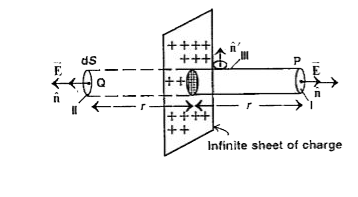
Gauss.s Theorem : It states that total electric flux through a closed surface enclosing a charge is equal to `(1)/(epsilon_(0))` times the magnitude of charge enclosed. Mathematical form of Gauss.s Las :
Electric flux =` phi = oint vec(E ).vec(dS) (q)/(epsilon_(0))`
Electric field intensity due to an infinite plane thin sheet of charge :
Consider a thin, infinite plane sheet of charge.
Let `sigma` = Surface charge density on both sides
Consider a point P at a distance r from the sheet.
Draw a cylindrical Gaussian surface of cross - section S through the point P with lenght r on each side of the cap.
Electric field E is perpendicular to its end circular Cpas I and II.
Charge enclosed by the Gaussian surface = `q = sigma S`
Using Gauss.s theorem
`oint vec(E). vec(dS) = (q)/(epsilon_(0)) = (sigma S)/(epsilon_(0))`
Gaussian surface is divided into three parts, I II and III

`therefore` Eqn. (i) becomes `underset(I)ointvec(E).vec(dS)+ underset_(II)ointvec(E).vec(dS)+underset(III)ointvec(E).vec(dS)=(sigmaS)/(epsilon_(0))`
Angle between `vec(E) and vec(dS)` is `90^(@)` for the curved III. In this case `underset(III)oint vec(E).vec(dS) = E.dS cos 90^(@) = 0`
Hence eqn. (ii) becomes `underset(I)oint vec(E).vec(dS) = undereset(II) oint vec(E).vec(dS) = (sigma S)/(epsilon_(0))`
Since angle between `vec(E) and vec(dS)` for surface I and II is zero, so
`underset(I)ointvec(E).dScos0^(@)+underset(II)ointE.dS cos 0^(@) = (sigma S)/(epsilon_(0)) or underset(I)ointE.dS+underset(II)oint E dS = (sigmaS)/(epsilon_(0))`
Since electric field intensity E is Constant at very point of the Gaussian surface so
`therefore Eunderset(I)ointdS+Eunderset(II)ointdS=(sigmaA)/(epsilon_(0))orES+ES=(sigmaS)/(epsilon_(0)) [therefore oint dS = S = "Area of end cap"]`
or `2ES = (sigma)/(epsilon_(0))`
or `E = (sigma)/(2 epsilon_(0))`
If the plane sheet has a finite thickness : then charges on both sides of the sheet are to be considered. Thus equation (i) is written as `int vec(E).vec(dS) = (2sigmaS)/(epsilon_(0))`
Then above eqn. becomes 2ES = `(2 simgma)/(epsilon_(0))` i.e., `E = (sigma)/(epsilon_(0)) " " [theregore int vec(E).vec(dS) = 2ES]`
Promotional Banner

Topper's Solved these Questions

  • GAUSS'S THEOREM

    BETTER CHOICE PUBLICATION|Exercise MOST EXPECTED NUMERICALS|4 Videos
  • GAUSS'S THEOREM

    BETTER CHOICE PUBLICATION|Exercise SHORT ANSWER TYPE QUESTIONS|8 Videos
  • FORCE ON A CURRENT

    BETTER CHOICE PUBLICATION|Exercise NUMERICAL PROBLEMS|10 Videos
  • HUYGENS' PRINCIPLE

    BETTER CHOICE PUBLICATION|Exercise LONG ANSWER TYPE QUESTIONS |11 Videos

Similar Questions

Explore conceptually related problems

State Gauss.s theorem in electrostatics. Using it, derive an experssion for electric field intensity at a point due to infinite sheet of charge. How does the electric field change for a thick sheet of charge?

State and prove Gauss's theorem in electrostatics.

State Gauss' theorem in electrostatics. Derive an expression for the electric field intensity at any point of to an infinite plane sheet of charge.

Derive expression for the electric field due to a uniformly charged spherical shell at a point inside

State Gauss' theorem in electrostatics. Hence obtain expression for the force between two point charges.

State Gauss' law in electrostatics. Using this law, derive an expression for the electric field due to an infinitely long straight charged wire at a point distant r from it. Plot a graph showing the variation of electric field with r.

State Gauss' law and using this law , derive an expression for the electric field intensity due to a uniformly charged thin spherical shell at a point inside

