Home
Class 12
PHYSICS
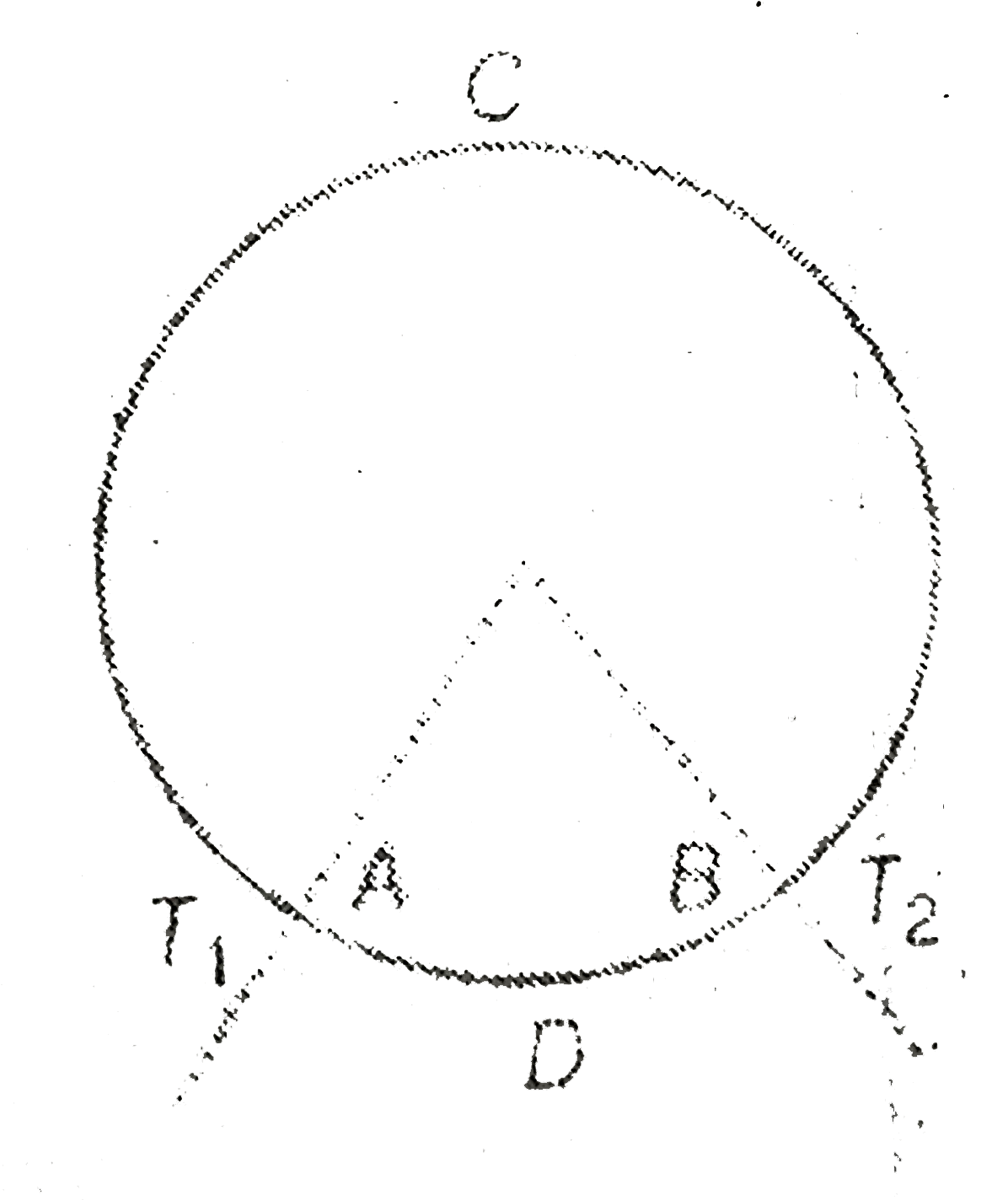
A ring consisting of two parts ADB and A...

A ring consisting of two parts ADB and ACB of same conductivity K carries an amount of heat H. The ADB part is now replaced with another metal keeping the temperature `T_(1)` and `T_(2)` constant. The heat carried increases to 2H. What is should be the conductivity of the new ADB part?
(Given `(ACB)/(ADB)=3`)

A

`(7)/(3)k`

B

`2`k

C

`(5)/(2)`k

D

`3`k

Text Solution

Verified by Experts

The correct Answer is:

A

`H=(T_(1)-T_(2))/(R)` and `2H = (T_(1)-T_(2))/(R) implies R' = (R)/(2)`
(where `R` &`R'` are thermal resistance).
`R = (1)/((L)/(kA) + (3L)/(kA)) implies R' = (1)/((kA)/(3L) + (k'A)/(3L)).`
`implies k' = (7k)/(3)` (k' = cond. Of `ADB` wire).
Promotional Banner

Topper's Solved these Questions

  • GEOMETRICAL OPTICS

    ALLEN|Exercise EXERCISE -03|10 Videos
  • GEOMETRICAL OPTICS

    ALLEN|Exercise ASSERTION-REASON|36 Videos
  • GEOMETRICAL OPTICS

    ALLEN|Exercise EXERCISE -01|65 Videos
  • CURRENT ELECTRICITY

    ALLEN|Exercise EX.II|66 Videos
  • GRAVITATION

    ALLEN|Exercise EXERCISE 4|9 Videos

Similar Questions

Explore conceptually related problems

A ring consisting of two parts ADB and ACB of same conductivity k carries an amount of heat H The ADB part is now replaced with another metal keeping the temperature T_1) and T_(2) constant The heat carried increases to 2H What should be the conductivity of the new ADB Given (ACB)/(ADB)=3 .

A ring consisting of two parts ADB and ACB of same conductivity k carries an amount of heat H The ADB part is now replaced with another metal keeping the temperature T_91) and T_(2) constant The heat carried increases to 2H What should be the conductivity of the new ADB Given (ACB)/(ADB)=3 .

A ring consisting of two parts ADB and ACB of same conductivity k carries an amount of heat H The ADB part is now replaced with another metal keeping the temperature T_91) and T_(2) constant The heat carried increases to 2H What should be the conductivity of the new ADB Given (ACB)/(ADB)=3 .

Consider two rods of same length and different specific heats ( S_1 and S_2 ), conductivities K_1 and K_2 and area of cross section ( A_1 and A_2 ) and both having temperature T_1 and T_2 at their ends. If the rate of heat loss due to conduction is equal then

A rod of length l and cross sectional area A has a variable conductivity given by K=alphaT , where alpha is a positive constant T is temperatures in Kelvin. Two ends of the rod are maintained at temperatures T_1 and T_2(T_1gtT_2) . Heat current flowing through the rod will be

Three rods of same cross-section but different length and conductivity are joined in series . If the temperature of the two extreme ends are T_(1) and T_(2) (T_(1)gtT_(2)) find the rate of heat transfer H.

A rod of length l and cross-section area A has a variable thermal conductivity given by K = alpha T, where alpha is a positive constant and T is temperature in kelvin. Two ends of the rod are maintained at temperature T_(1) and T_(2) (T_(1)gtT_(2)) . Heat current flowing through the rod will be

The temperature of the two outer surfaces of a composite slab, consisting of two materials having coefficients of thermal conductivity K and 2K and thickness x and 4x respectively. Temperatures on the opposite faces of composite slab are T_(1) and T_(2) where T_(2)gtT_(1) , as shown in fig. what is the rate of flow of heat through the slab in a steady state?

Four identical rods AB, CD, CF and DE are joined as shown in figure. The length, cross-sectional area and thermal conductivity of each rod are l, A and K respectively. The ends A, E and F are maintained at temperature T_(1) , T_(2) and T_(3) respectively. Assuming no loss of heat to the atmosphere, find the temperature at B.

Four identical rods AB, CD, CF and DE are joined as shown in figure. The length, cross-sectional area and thermal conductivity of each rod are l, A and K respectively. The ends A, E and F are maintained at temperature T_(1) , T_(2) and T_(3) respectively. Assuming no loss of heat to the atmosphere, find the temperature at B .

ALLEN-GEOMETRICAL OPTICS-EXERCISE -02
  1. A body with an initial temperature theta(1) is allowed to cool in a su...

    Text Solution

    |

  2. A rod of length l and cross-sectional area A has a variable conductivi...

    Text Solution

    |

  3. A ring consisting of two parts ADB and ACB of same conductivity K carr...

    Text Solution

    |

  4. Twelve conducting rods from the sides of a uniform cube of side l. If ...

    Text Solution

    |

  5. Radius of a conductor increases uniformly from left end to right end a...

    Text Solution

    |

  6. A sphere of ice at 0^(@)C having initial radius R is placed in an envi...

    Text Solution

    |

  7. Three identical rods AB, CD and PQ are joined as shown. P and Q are mi...

    Text Solution

    |

  8. Three bodies A , B and C have equal surface area and thermal emissivit...

    Text Solution

    |

  9. A and B are two points on a uniform metal ring whose centre is C. The ...

    Text Solution

    |

  10. In a 10 m deep lake, the bottom is at a constant temperature of 4^(@)C...

    Text Solution

    |

  11. The solar constant for a planet is sum. The surface temperature of the...

    Text Solution

    |

  12. A system S receives heat continuously from an electric heater of power...

    Text Solution

    |

  13. If the absorption coefficient and reflection coefficient of a surface ...

    Text Solution

    |

  14. Temperature of black body is 3000K. When black body cools, then change...

    Text Solution

    |

  15. Two plates of equal area are placed in contact with each other. The th...

    Text Solution

    |

  16. Two identical square rods of metal are welded end to end as shown in f...

    Text Solution

    |

  17. Three rods of same dimensions are arranged as shown in figure. They ha...

    Text Solution

    |

  18. The temperature of the two outer surface of a composite slab, co...

    Text Solution

    |

  19. The figure shows a system of two concentric spheres of radii r(1), and...

    Text Solution

    |

  20. The pressure of an ideal gas varies according to the law P = P(0) - AV...

    Text Solution

    |
