Home
Class 12
PHYSICS
Find the force acting on a current carry...

Find the force acting on a current carrying conductor placed in an uniform magnetic field.

Text Solution

Verified by Experts
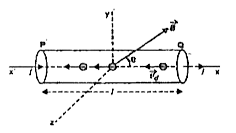
Consider a conductor PQ of length l having area of cross-section A and lying along X-axis.
Let `vecB =` Magnetic field which acts in XY plane making an angle `theta` with the X-axis.
`I =` current flowing through conductor from P and Q.
Electron in the conductor move in a direction opposite to that of direction of current i.e., from Q to P.
`vecv_(d) =` Drift velocity of electrons.
`vecF_(m) =` Magnetic Lorentz force experienced by an electron.
`vecF_(m) = -e(vecv_(d) xx vecB)`
If n = Number of electrons per unit volume of the conductor.
Total number of electrons in the conductor = N ,br> `N = n xx` Volume of conductor `N prop n xx Al = n Al`
`therefore` Total force on the conductor itself is equal to the force acting on all the free electrons moving in the conductor in the magnetic field and is given by

`vecF = NvecF_(m) = nAl[-e(vecv_(d) xx vecB)]`
` =-nAl e(vecv_(d) xx vecB)`
We know `I = ne A v_(d) or Il = ne Al v_(d)`
`Ivecl` represents a current element vector and it actsin the direction of flow of current, i.e., along `+ve` X-axis. As `Ivecl` and drift velocity `vecv_(d)`are acting in opposite directions, so we can write
`Ivecl = -nAle vecv_(d)`
from eqn. (1), we have
`vecF = I(vecl xx vecB)`
Direction of force :
The direction of `vecF` can be found using the rule for the direction of cross product `(vecl xx vecB)` which can be found by right hand screw rule or Fleming.s left hand rule. Thus, it acts perpendicular to the plane containing `vecl` and `vecB` and directed upward, i.e., along + Z-axis.
The magnitude of force `vecF` is given by
`F = Il B sin theta" "...(2)`
Where `theta` is the smaller angle between `Ivecl and vecB`.
Special cases : (i) If `theta = 0^(@) or 180^(@), sin theta = 0`, then from eqn. (2), Force , F = 0 (minimum).
It means that a current carrying conductor does not experience any force when placed parallel or antiparallel to the direction of magnetic field.
(ii) If `theta = 90^(@), sin theta = 1,` then from eqn. (2)
`F = I//B` (maximum)
It means that a current carrying conductor placed at right angle to the uniform magnetic field experiences a maximum force. The direction of force in this case can also be determined by Fleming.s left hand rule or right hand screw rule.
Promotional Banner

Topper's Solved these Questions

  • FORCE ON A CURRENT

    BETTER CHOICE PUBLICATION|Exercise SHORT ANSWER TYPE QUESTIONS (MOST EXPECTED QUESTIONS) |5 Videos
  • FORCE ON A CURRENT

    BETTER CHOICE PUBLICATION|Exercise LONG ANSWER TYPE QUESTIONS |15 Videos
  • FORCE ON A CURRENT

    BETTER CHOICE PUBLICATION|Exercise VERY SHORT ANSWER TYPE QUESTIONS (MOST EXPECTED QUESTIONS ) |5 Videos
  • FORCE ON A CHARGE

    BETTER CHOICE PUBLICATION|Exercise NUMERICAL PROBLEMS |14 Videos
  • GAUSS'S THEOREM

    BETTER CHOICE PUBLICATION|Exercise MOST EXPECTED NUMERICALS|4 Videos

Similar Questions

Explore conceptually related problems

Find an expression for the torque acting on a current carrying loop suspended in a uniform magnetic field. Under what conditions this torque will be maximum and minimum ?

Derive the expression for the torque acting on a current carrying loop placed in a magnetic field.

When is the force experienced by a current carrying conductor placed in a magnetic field, the largest?

Derive an expression for the force experienced by a current carrying conductor placed in a magnetic field. Under what condition the force is zero or maximum ?

