

Home
Class 11
PHYSICS
A smooth block loosely fits in a circula...

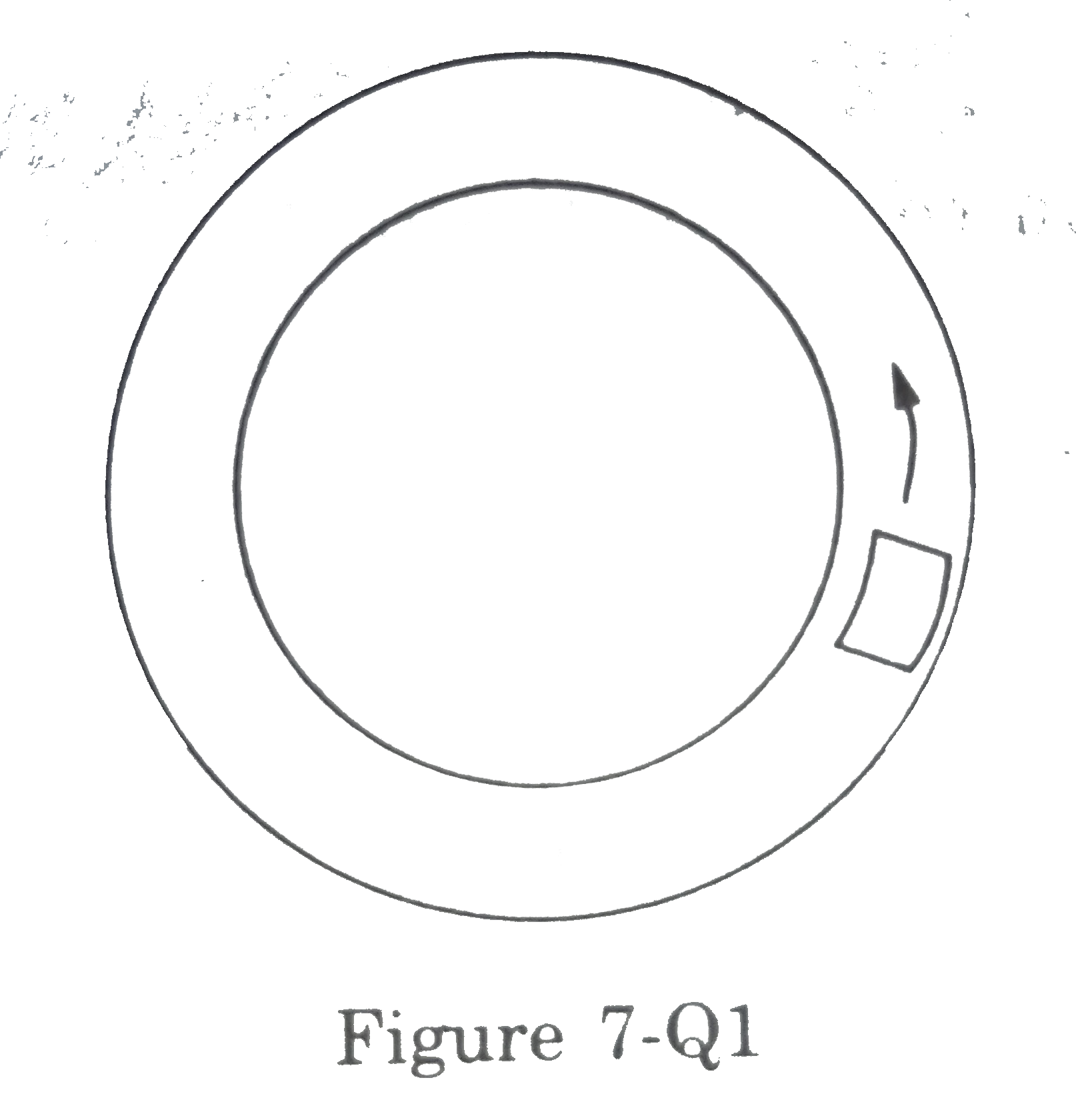
A smooth block loosely fits in a circular tube placed on a horizontal surface. The block moves in as uniform circular motion along the tube figure. Which wall (inner or outer) will exert a nonzero normal contact force on the block?
.

Promotional Banner

Topper's Solved these Questions

  • CIRCULAR MOTION

    HC VERMA|Exercise Objective -1|16 Videos
  • CIRCULAR MOTION

    HC VERMA|Exercise Objective -2|7 Videos
  • CIRCULAR MOTION

    HC VERMA|Exercise worked out Examples|13 Videos
  • CENTRE OF MASS, LINEAR MOMENTUM, COLLISION

    HC VERMA|Exercise Exercises|64 Videos
  • FLUID MECHANICS

    HC VERMA|Exercise All Questions|96 Videos

Similar Questions

Explore conceptually related problems

A block of mas m is placed on a triangular block of mas m, which in tunis placed on a horizontal surface as shown in figure. Assuming frictionless surfaces find the velocity of the triangular block when the smaller block reaches the bottom end.

A block is mass m moves on as horizontal circle against the wall of a cylindrical room of radius R. The floor of the room on which the block moves is smooth but the friction coefficient between the wall and the block is mu . The block is given an initial speed v_0 . As a function of the speed v write a. the normal force by the wall on the block. b. the frictional force by the wall and c. the tangential acceleration of the block. d. Integrate the tangential acceleration ((dv)/(dt)=v(dv)/(ds)) to obtain the speed of the block after one revoluton.

A block is placed on the horizontal surface. There are two forces acting on the block. One, the downward pull of gravity and other a normal force acting on it. Are these forces equal and opposite? Do they form action - reaction pair? Discuss with your friends.

Figure shows a small block of mass m which is started with a speed v on the horizontal part of the bigger block of mas m placed on a horizontal floor. The curved part of the surface shown is semicircular. All the surfaces are frictionless. Find the speed of the bigger block when the smaller block reaches the point A of the surface.

A block of mass m containing a net positive charge q is placed on a smooth horizontal table which terminates in a vertical wall as shown in figure(29-E2). The distance of the block from the wall is d. A horizontal electric field E to towards right is switched on. Assuming elastic collisions find the time period of the resulting oscillatory motion. Is it a simple harmonic motion?

A small block of mass 100 g moves wth uniform speed n a horizontal circular groove, with vertical side walls, of radisu 25 cm.If the block takes 2.0 s to complete ne round, find the normal contact force by tehside wall of the groove.

A rectangle block rests on a horizontal table. A horizontal force is applied on the block at a height h above the table to move the block. Does the line of action of the normal force N exerted by the table on block depend on h?

A block of mass 2 kg is pushed against a rough vertical wall with a force is 40 N. Coefficient of static friction being 0.5. Another horizontal force is 15 N, is applied on the block in a direction parallel to the wall. Will the block move? If yes in which direction? If no, find the frictional force exerted by the wall on the block.