Home
Class 12
PHYSICS
Figure show two capacitors connected in ...

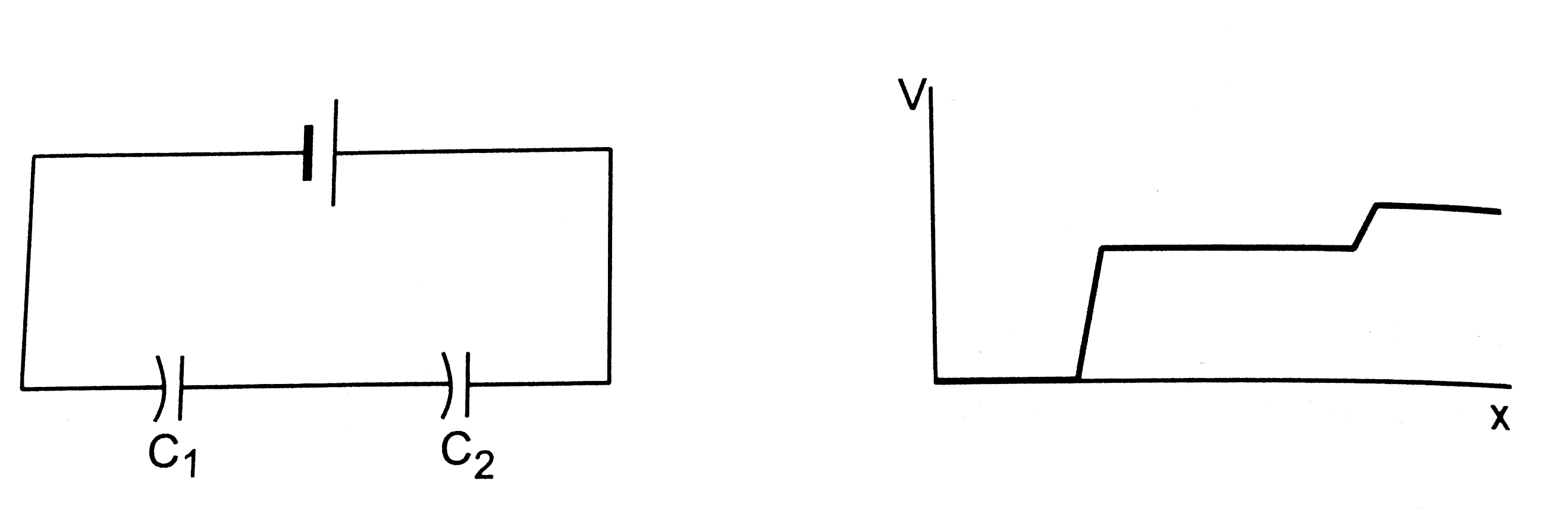
Figure show two capacitors connected in series and joind to a bettery. The graph shows the variation in potential as one movies from left to right on the branch containing the capacitors.

A

(a) `C_1gtC`

B

(b) `C_1=C_2`

C

(c) `C_1ltC_2`

D

(d) The information is not sufficient to decide the relation between `Q_+` and `Q_.`

Text Solution

Verified by Experts

The correct Answer is:

C
Promotional Banner

Topper's Solved these Questions

  • CAPACITORS

    HC VERMA|Exercise OBJECTIVE 2|7 Videos
  • CAPACITORS

    HC VERMA|Exercise Exercise|68 Videos
  • CAPACITORS

    HC VERMA|Exercise short answer|7 Videos
  • BOHR'S MODEL AND PHYSICS OF THE ATOM

    HC VERMA|Exercise Exercises|46 Videos
  • DISPERSION AND SPECTRA

    HC VERMA|Exercise Exercises|11 Videos

Similar Questions

Explore conceptually related problems

Figure shown pallel plate capacitors with fixed plate and connected to two batteries .The separation between the plate is the same for the two capacitors .The plates are rectangular in shape with width b and lengths l_1 and l_2. The left half of the dielectric slab has adielectric constant K_1 and the right half K_2 . neglecting any friction ,find the ratio of the emf of the right battery for which the dielctric slab may remain in equilibrium.

Two capacitors of capacitances 20 .0pF and 50.0pF are connected in series with a 6.00V battery . Find (a )the potential difference across each capacitor and (b) the energy stored in each capacitor .

Draw a graph showing the variation of reactance of (i) a capacitor and (ii) an inductor with the frequency of an a.c circuit.

Consider the situation shown in figure .The plates of the capacitor have plate area A and are clapmed in the laborstory . The dielectric slab is released from rest with a length a inside the capacitor. Neglecting any effect of friction or gravity, show that slab will execute periodie motion and find its time period.

Figure. shows the x-t plot of one-dimensional motion of a particle. Is it correct to say from the graph that the particle moves in a straight line for t lt 0 and on a parabolic path for t gt 0 ? If not, suggest a suitable physical context for this graph.

A potentiometre wire is 100 cm long and a constant potential difference is maintained across it. Two cells are connected in series first to support one another and then in opposite direction.The balance points are obtained at 50 cm and 10 cm from the positive end of the wire in two cases. The ration of emf's is

A capacitor of capacitor of capacitance 2.0muF is charge to a potential diffrence of 12V It is then connected of uncharged capacitor of capacitance 4.0muF as shown in figure . Find (a ) the charge on each of the two capacitors after the connection, (b ) the electrostatic energy stored in each of the two capacitors.

Figure shows two identical parallel plate capacitors connected to a switch S. Initially ,the switch is closed so that the capacitors are completely charged .The switch is now opened and the free space between the plates of the capacitors is filled with a dielectric of dielectric constant 3. Find the ratio of the initial total energy stored in the capacitors to the final total energy stored.

Two parallel plate capacitors, each of capacitance 40 muF , are connected is series. The space between the plates of one capacitor is filled with a dielectric material of dielectric constant K =4. Find the equivalent capacitacne of the system.

Figure shows a capacitor made of two circular plates each of radius 12 cm and separated by 5.0 cm. The capacitor is being charged by an external source (not shown in the figure). The charging current is constant and equal to 0.15 A. a. Calculate the capacitance and the rate of change of potential difference between the plates. b. Obtain the displacement current across the plates. c. Is Kirchhoff's first rule (junction rule) valid at each plate of the capacitor ?
