Home
Class 12
PHYSICS
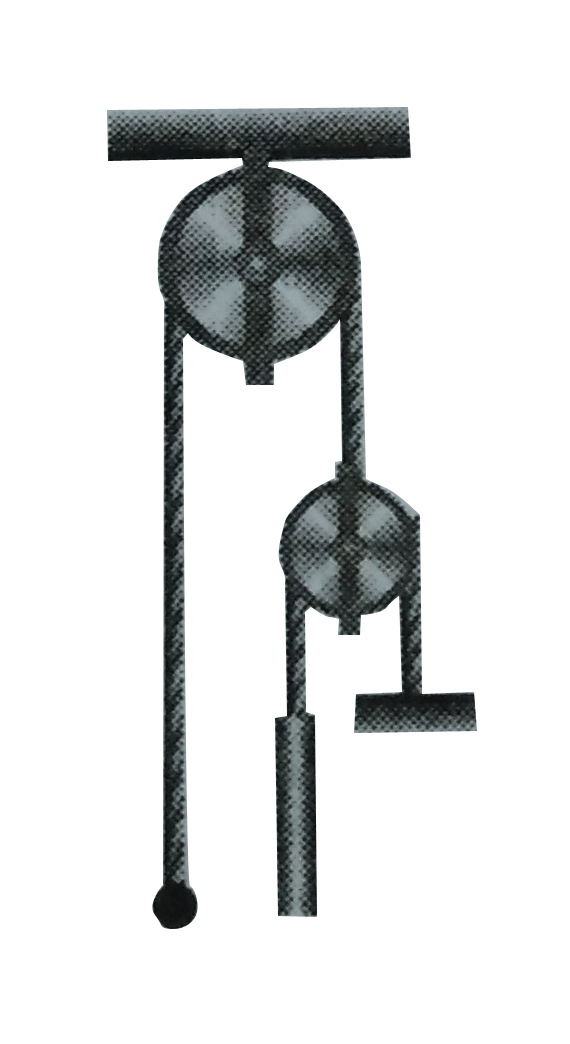
In the arrangement shown in figure the m...

In the arrangement shown in figure the mass of the ball is `eta` times as that of the rod. The length of the rod is `L` the masses of the pulleys and the threads as well as the friction, are negligible. The ball is set on the same level as the lower end of the rod and then released. How soon will the ball be opposite the upper end of the rod?

Text Solution

Verified by Experts

The correct Answer is:

`1.40 s `
Promotional Banner

Topper's Solved these Questions

  • LAWS OF MOTION

    AAKASH SERIES|Exercise Problem|162 Videos
  • LAWS OF MOTION

    AAKASH SERIES|Exercise Application|6 Videos
  • LAWS OF MOTION

    AAKASH SERIES|Exercise NUMERICAL EXERCISE ( LEVEL-2)|13 Videos
  • GEOMETRICAL OPTICS

    AAKASH SERIES|Exercise ADDITIONAL PRACTICE EXERCISE (LEVEL-II PRACTICE SHEET (ADVANCED) INTEGER TYPE QUESTIONS)|10 Videos
  • LOGIC GATES

    AAKASH SERIES|Exercise Exercise (Very Short Answer)|10 Videos

Similar Questions

Explore conceptually related problems

In the arrangement shown in fig., mass of the rod M exceeds the mass m of the ball. The ball has an opening permitting it to slide along the thread with some friction. The mass of the pulley and the friction in its axle are negligible. At the initial moment, the ball was located opposite the lower end of the rod. When set free, both bodies began moving with constant accelerations. Find the friction force between the ball and the thread if t seconds after the beginning of motion, the ball got opposite to the upper end of the rod. The rod length equals l.

In the figure , mass of a ball is 9/5 times mass of the rod, Length of rod is 1m.The level of ball is same as rod level.Find out time taken by the ball to reach at upper end of rod.

Find the accelerations of rod A and wedge B in the arrangement shown in figure if the ratio of the mass of the wedge to that of the rod equals eta , and the friction between all contact surfaces is negligible.

Find the acceleration of the body of mass m_(2) in the arrangement shown in figure. If the mass m_(2) is eta time the mass m_(1) and the angle that the inclined plane forms with the horizontal is equal to theta . The masses of the pulley and threads, as well as the friction, are assumed to be negligible.

A block of mass m is arranged on the wedge as shown in figure . The wedge angle is theta . If the masses of pulley and thread and negligible and friction is absent , find the acceleration of the wedge

In the figure shown, the instantaneous speed of end A of the rod is v to the left. The angular velocity of the rod of length L must be

One fourth length of a uniform rod of length 2l and mass m is place don a horizontal table and the rod is held horizontal. The rod is released from rest. Find the normal reaction on the rod as soon as the rod is released.

Uniform rod AB is hinged at the end A in a horizontal position as shown in the figure ( the hinge is frictionless that is , it does not exert any friction force on the rod ) . The other end of the rod is connected to a block through a massless string as shown. The pulley is smooth and massless . Masses of the block and the rod are same and are equal to 'm' . Then just after released of block from this position, the angular acceleration of the rod is

Uniform rod AB is hinged at the end A in a horizontal position as shown in the figure ( the hinge is frictionless that is , it does not exert any friction force on the rod ) . The other end of the rod is connected to a block through a massless string as shown. The pulley is smooth and massless . Masses of the block and the rod are same and are equal to 'm' . Then just after release of block from this position, the tension in the thread is

Uniform rod AB is hinged at the end A in a horizontal position as shown in the figure ( the hinge is frictionless that is , it does not exert any friction force on the rod ) . The other end of the rod is connected to a block through a massless string as shown. The pulley is smooth and massless . Masses of the block and the rod are same and are equal to 'm' . Then just after release of block from this position, the magnitude of reaction exerted by hinge on the rod is
