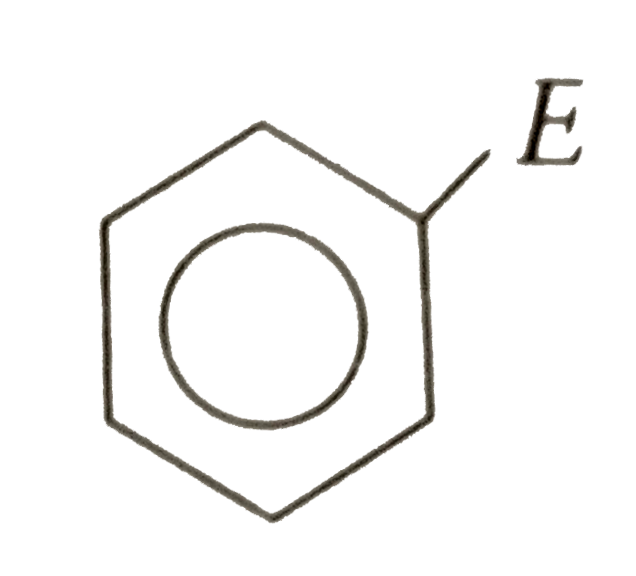
 electrophilic substitution has occurred The substituent -E are methyl, `-CH_(2)Cl, -C Cl_(3)` and `-CHCl_(2)`. The correct increasing order towards electrophilic substitution is
 A
B
C
D
Text Solution
Verified by Experts
The correct Answer is:



Topper's Solved these Questions
GENERAL ORGANIC CHEMISTRY
ERRORLESS|Exercise NCERT BASED QUESTIONS (Structural and Stereo Isomerism )|99 VideosGENERAL ORGANIC CHEMISTRY
ERRORLESS|Exercise PAST YEARS QUESTIONS |85 VideosGENERAL ORGANIC CHEMISTRY
ERRORLESS|Exercise NCERT BASED QUESTIONS (Dipole Moment, Resonance and Reaction Intermediates )|70 VideosENVIRONMENTAL CHEMISTRY
ERRORLESS|Exercise ASSERTION & REASON|7 VideosHYDROCARBONS
ERRORLESS|Exercise ASSERTION & REASON|18 Videos
Similar Questions
Explore conceptually related problems
ERRORLESS-GENERAL ORGANIC CHEMISTRY -NCERT BASED QUESTIONS (Organic Reactions and their Mechanism )
- Which of the following applies in the reaction, CH(3)CHBr CH(2)CH(3)...
Text Solution
|
- For CH(3)Br+OHrarrCH(3)OH+Br the rate of reaction is given by the ex...
Text Solution
|
- The compound electrophilic substitution has occurred The substituent ...
Text Solution
|
- The elimination reaction {:(CH(3)-CH(2).CH-CH(3)),(" ...
Text Solution
|
- Which of the following is not true for S(N^(1)) reaction ?
Text Solution
|
- The following reaction CH(3)-underset(CH(3))underset(|)overset(H)ove...
Text Solution
|
- Which of the following statement is incorrect for biomolecular nucleop...
Text Solution
|
- S(N)1 reaction is faster in
Text Solution
|
- To which of the following four types does this reaction belong ?
Text Solution
|
- The above reaction proceeds through
Text Solution
|
- H(3)C- overset(CH(3))overset(|)underset(CH(3)) underset(|)( C) - Br + ...
Text Solution
|
- The most common type of reaction in aromatic compounds is
Text Solution
|
- Addition of HCl to vinyl chloride gives 1, 1-dichloroethane because of
Text Solution
|
- The following compound will undergo electrophilic substitution more re...
Text Solution
|
- Which of the following cannot undergo nucleophilic substitution under ...
Text Solution
|
- Which of the following shows S(N^(1)) reaction most readily ?
Text Solution
|
- Which gives nucleophilic addition reactions ?
Text Solution
|
- Which one of the following species will be most reactive in S(N^(2)) r...
Text Solution
|
- Arrange the following compounds in order of their decreasing reactivit...
Text Solution
|
- Which of the following are correct chain isomers of butane ? (i) <im...
Text Solution
|