Home
Class 11
CHEMISTRY
Neopentyl bromide undergoes dehydro halo...

Neopentyl bromide undergoes dehydro halogenation to give alkene even though it has no `beta-` hydrogen. This is due to `:`

A

`E_(2)` mechanism

B

`E_(1)` mechanism

C

Due to rearrangement of carbocation by `E_(1)` mechanism

D

`E_(1)` do mechanism

Text Solution

Verified by Experts

The correct Answer is:
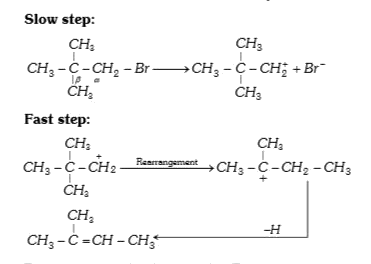
C


Rearrangement of carbocation by `E_(1)` mechanism
Promotional Banner

Topper's Solved these Questions

  • GENERAL ORGANIC CHEMISTRY

    ERRORLESS|Exercise NCERT BASED QUESTIONS (Structural and Stereo Isomerism )|99 Videos
  • GENERAL ORGANIC CHEMISTRY

    ERRORLESS|Exercise PAST YEARS QUESTIONS |85 Videos
  • GENERAL ORGANIC CHEMISTRY

    ERRORLESS|Exercise NCERT BASED QUESTIONS (Dipole Moment, Resonance and Reaction Intermediates )|70 Videos
  • ENVIRONMENTAL CHEMISTRY

    ERRORLESS|Exercise ASSERTION & REASON|7 Videos
  • HYDROCARBONS

    ERRORLESS|Exercise ASSERTION & REASON|18 Videos

Similar Questions

Explore conceptually related problems

Neopentyl bromide undergoes dehydrohalogenation to give alkene even though it has no beta -hydrogen. This is due to :

The removal of two atoms or groups one generally hydrogen (H^(+)) and the other a leaving group (L^(-)) resulting in the formation of unsaturated compound is known as elimination reaction. In E_(1) (elimination) reactions the C-L bond is broken heterolytically (in step 1) to form a carbocation (as in S_(N^(1)) reaction) in which (L^(-)) is lost (rate determining step). The carbocation (in step 2) loses a proton from the beta- carbon atom by a base (nucleophile) to form an alkene. E_(1) reaction is favoured in compounds in which the leaving group is at secondar (2^(@)) or tertiary (3^(@)) Position. In E_(2) (elimination) reactions two sigma bonds are broken and a pi- bond is formed simultaneously. E_(2) reactions occur in one step through a transition state. E_(2) reactions are most common in haloalkanes (particulary 1^(@) ) and better the leaving group higher is the E_(2) reaction. In E_(2) reactions, both the leaving groups should be antiplaner. E_(1) cb (Elimination unimolecular conjugate base) reaction involves the removal of proton by a conjugate base (step 1) to produce carbanion which loses a leaving group to form an alkene (step 2) and is a slow step Neopentyl bromide undergoes dehydrohalogenation to give alkene even though it has no beta- hydrogen.This is due to :

Neopentyl bormide, undergoes dehydrohalogenation to give alkenes even though it has no beta-H . This is due to

2,3-Dimethyl-2-butene undergoes catalytic hydrogenation to give

Phosphorus in pentavalent state is more stable when compared to that of nitrogen in the same state even though they belong to same group. This is due to

Neopentyl bromide is heated with an alcoholic KOH solution. The major alkene formed is

Knowledge Check

  • Neopentyl bromide undergoes dehydrohalogenation to give alkene even though it has no beta -hydrogen. This is due to :

    A
    `E_(2)` mechanism
    B
    `E_(1)` mechanism
    C
    Hofmann elimination
    D
    rearrangement of carbocation by `E_(1)` mechanism
  • Neopentyl bromide undergoes dehydrohalogenation to give alkene even though it has no beta -hydrogen. This is due to

    A
    `E_(2)` mechanism
    B
    `E_(1)` mechanism
    C
    Due to rearrangement of carbocation by `E_(1)` mechanism
    D
    `E_(1)` cb mechanism
  • The removal of two atoms or groups one generally hydrogen (H^(+)) and the other a leaving group (L^(-)) resulting in the formation of unsaturated compound is known as elimination reaction. In E_(1) (elimination) reactions the C-L bond is broken heterolytically (in step 1) to form a carbocation (as in S_(N^(1)) reaction) in which (L^(-)) is lost (rate determining step). The carbocation (in step 2) loses a proton from the beta- carbon atom by a base (nucleophile) to form an alkene. E_(1) reaction is favoured in compounds in which the leaving group is at secondar (2^(@)) or tertiary (3^(@)) Position. In E_(2) (elimination) reactions two sigma bonds are broken and a pi- bond is formed simultaneously. E_(2) reactions occur in one step through a transition state. E_(2) reactions are most common in haloalkanes (particulary 1^(@) ) and better the leaving group higher is the E_(2) reaction. In E_(2) reactions, both the leaving groups should be antiplaner. E_(1) cb (Elimination unimolecular conjugate base) reaction involves the removal of proton by a conjugate base (step 1) to produce carbanion which loses a leaving group to form an alkene (step 2) and is a slow step Neopentyl bromide undergoes dehydrohalogenation to give alkene even though it has no beta- hydrogen.This is due to :

    A
    `E_(2)`mechanism
    B
    `E_(1)` mechanism
    C
    due to rearrangement of carbocation by `E_(1)` mechanism
    D
    `E_(1)` cb mechanism
  • ERRORLESS-GENERAL ORGANIC CHEMISTRY -NCERT BASED QUESTIONS (Organic Reactions and their Mechanism )
    1. Geometry of reaction intermediate in S(N^(1)) reaction is

      Text Solution

      |

    2. Which of the following is most reactive toward nucleophilic substituti...

      Text Solution

      |

    3. Neopentyl bromide undergoes dehydro halogenation to give alkene even t...

      Text Solution

      |

    4. In electrophilic aromatic substitution reaction, the nitro group is me...

      Text Solution

      |

    5. Find the product of the given reaction

      Text Solution

      |

    6. Match the following Column A to Column B

      Text Solution

      |

    7. Dehydrohalogenation in presence of OH^(-) is correctly represented by

      Text Solution

      |

    8. The enantiomeric pair among the following four structures

      Text Solution

      |

    9. The major product formed in the reaction

      Text Solution

      |

    10. Which of the following are correct chain isomers of butane ? (i) <im...

      Text Solution

      |

    11. Match the following Column A to Column B

      Text Solution

      |

    12. In the reaction benzene with an electrophile E^(+), the structure of t...

      Text Solution

      |

    13. The major product in the following reaction is

      Text Solution

      |

    14. The major product of the following reaction is

      Text Solution

      |

    15. Which of the following are correct chain isomers of butane ? (i) <im...

      Text Solution

      |

    16. The order of S(N)1 reactivity in aqueous aceic acid solution for the c...

      Text Solution

      |

    17. The species that exhibits the highest R(f) value in a thin layer chrom...

      Text Solution

      |

    18. The major product of the following reaction overset(Cu, Delta) (t...

      Text Solution

      |

    19. The major product of the reaction between CH(3) CH(2) O Na and (CH(3))...

      Text Solution

      |

    20. In the given compounds (A) CH(3)CH(2)CH(2)CH(2)-Br (B) CH(3)-CH(2)...

      Text Solution

      |

