Home
Class 12
CHEMISTRY
Names of organic compounds are under the...

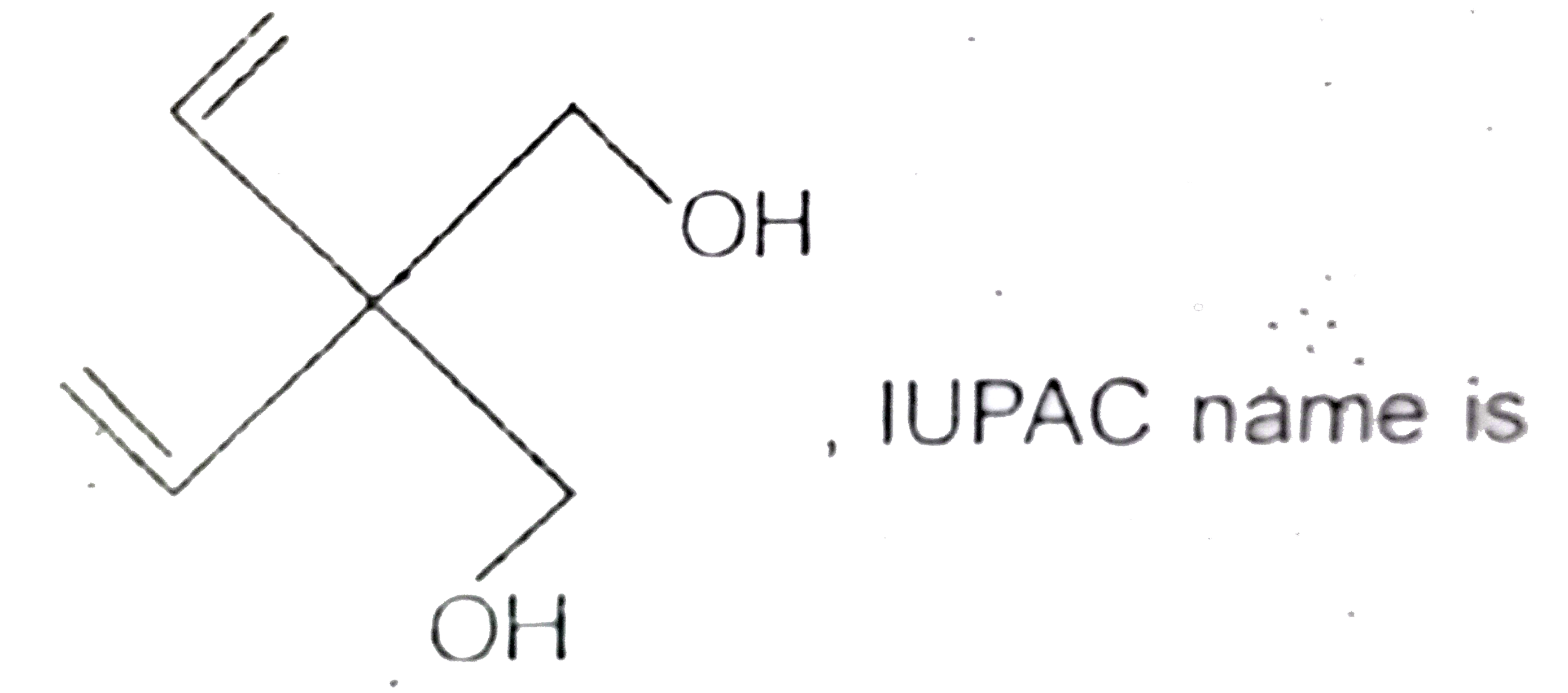
Names of organic compounds are under the latest guide line of IUPAC IUPAC means international union of pure and applied chemistry. The main rules are longest chain rule, lowest number rule etc. We have to include the rules for naming the substituetns, multiple bonds and even functional groups.

A

3,3-diethenyl pentane 1,5-diol

B

2,2-diethenyl propane 1,3-diol

C

2,3-diethenyl propane 1,3-diol

D

3,3-diethenyl propane 1,3j-dialcohol

Text Solution

Verified by Experts

The correct Answer is:

B
Promotional Banner

Topper's Solved these Questions

  • ORGANIC CHEMISTRY: SOME BASIC PRINCIPLE AND TECHNIQUES

    AAKASH INSTITUTE|Exercise SECTION-E ASSERTION-REASON TYPE QUESTIONS|13 Videos
  • ORGANIC CHEMISTRY: SOME BASIC PRINCIPLE AND TECHNIQUES

    AAKASH INSTITUTE|Exercise SECTION-G INTEGER ANSWER TYPE QUESTIONS|8 Videos
  • ORGANIC CHEMISTRY: SOME BASIC PRINCIPLE AND TECHNIQUES

    AAKASH INSTITUTE|Exercise SECTION-C OBJECTIVE TYPE QUESTION (MORE THAN ONE OPTIONS ARE CORRECT)|18 Videos
  • ORGANIC CHEMISTRY : SOME BASIC PRINCIPLES AND TECHNIQUES

    AAKASH INSTITUTE|Exercise Assignment(Section-D)(Assertion - Reason Type Questions)|12 Videos
  • POLYMERS

    AAKASH INSTITUTE|Exercise ASSIGNMENT (SECTION-D)|13 Videos

Similar Questions

Explore conceptually related problems

Questions|Rules For Naming Organic Compound Containing One Functional Group|Questions|Summary

A homologous series is a series of organic compounds which belong to the same family (i.e. possess same functional group) and show similar chemical properties. The members of this series are called homologous and differ from each other by the number of CH_(2) , units in the main carbon chain Which of the following represent the name and formula of the 2^(nd) member of homologous series having general formula C_(n)H_(2n+2) ?

A homologous series is a series of organic compounds which belong to the same family i.e., possess same functional group) and show similar chemical properties. The members of this series are called homologous and differ from each other by the number of CH_2 , units in the main carbon chain. Which of the following represent the name and formula of the 2^(nd) member of homologous series having general formula C_(n)H_(2n + 2) ?

Give the IUPAC names for each of the following : (i) (CH_(3)CH_(2))_(2)CHCH(CH_(3))CH_(2)CH_(3) (ii) (CH_(3))_(4)C (iii) [(CH_(3))_(3)C]_(4)C (iv) (CH_(3))_(3)C CH_(2)C (CH_(3))_(3) Strategy: Select as the parent structure the longest possible continous chain and then consider the compound to have been derived from this structure by the replacement of H atoms by ends of the longest chain, begin numbering at the end nearest to the branch that is first in alphabetical order. 3. Assign the name and position number to each substituent. Arrange the substituents in alphabetical order. Hyphenated prefixes such as tert- sec- are not used in the alphabetization of substituents. 4. Use on appropriate prefix to group like substituents: di=2, tri=3, tetra=4 penta= 5, and so on. Do not consider these prefix when alphabetizing attached groups. 5. Write the name as single word. Use hyphens to separate numbers and letters (plus some hyphenated prefix) and commas to spearate numbers. Do not leave any spaces. Some examples showing the application of the rules of nomenclature are given below: various alkyl groups as substituents. To avoid any mistake. it is always better to write the complete structural formula.

Rules For Naming Organic Compound Containing One Functional Group|Rules For Naming Compounds Containing More Than One Functional Group|Summary

Rules For Naming Organic Compound Containing One Functional Group|Rules For Naming Compounds Containing More Than One Functional Group|Summary
