Home
Class 12
PHYSICS
Consider example 25, taking the coeffici...

Consider example 25, taking the coefficient of friction `mu` to be 0.4 and calculate the maximum compression of the spring `(g=10ms^(-2))`

Text Solution

Verified by Experts
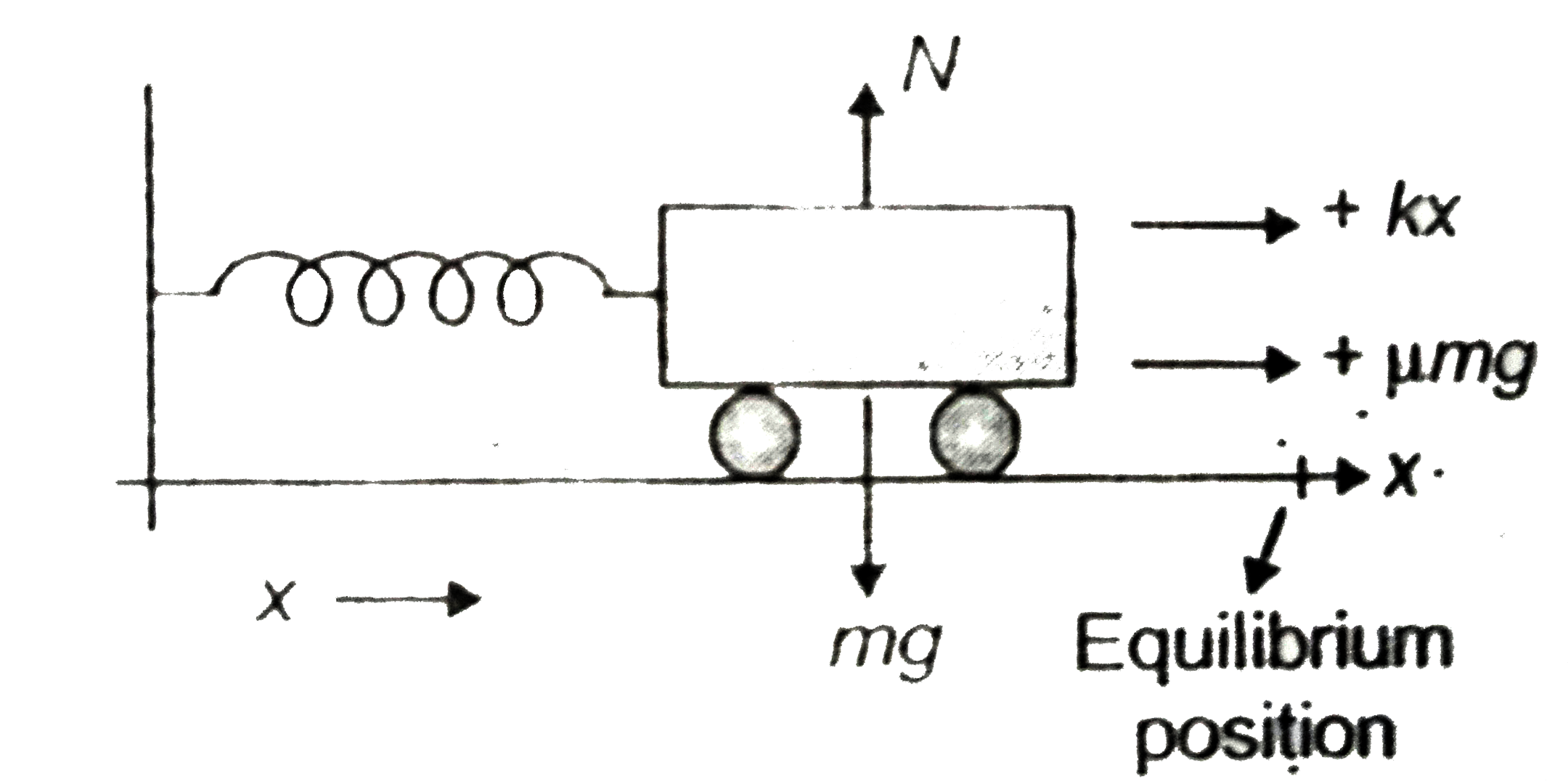
Both the frictional force and the speing force act so as to oppose the compressin of the spring as shown in figure.

Use the work-energy theorem,
The change in `KE=Delta K=K_(t)-K_(i)=0-1/2mv^(2)`
The work done by the net force is `W=1/2kx_(m)^(2)mu mgx_(m)`
Equating the two, we get
`1/2mv^(2)=1/2Kx_(m)^(2)+mumgx_(m)`
`mumg=0.4xx1500xx10=6000N`
`Kx_(m)^(2)+2mumgx_(m)-mv^(2)=0" "("After rearranging the given equlatin")`
`x_(m)=(-2mumg+sqrt(4mu^(2)m^(2)g^(2)-4(k)(-mv^(2))))/(2K)("Taking + ve sign with square root as"x_(m)"is +ve")`
`=(-mumg+sqrt(mu^(2)m^(2)g^(2)+mkv^(2)))/(K)`
`=(-0.4xx1500xx10+sqrt((0.4xx1500xx10)^(2)+1500+7.5xx10^(3)xx10^(2)))/(7.5xx10^(3))=3.74m`
Which as expected, is less than the result in Example 25. If the two forces on the body consist of a conservation for `F_(c)` and a non-nocervative force `F_(nc,)` the conservation of mechanical energy formula will have to be modified by the W-E theorem,
`(F_(c)+F_(nc))Deltax=DeltaK`
But `F_(c)Deltax=-DeltaV`
Hence `Delta(K+V)=F_(nc)Deltax`
`DeltaE=F_(nc) Delta x`
Where E is the total mechanical energy. Over the path this assumes the form ` E_(f)-E_(i)=W_(nc)`
Where `W_(nc)` is the total work done by the non-conservative forces over the path. Unlike conservative force, `W_(nc)` depends on the path taken.
Promotional Banner

Topper's Solved these Questions

  • WORK, ENERGY AND POWER

    AAKASH INSTITUTE|Exercise IILUSTRATION|2 Videos
  • WORK, ENERGY AND POWER

    AAKASH INSTITUTE|Exercise TRY YOURSELF|95 Videos
  • WAVES

    AAKASH INSTITUTE|Exercise ASSIGNMENT ( SECTION-D ( Assertion - Reason Type Questions ))|12 Videos

Similar Questions

Explore conceptually related problems

A block of mass m is moving with a speed v on a horizontal rought surface and collides with a horizontal monted spring of spring constant k as shown in the figure .The coefficient of friction between the block and the floor is mu The maximum cobnpression of the spring is

The arrangement shown in figure is at rest. An ideal spring of natural length l_0 having spring constant k=220Nm^-1 , is connected to block A. Blocks A and B are connected by an ideal string passing through a friction less pulley. The mass of each block A and B is equal to m=2kg when the spring was in natural length, the whole system is given an acceleration veca as shown. If coefficient of friction of both surfaces is mu=0.25 , then find the maximum extension in 10(m) of the spring. (g=10ms^-2) .

The coefficient of friction between two surface is 0.2. The maximum angle of friction is

Blocks A and B in the Fig are connected by a bar of negligible weight .Mass of each block is 170 kg and mu_(A) = 0.2 and mu_(B) = 0.4 where mu_(A) and mu_(B) are the coefficient of limiting friction between bloock and plane calculate the force developed in the bar (g = 10 ms^(-2))

A is a 100kg block, and B is a 200kg block. As shown in figure the block A is attached to a string tied to a wall. The coefficient of friction between A and B is 0.2 and the coefficient of fricition between B and floor is 0.3. Then calculate the minimum force required to move the block B. (take g=10m//s^(2) ).

A block of mass m is attached to one end of a mass less spring of spring constant k. the other end of spring is fixed to a wall the block can move on a horizontal rough surface. The coefficient of friction between the block and the surface is mu then the compession of the spring for which maximum extension of the spring becomes half of maximum compression is .

. In the figure shown, AB = BC = 2m . Friction coefficient everywhere is mu=0.2. Find the maximum compression of the spring.

In the previous problem , mass of the ball is 10 g and it is moving with 4 m//s . The surface from the block to free end of spring is rough with friction coefficient mu = 1//14 and of length 10 cm . The maximum compression of spring (k = 50 N//m) is

AAKASH INSTITUTE-WORK, ENERGY AND POWER-Assignment (SECTION - D)
  1. Consider example 25, taking the coefficient of friction mu to be 0.4 a...

    Text Solution

    |

  2. A : The work done by a force during round trip is always zero. R : Th...

    Text Solution

    |

  3. A : The change in kinetic energy of a particle is equal to the work do...

    Text Solution

    |

  4. A : Internal forces can change the kinetic energy but not the momentum...

    Text Solution

    |

  5. A : The potential energy can be defined only in conservative field. ...

    Text Solution

    |

  6. A : When a body moves in a circle the work done by the centripetal for...

    Text Solution

    |

  7. A : If net force acting-on a system is zero, then work done on the sys...

    Text Solution

    |

  8. A : During collision between two objects, the momentum of colliding ob...

    Text Solution

    |

  9. A : The potential energy of a system increases when work is done by co...

    Text Solution

    |

  10. A : In inelastic collision, a part of kinetic energy. convert into hea...

    Text Solution

    |

  11. A : Energy dissipated against friction depends on the path followed. ...

    Text Solution

    |

  12. A : Work done by the frictional force can’t be positive. R : Fricti...

    Text Solution

    |

  13. A : Impulse generated on one body by another body in a perfectly elas...

    Text Solution

    |

  14. A : Power of the gravitational force on the body in a projectile motio...

    Text Solution

    |

  15. A : Power delivered by the tension in the wire to a body in vertical c...

    Text Solution

    |

  16. A : When a man is walking on a rough road, that work done by frictiona...

    Text Solution

    |

