Home
Class 12
PHYSICS
A particle moves in x-y plane under acti...

A particle moves in x-y plane under action of a path dependent force `F=yhati+xhatj.` The work done by the force as it moves in x-y plane can be evaluated by solving the integral `intvecF.vecdr,`where `vec(dr)=dxhati+dyhatj.` The position coordinates x and y will vary according to some constraint determined by teh path followed by the particle. For example, if particle moves along a straight line from one position to other, then an possible rarticle. For example, if particle moves along a straight line from one position to other, then a possible relation is `y=mx+c.` NOw. try to solve the following questions.
1. The particel moves along a straight line from origin to (a ,a) . The work done by the force on the particle is
`(1) a^(2)" "(2)2s" "(3)(a^(2))/(2)" "(4)`Zero
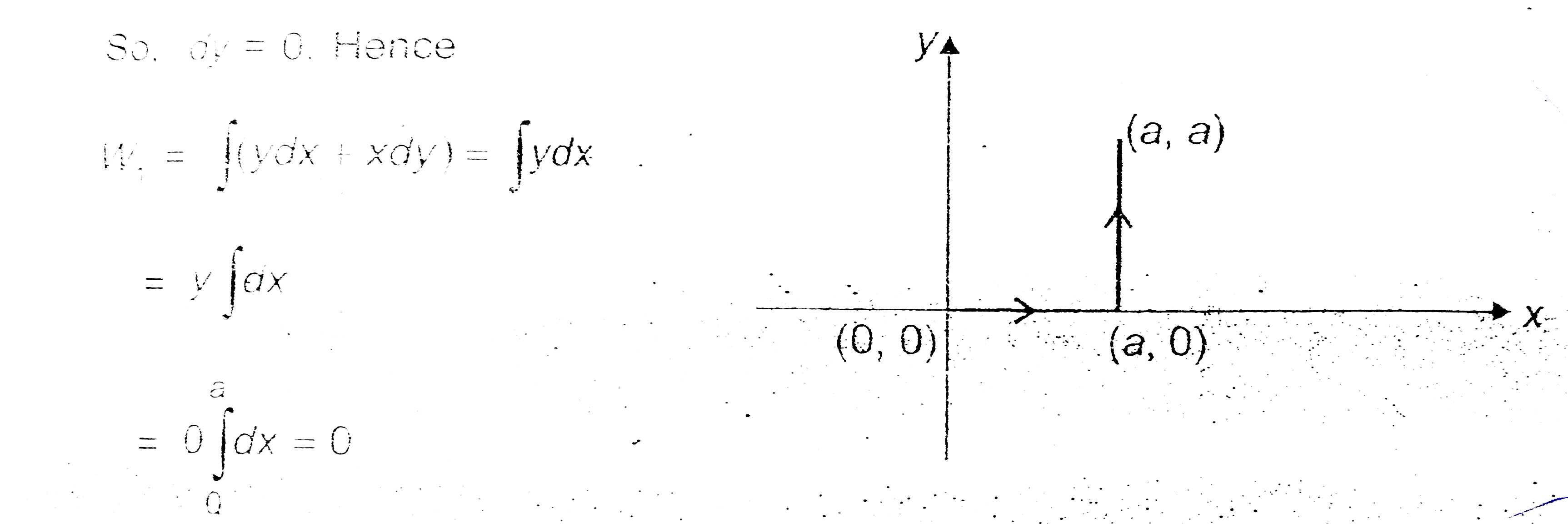
2. The particle moves from `(0,0)` to (a,0) and then from, `(a,0)` to `(a,a),` in straight line paths. The work done by the force on the particle is
`(1)a^(2)" "(2)2a" "(3)(a^(2))/(2)" "(4)` Zero
3. The differential work by the given force over an elementary displacement is given as `dW=vecF.vec(dr)=ydx+xdy`
This can be expressed as `dW=d(xy).` From this, it can be inferred that the work done by the force
(1) Depends only on initial and final values of x and y
(2) Depends on initial and final values and on the path followed
(3) Is zero for any values of x and y
(4) Is zero when object returns to original position after following any path

Text Solution

Verified by Experts
1. Answer (1) As the particle moves straight from (0,0) to (a,a) it moves along the line
`y=ximplies(dy)/(dx)=1ordy=dx`
Now, work done is calculated using
`W=intvecF.vec(dr)=int(yhati+xhatj)(dxhati+dyhatj)`
`int(ydx+xdy)`
Taking `y=xand dy=dx` and limits from (0,0) to (a,a),
`W=underset(0)overset(a)int2xdx=[x^(2)]_(0)^(a)=a^(2)`
2. Answer (1)
The path followed is shown in the figure. For the path between (0,0) to (a,0), y remains constant
So, `dy=0.` Hence

`W_(1)=int(ydx+xdy)=intydx`
`=yintdx`
`=0underset(0) overset(a) intdx=0`
For the between (a,0) to (a,a) x remains constant and `dx=0`
`impliesW_(2)=int(ydx+xdy)=x intdy=a underset(0)overset(a)intdy=a^(2)impliesW=0+a^(2).`
3. Answer (1,4)
`dW =vecF.vec (dr)=ydx+xdy=d(xy)`
`impliesW=intd(xy)=[xy]_((x_(1)y_(1)))^(""(x_(2),y_(2)))`
`=x_(2)y_(2)-x_(1)y_(1)`
In this case, work depends only on `(x_(1),y_(1))` the initial position, and `(x_(2),y_(2))` the final position. If `(x_(2),y_(2))=(x_(1),y_(1)),W=0.`
Promotional Banner

Topper's Solved these Questions

  • WORK, ENERGY AND POWER

    AAKASH INSTITUTE|Exercise IILUSTRATION|2 Videos
  • WORK, ENERGY AND POWER

    AAKASH INSTITUTE|Exercise TRY YOURSELF|95 Videos
  • WAVES

    AAKASH INSTITUTE|Exercise ASSIGNMENT ( SECTION-D ( Assertion - Reason Type Questions ))|12 Videos

Similar Questions

Explore conceptually related problems

A particle moves along x -axis under the action of a position dependent force F = (5x^(2) -2x) N . Work done by forces on the particle when it moves from origin to x = 3m is

A particle moves along x - axis under the action of a position dependent force F=(5x^(2)-2x)N . Work done by force on the particle when it moves from origin to x = 3 m is

A particle moves in x-y plane according to rule x=asin omegat and y=-acosomegat . The particle follows

A force vecF=k[yhati+xhatj] where k is a positive constant acts on a particle moving in x-y plane starting from the point (3, 5), the particle is taken along a straight line to (5, 7). The work done by the force is :

A particle moves in x-y plane according to ru le x =a sin omegat and y= a cos omegat . The particles follows:

Force acting on a particle varies with x as shown in figure. Calculate the work done by the force as the particle moves from x = 0 to x = 6.0 m.

A particle moves under the effect of a force F=kx^(2) from x=0 to x=4 , the work done by force is ?

A particle moves in the x-y plane. It x and y coordinates vary with time t according to equations x=t^(2)+2t and y=2t . Possible shape of path followed by the particle is

AAKASH INSTITUTE-WORK, ENERGY AND POWER-Assignment (SECTION - D)
  1. A particle moves in x-y plane under action of a path dependent force F...

    Text Solution

    |

  2. A : The work done by a force during round trip is always zero. R : Th...

    Text Solution

    |

  3. A : The change in kinetic energy of a particle is equal to the work do...

    Text Solution

    |

  4. A : Internal forces can change the kinetic energy but not the momentum...

    Text Solution

    |

  5. A : The potential energy can be defined only in conservative field. ...

    Text Solution

    |

  6. A : When a body moves in a circle the work done by the centripetal for...

    Text Solution

    |

  7. A : If net force acting-on a system is zero, then work done on the sys...

    Text Solution

    |

  8. A : During collision between two objects, the momentum of colliding ob...

    Text Solution

    |

  9. A : The potential energy of a system increases when work is done by co...

    Text Solution

    |

  10. A : In inelastic collision, a part of kinetic energy. convert into hea...

    Text Solution

    |

  11. A : Energy dissipated against friction depends on the path followed. ...

    Text Solution

    |

  12. A : Work done by the frictional force can’t be positive. R : Fricti...

    Text Solution

    |

  13. A : Impulse generated on one body by another body in a perfectly elas...

    Text Solution

    |

  14. A : Power of the gravitational force on the body in a projectile motio...

    Text Solution

    |

  15. A : Power delivered by the tension in the wire to a body in vertical c...

    Text Solution

    |

  16. A : When a man is walking on a rough road, that work done by frictiona...

    Text Solution

    |

