Home
Class 12
PHYSICS
Figure shows two discs of same mass m. T...

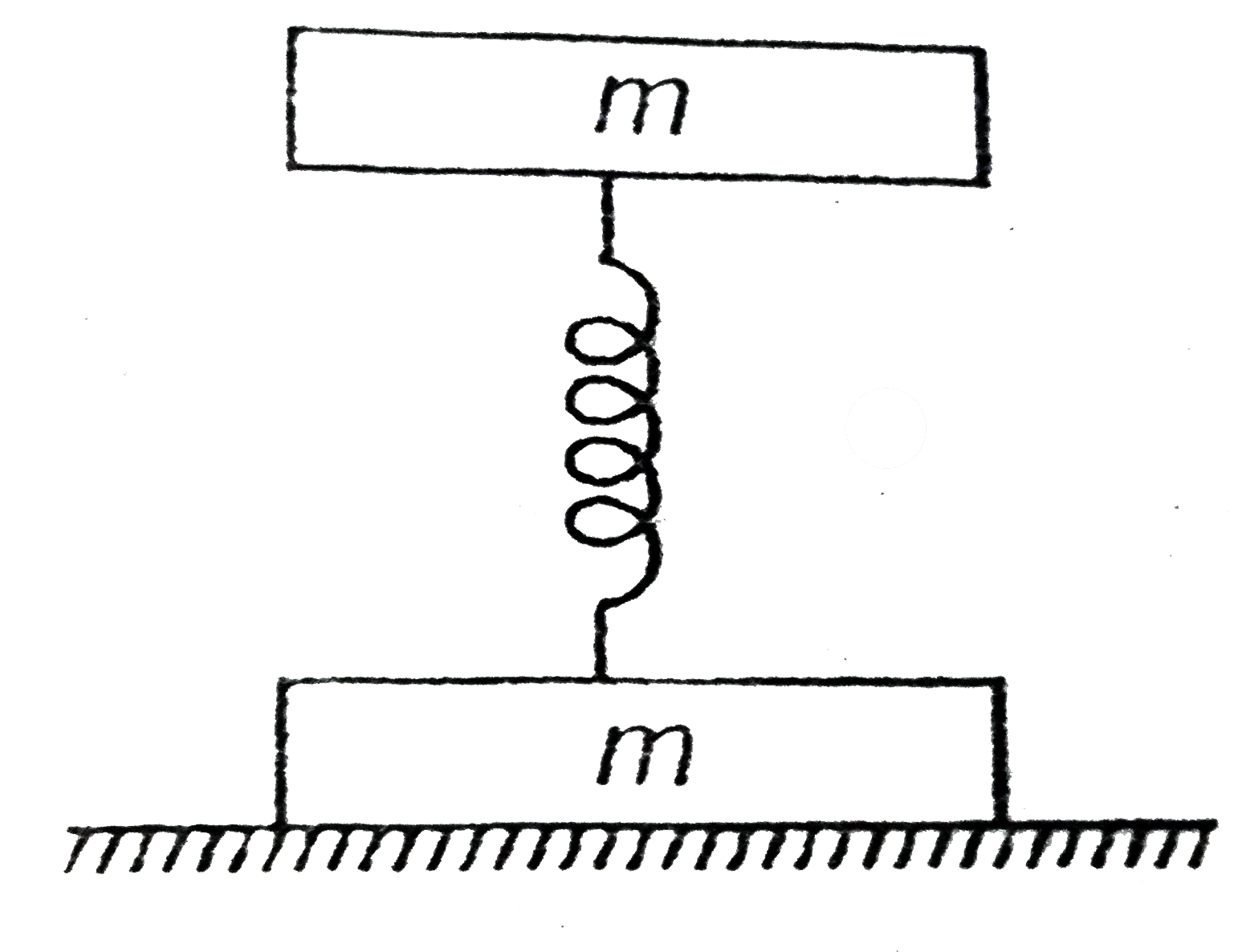
Figure shows two discs of same mass m. They are rigidy attached to a spring of stiffness k. The system is in equlibrium. From this equilibrium position, the upper disc is pressed down slowly by a distance x and released. Find the minimum vlue of x, if the lower disc is just lifted off the ground.

Text Solution

Verified by Experts
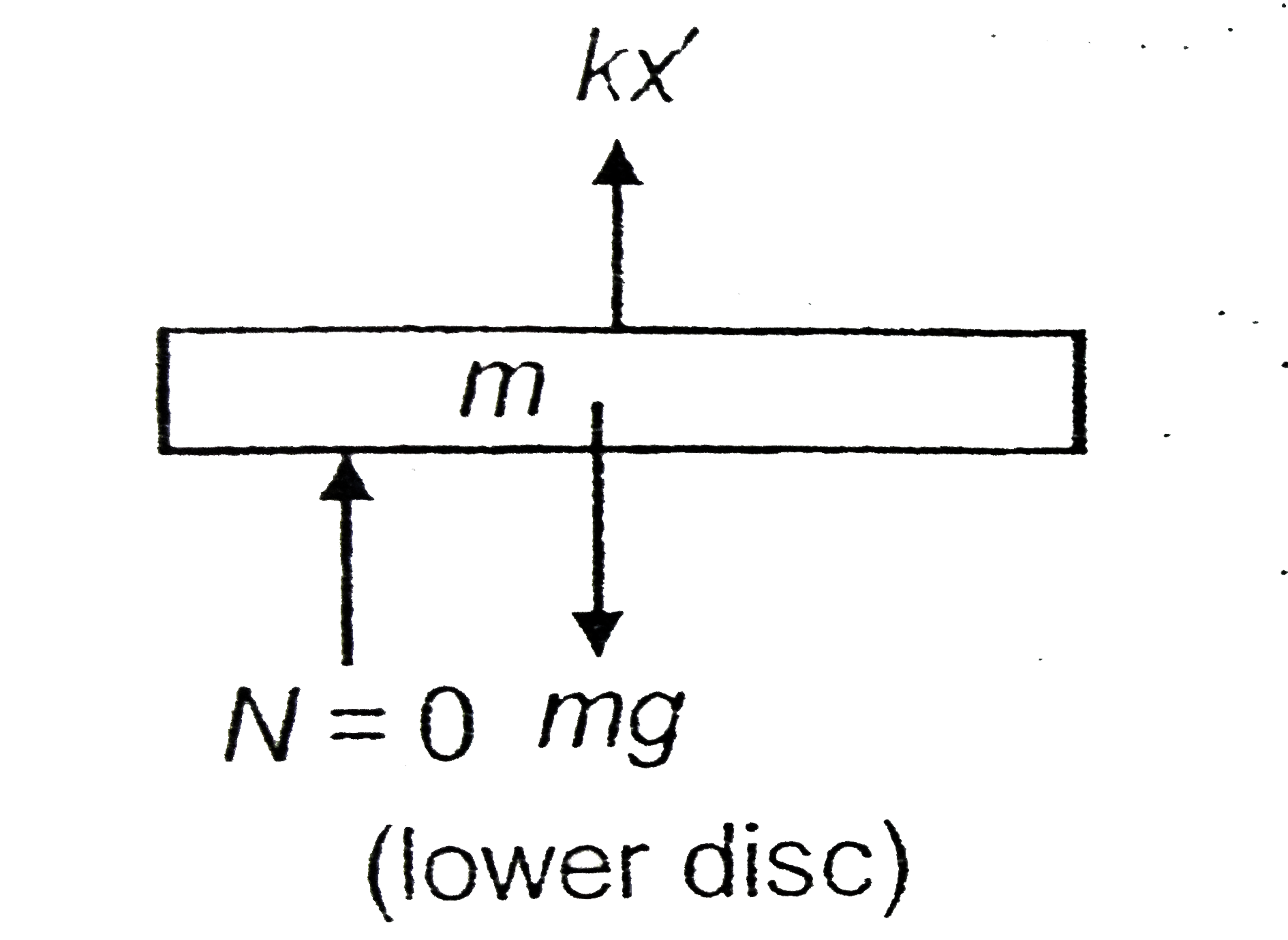
Let us first find out the minimum elongation (x') needed to lift the lower discc from the ground . THe free body digram of the lower disct at this instant will be

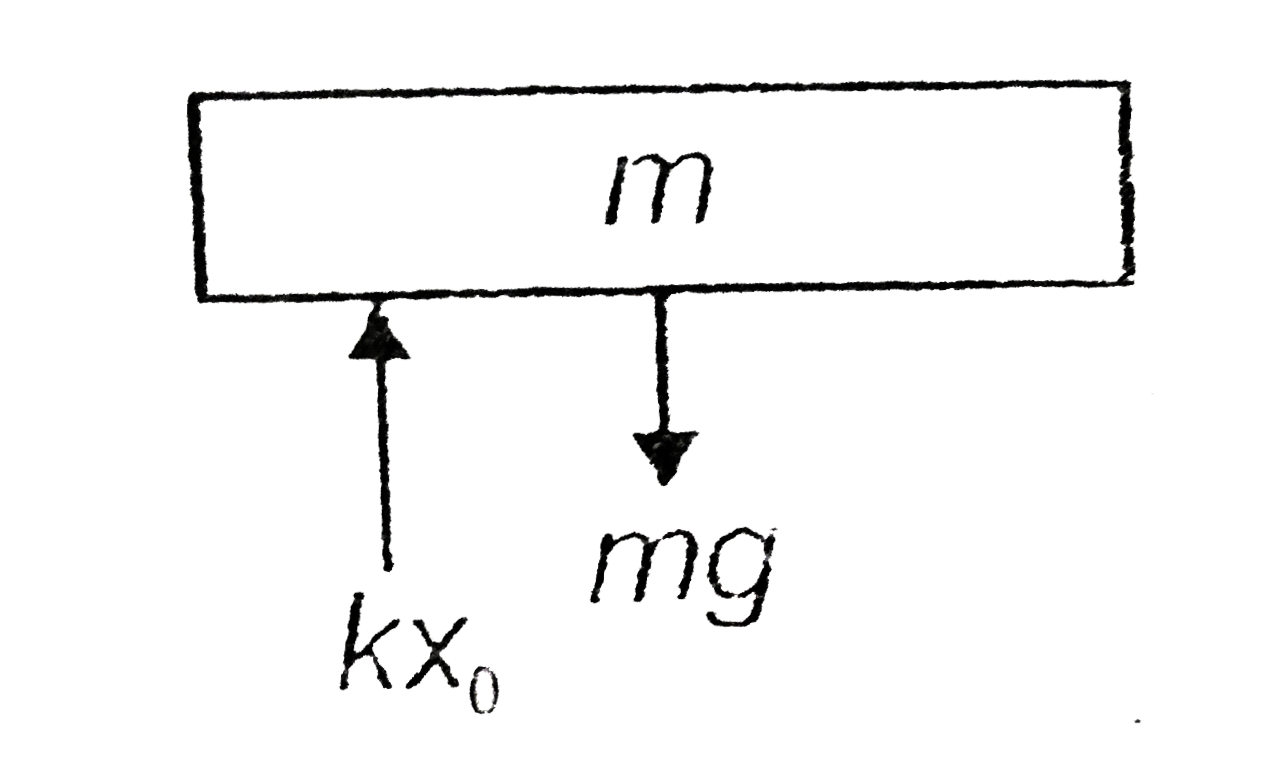
The system given in the question is in equlibrium thus for the equlibrium of upper disc initial compression `(x_(0))` in spring is

now from this equlibrium state spring is further compressed by an amount x and released. Now let us apply energy conservation from this compressed state and final state. Let us take the reference for gravitation potential energy at unstreatched position then
`1/2k(x+x_(0))^(2)=-mg(x+x_(0))=1/2kx^(2)+mgx'`
Now, `x_(0)=(mg)/(k)`
`x=(mg)/(k)`
on solving, we get
`x=(2mg)/(k)`
Promotional Banner

Topper's Solved these Questions

  • WORK, ENERGY AND POWER

    AAKASH INSTITUTE|Exercise IILUSTRATION|2 Videos
  • WORK, ENERGY AND POWER

    AAKASH INSTITUTE|Exercise TRY YOURSELF|95 Videos
  • WAVES

    AAKASH INSTITUTE|Exercise ASSIGNMENT ( SECTION-D ( Assertion - Reason Type Questions ))|12 Videos

Similar Questions

Explore conceptually related problems

A bob of mass 2m hanges by a string attached to the block of mass m of a spring blocks syetem. The whole arrangement is in a state of equilibrium. The bob of mass 2m is pulled down slowely by a distance x_(0) and released.

A disc of mass 3 m and a dise of mass m are connected by a massless sping of stiffness k. The heavier is disc placed on the ground with the spring vertical and lighter disc on top from its equilibrium position the upper disc is pushed down by a distance delta and released. Then.

A sand bag of mass m is hanging from a light spring of stiffness k. Find the elongation of the spring. If we pull the sand bag down by an additional distance x and release it, find its acceleration and maximum velocity of block.

Passage VIII A disc of mass m and radius R is attached with a spring of force contant k at its center as shown in figure. At x-0, spring is unstretched. The disc is moved to x=A and then released. There is no slipping between disc and ground. Let f be the force of friction on the disc from the ground. f versus t (time) graph will be as

In the figure shown, a block A of mass m is rigidy attached to a light spring of stiffness k and suspended from a fixed support. Another block B of same mass is just placed on it and blocks are in equilibrium. Suddenly the block B is removed. Choose the correct options (s) afterward.

Two bars of masses m_1 and m_2 connected by a weightless spring of stiffness ϰ (figure) rest on a smooth horizontal plane. Bar 2 is shifted a small distance x to the left and then released. Find the velocity of the centre of inertia of the system after bar 1 breaks off the wall.

In the figure shown the spring constant is K the mass of the upper disc is m and that of the lower disc is 3m the upper block is depressed down from its equilibrium position by a distance delta=5mg//k and released at t=0 find the velocity of m when normal reaction on 3m is mg

Two identical springs of spring constant k are attached to a block of mass m and to fixed supports as shown in figure. When the mass is displaced from equilibrium position by a distance x towards right, find the restoring force.

Two bars of masses m_1 and m_2 connected by a weightless spring of stiffness k , rest on a smooth horizontal plane. Bar 2 is shifted by a small distance x_0 to the left and released. The veloicyt of the centre of mass of the system when bar 1 breaks off the wall is

AAKASH INSTITUTE-WORK, ENERGY AND POWER-Assignment (SECTION - D)
  1. Figure shows two discs of same mass m. They are rigidy attached to a s...

    Text Solution

    |

  2. A : The work done by a force during round trip is always zero. R : Th...

    Text Solution

    |

  3. A : The change in kinetic energy of a particle is equal to the work do...

    Text Solution

    |

  4. A : Internal forces can change the kinetic energy but not the momentum...

    Text Solution

    |

  5. A : The potential energy can be defined only in conservative field. ...

    Text Solution

    |

  6. A : When a body moves in a circle the work done by the centripetal for...

    Text Solution

    |

  7. A : If net force acting-on a system is zero, then work done on the sys...

    Text Solution

    |

  8. A : During collision between two objects, the momentum of colliding ob...

    Text Solution

    |

  9. A : The potential energy of a system increases when work is done by co...

    Text Solution

    |

  10. A : In inelastic collision, a part of kinetic energy. convert into hea...

    Text Solution

    |

  11. A : Energy dissipated against friction depends on the path followed. ...

    Text Solution

    |

  12. A : Work done by the frictional force can’t be positive. R : Fricti...

    Text Solution

    |

  13. A : Impulse generated on one body by another body in a perfectly elas...

    Text Solution

    |

  14. A : Power of the gravitational force on the body in a projectile motio...

    Text Solution

    |

  15. A : Power delivered by the tension in the wire to a body in vertical c...

    Text Solution

    |

  16. A : When a man is walking on a rough road, that work done by frictiona...

    Text Solution

    |