Home
Class 12
PHYSICS
A particle is suspended vertically from ...

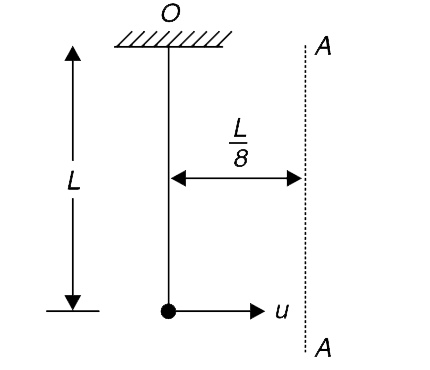
A particle is suspended vertically from a point O by an inextensible mass less string of length L. A vertical line AB is at a distance of `L/8` from O as shown in figure. The particle is given a horizontal velocity u. At some point, its motion ceases to be circular and eventually the object passes through the line AB. At the instant of crossing AB, its velocity is horizontal. Find u.

Text Solution

Verified by Experts
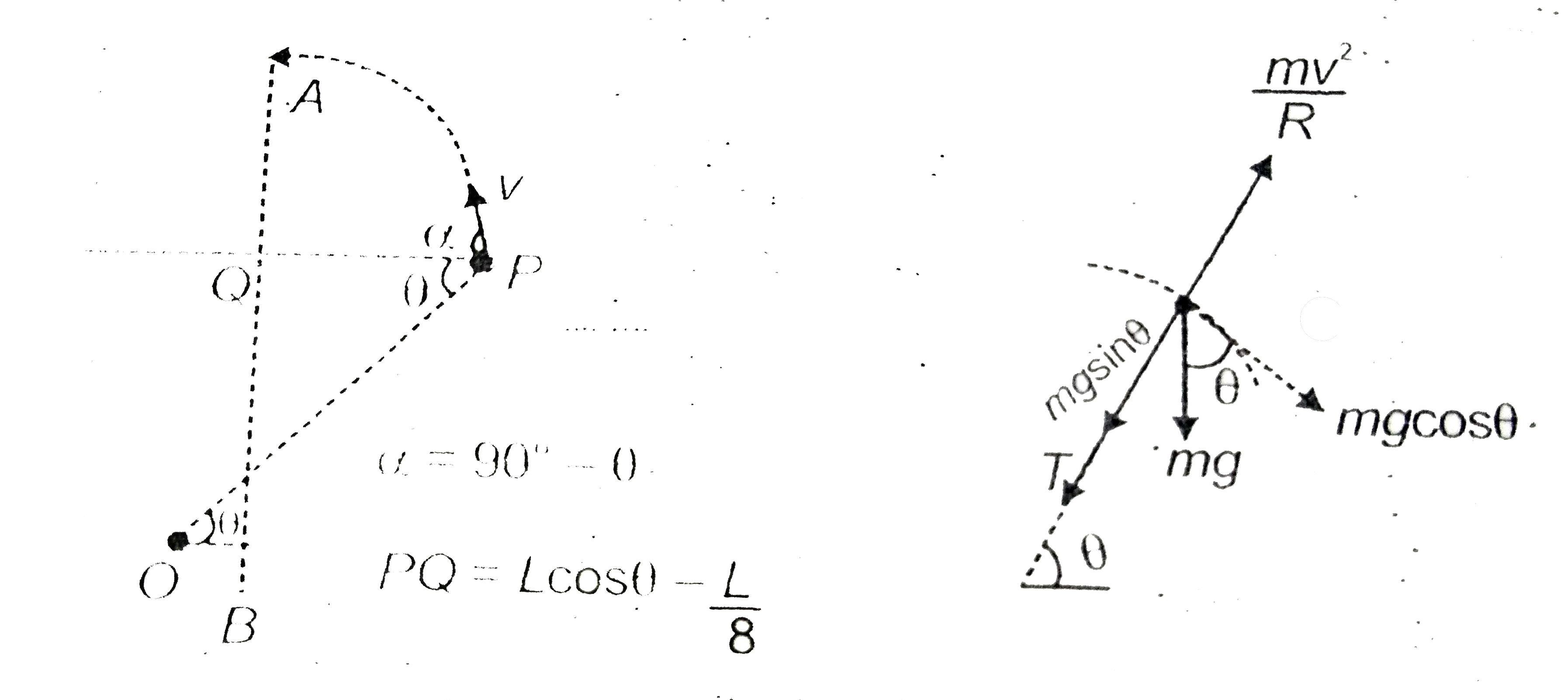
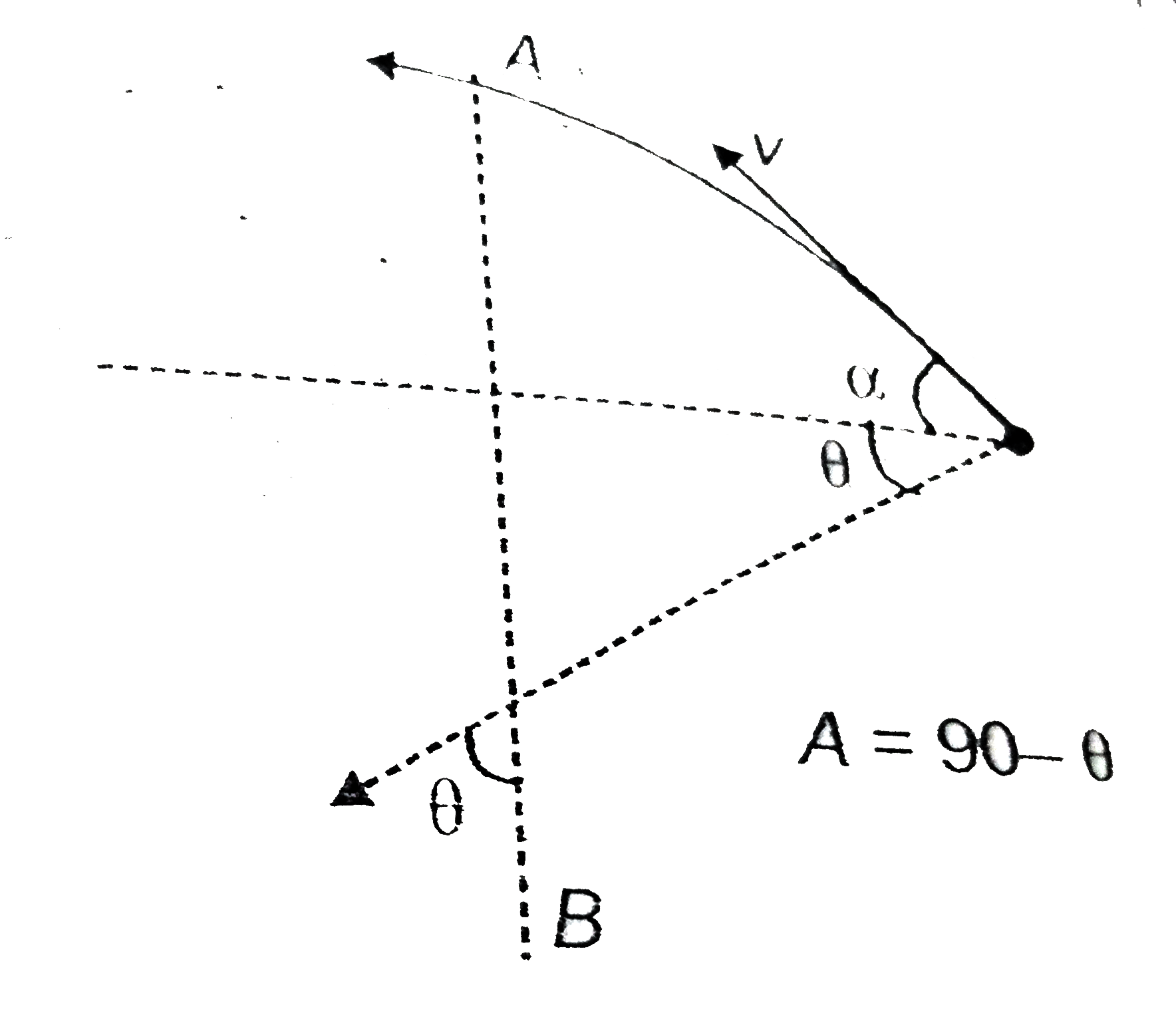
Let its circular motion cases at upper half circle at an angle `'theta'` with horzontal as shown in figure. Also it cannot cases in lower half circle, because in lower half circle, its can velocity cannot be horzontal while passing through AB, F.B.D at 'P' w.r.t. non-inertial from

`because At"p"` circuilar motion cases, its tension becomes zero.
`(mv^(2))/(L)=mg sintheta" "...(1)`
`v=sqrt(gLsintheta)`
Now, applying coservation of mechanical energy between bottom most point and at P. `K_(i)+U_(i)=H_(f)+U_(f)` [Assumign bottom most point as fererence]
`1/2m u^(2)+0=1/2mv^(2)+mgL(1+sin0)`
From equation (1),
`u^(2)=g Lsintheta + 2gL(1+ sin theta)" "...(2)`
The motion of particle after P is projectile and when it passes through line AB, then its becomes horzontal, it means at AB line it will be at its maximum height, from the given diagram.
`PQ=1/2"Range"`
`L cos 0-L/8=1/2(v^(2)sin2alpha)/(g)`
`2L(costheta)1/8=9Lsin theta(2 sin alpha cosalpha)/(g)`
`costheta-1/8=sinthetasin (90-theta)con(90-theta)`
`=sin^(2)thetacostheta`
`=(1-cos^(2)theta)costheta`
`costheta-1/8=costheta-cos^(3)theta`

`cos theta-1/8=costheta-cos^(3)theta`
`impliescos^(3)theta=1/8`
`impliescostheta=1/2`
`impliestheta=60^(@)`
From equation (2),
`u^(2)=2gL+3gL(sqrt3)/(2)`
`u=sqrt((gL)/(2)(4+3sqrt3))`
Promotional Banner

Topper's Solved these Questions

  • WORK, ENERGY AND POWER

    AAKASH INSTITUTE|Exercise IILUSTRATION|2 Videos
  • WORK, ENERGY AND POWER

    AAKASH INSTITUTE|Exercise TRY YOURSELF|95 Videos
  • WAVES

    AAKASH INSTITUTE|Exercise ASSIGNMENT ( SECTION-D ( Assertion - Reason Type Questions ))|12 Videos

Similar Questions

Explore conceptually related problems

A particle of mass m is suspended from a ceiling through a string of length L. The particle moves in a horizontal circle of radius r such that r =L/(sqrt2) . The speed of particle will be :

As shown in figure, a particle of mass m is performing vertical circular motion. The velocity of the particle is increased, then at which point will the string break?

A particle of mass m is suspended from a fixed O by a string of length L. At t = 0 , it is displaced from its equilibrium position and released. The graph which shows the variation of the tension T in the string with time t is :

A particle of mass m is suspended from point O and undergoes circular motion in horizontal plane as conical pendulum as shown in figure.

A particle suspended from a fixed point, by a light inextensible thread of length L is projected horizontally from its lowest position with velocity 7gL . The thread will slack after swinging through an angle , such that  equal

A particle of mass m is attached to one end of a light inextensible string and the other end of the string is fixed in vertical plane as shown. Particle is given a horizontal velocity u = sqrt((5)/(2)gl) The tension in the string at an instant when acceleration of the particle is horizontal and sqrt(3)g is

A particle of mass m is suspended from a fixed point O by a string length l.At t=0, it is displaced from its equilibrium position and released.If T is the tension in the string with time t, then the correct graph is

A particle of mass m is attached to one end of a light inextensible string and the other end of the string is fixed in vertical plane as shown. Particle is given a horizontal velocity u = sqrt((5)/(2)gl) The maximum angle made by the string with downward vertical is

AAKASH INSTITUTE-WORK, ENERGY AND POWER-Assignment (SECTION - D)
  1. A particle is suspended vertically from a point O by an inextensible m...

    Text Solution

    |

  2. A : The work done by a force during round trip is always zero. R : Th...

    Text Solution

    |

  3. A : The change in kinetic energy of a particle is equal to the work do...

    Text Solution

    |

  4. A : Internal forces can change the kinetic energy but not the momentum...

    Text Solution

    |

  5. A : The potential energy can be defined only in conservative field. ...

    Text Solution

    |

  6. A : When a body moves in a circle the work done by the centripetal for...

    Text Solution

    |

  7. A : If net force acting-on a system is zero, then work done on the sys...

    Text Solution

    |

  8. A : During collision between two objects, the momentum of colliding ob...

    Text Solution

    |

  9. A : The potential energy of a system increases when work is done by co...

    Text Solution

    |

  10. A : In inelastic collision, a part of kinetic energy. convert into hea...

    Text Solution

    |

  11. A : Energy dissipated against friction depends on the path followed. ...

    Text Solution

    |

  12. A : Work done by the frictional force can’t be positive. R : Fricti...

    Text Solution

    |

  13. A : Impulse generated on one body by another body in a perfectly elas...

    Text Solution

    |

  14. A : Power of the gravitational force on the body in a projectile motio...

    Text Solution

    |

  15. A : Power delivered by the tension in the wire to a body in vertical c...

    Text Solution

    |

  16. A : When a man is walking on a rough road, that work done by frictiona...

    Text Solution

    |