(1) Nweton's law of universal gravitation : Every particles of matter in the universe attracts every other particle with a force which is directly proportional to the product of their masses, invessely proportional to the square of the distance between them and acts along the line joining them.
(2) Explanation : The gravitational interaction is an attraction between any two bodies in the universe, independent of the medium between them.
For two particles of masses `m_(1)` and `m_(2)` separated by a distance r, the magnitude of the gravitational force between them is
`F prop(m_(1)m_(2))/(r^(2))" " :. F=G(m_(1)m_(2))/(r^(2))`
where the constant of proportionality G is called the universal gravitational constant.
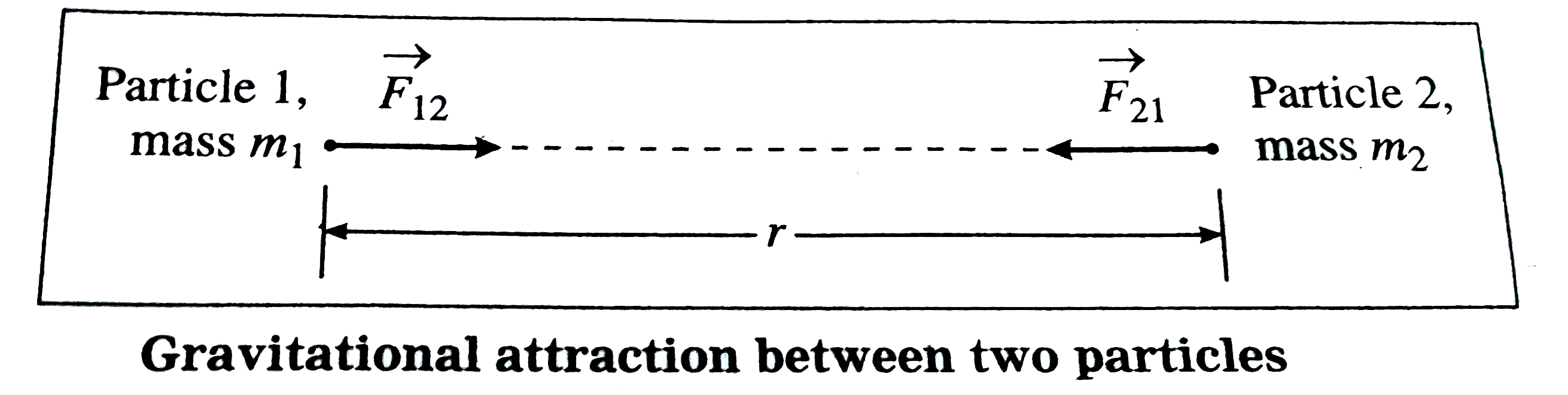
The force on particle 2 by particle 1 is `vecF_(21)`
The force on particle 1 by particle 2 is `vecF_(12)`
`vecF_(12)=-vecF_(21)`. The forces `vecF_(21)` and `vecF_(12)`, equal in magnitude and opposite in direaction ,act along the line joining the two interacting particles. They form the action-reaction pair.


