Home
Class 12
PHYSICS
Find the currents going through the thre...

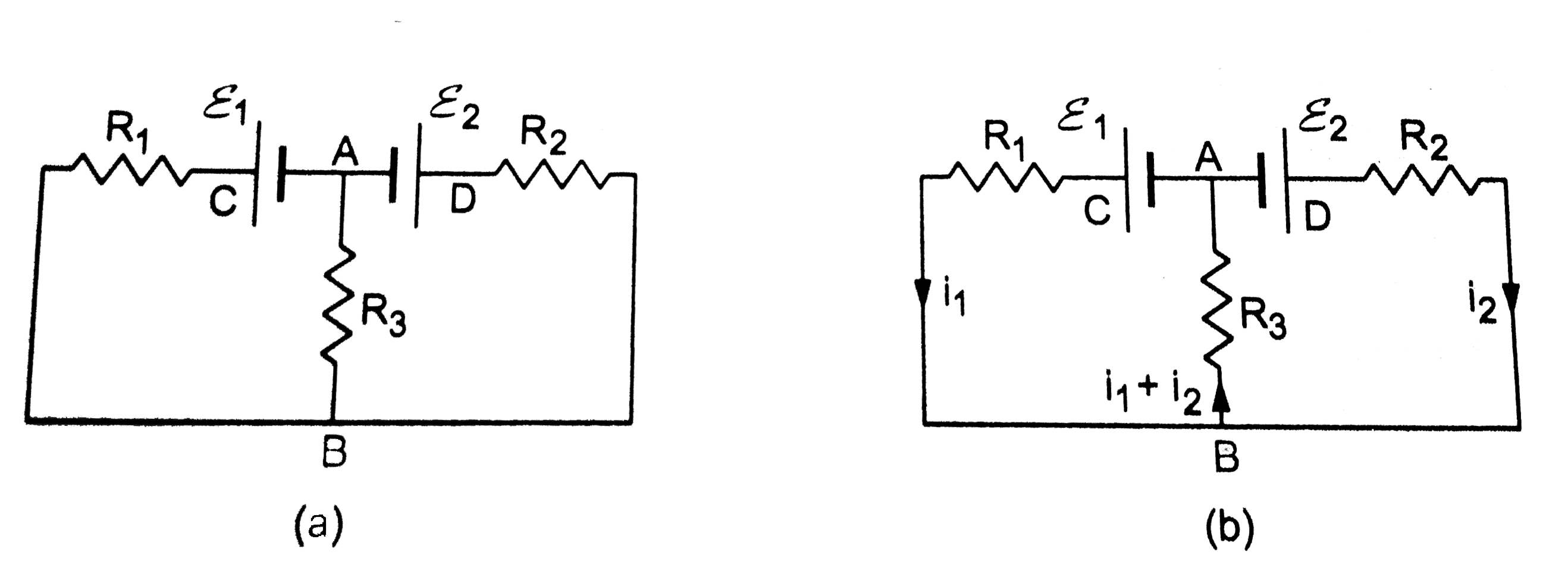
Find the currents going through the three resistors `R_(v),R_(2)andR_(3) in the circuit of figure.

Text Solution

Verified by Experts

Lets us take the potential of the point A to be zero. The potential at C will be (epsilon)_(1)and that at D will be `(epsilon)_(2)`.Let the potential at B be V . The currents through the three resistors are `i_(1),i_(2)and i_(1)+i_(2)`as shown in figure. Note that the current directed towards B equals the current directed away from B.
Applying Ohm's law to the three resistors `R_(1),R_(2)and R_(3),`
we get,
`(epsilon)_(1)-V=R_(1)i_(1) ...(i)`
`(epsilon)_(2)-V=R_(2)i_(2) ...(ii)`
`and V-0=R_(3)(i_(1)+I_(2)). ...(iii)`
Adding (i) and (iii),
`(epsilon)_(1)=R_(1)i_(1)+R_(3)(i_(1)+i_(2))`
`=(R_(1)+R_(3))i_(1)+R_(3)i_(2) ...(iv)`
`and adding (ii)and (iii)`
`(epsilon)_(2)=R_(2)i_(2)+R_(3)(i_(1)+I_(2))`
`=(R_(2)+R_(3))i_(2)+R_(3)i_(1). ...(v)`
Equations (iv) and (v) may be directly written from Kirchhoff's loop applied to the left half and the right half of the circuit.
Multiply (iv)by `(R_(2)+R_(3)), (v) by R_(3) and subtract to eliminate i_(2)`.This gives
`i_(1)=((epsilon_(1)(R_(2)+R_(3))-(epsilon_(2)R_(3))/(R_(1)+R_(3))(R_(2)+R_(3))-R_(3)^(2)).`
`((epsilon_1)(R_(2)+R_(3))-(epsilon_2)R_(3))/(R_(1)R_(2)+R_(2)R_(3)+R_(3)R_(1)).`
Similarly, eliminating `i_(1)`from (iv) and (v) we obtain,
`i_(2)=((epsilon_2)(R_(1)+R_(3))-(epsilon_1)R_(3))/(R_(1)R_(2)+R_(2)R_(3)+R_(3)R_(1))`
`And so`
`i_(1)+i_(2)=((epsilon_(1))R_(2)+(epsilon_(2)R_(1))/(R_(1)R_(2)+R_(2)R_(3)+R_(3)R_(1)).`
Promotional Banner

Topper's Solved these Questions

  • ELECTRIC CURRENT IN CONDUCTORS

    HC VERMA|Exercise worked out Example|1 Videos
  • ELECTRIC CURRENT IN CONDUCTORS

    HC VERMA|Exercise Short Answer|17 Videos
  • ELECTRIC CURRENT IN CONDUCTORS

    HC VERMA|Exercise Exercises|84 Videos
  • DISPERSION AND SPECTRA

    HC VERMA|Exercise Exercises|11 Videos
  • ELECTRIC CURRENT THROUGH GASES

    HC VERMA|Exercise Exercises|23 Videos

Similar Questions

Explore conceptually related problems

Find the currents through the three resistors shown in figure

Find the currents through the three resistors shown in Figure

Find the current through resistor R

Find the current flowing through the resistance R_(1) of the circuit shown in figure-3.103. the resistances are equal to R_(1)=10Omega,R_(2)=20Omega and R_(3)=30Omega and the potentials of points 1,2 and 3 are given as V_(1)=10V,V_(2)=6V and V_(3)=5V .

Find the current flowing through the resistance R_(1) of the circuit shown in figure if the resistances are equal to R_(1) = 10Omega, R_(2) = 20 Omega and R_(3), = 30 Omega and the potentials of the points 1, 2, and 3 are equal to varphi_(1) = 10 V, varphi_(2) = 6 V and varphi_(3) = 5 V

Find the heat developed per minutes in each of the three resistors R_(1),R_(2) and R_(3)

The circuit in figure, where there are three resistors R_(1),R_(2) and R_(3) . If the voltage between A and C is V, the current / is given by

How will you infer with the help of an experiment that the same current flows through every part of the circuit containing three resistors, R_(1), R_(2) and R_(3) in series connected to a battery of V volts?

HC VERMA-ELECTRIC CURRENT IN CONDUCTORS-Worked Out Examples
  1. Find the equivalent resistance between the point a and b of the networ...

    Text Solution

    |

  2. Find the effective resistance between the points A and B in figure.

    Text Solution

    |

  3. Find the equivalent resistance of the network shown in figure between ...

    Text Solution

    |

  4. Each resistor shown in figure has a resistance of 10(Omega)and the bat...

    Text Solution

    |

  5. Find the equivalent resistances of the nerwork shown in figure between...

    Text Solution

    |

  6. In the circuit shown in figure E,F, G and H are cell of emf 2,1,3, and...

    Text Solution

    |

  7. Find the equivalent resistance between the point a and b of the circui...

    Text Solution

    |

  8. Find the currents going through the three resistors R(v),R(2)andR(3) i...

    Text Solution

    |

  9. Twelve wire, each having resistance r, are joined to form a cube as sh...

    Text Solution

    |

  10. Find the equivalent resistance of the circuit of the previous problen ...

    Text Solution

    |

  11. Find the equivalent resistance between thepoints a and b of the infini...

    Text Solution

    |

  12. Find the equivalent resistance of the network shown in figure between ...

    Text Solution

    |

  13. (a)Find the current I supplied by the battery in the network shown in ...

    Text Solution

    |

  14. A part of a circuit in steady state along with the currents flowing in...

    Text Solution

    |

  15. (a)find the potential drops across the two resistors shown in figure. ...

    Text Solution

    |

  16. A galvanometer has a coil of resistance 100(Omega) showing a full-scal...

    Text Solution

    |

  17. The electric field between the plates of a parallel-plate capacitor of...

    Text Solution

    |

  18. A capacitor is connected to a 12 V battery through a resistance of (10...

    Text Solution

    |

  19. A capacitor charged to 50 V is discharged by connecting the two plates...

    Text Solution

    |

  20. A 5.0(mu)F capacitor having a charge of (20 (mu)C)is discharged throug...

    Text Solution

    |
