Home
Class 11
PHYSICS
Binary stars of comparable masses m(1) a...

Binary stars of comparable masses `m_(1)` and `m_(2)` rotate under the influence of each other's gravity with a time period `T`. If they are stopped suddenly in their motions, find their relative velocity when they collide with each constant of gravitation.

Text Solution

Verified by Experts
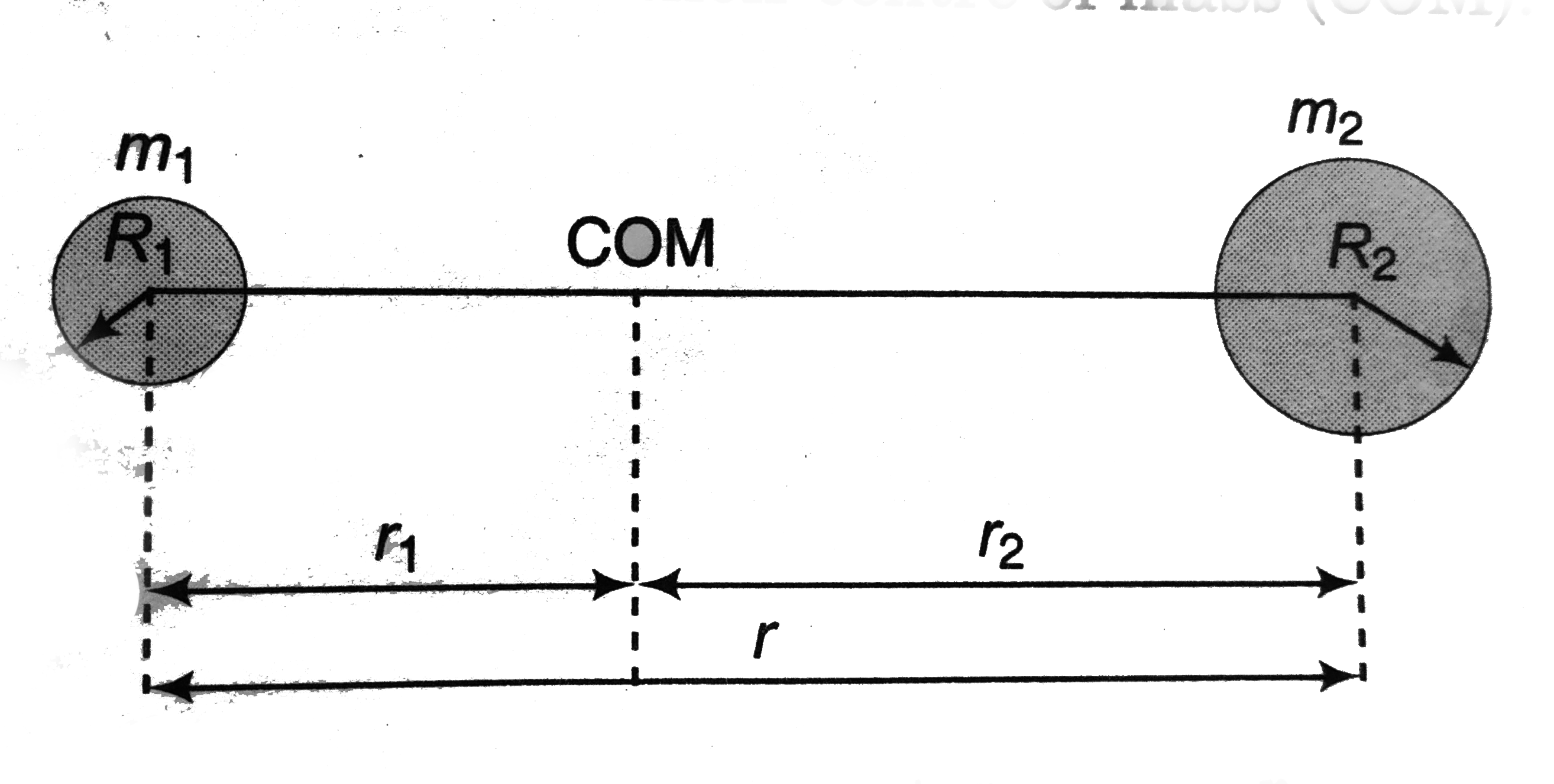
Both the stars rotate about their center of mass (COM).

For the position of `COM`, `(r_(1))/(m_(2)) = (r_(2))/(m_(1)) = (r_(1) + r_(2))/( m_(1) + m_(2)) = (r )/(m_(1) + m_(2))` `(r = r_(1) + r_(2))`
Also `m_(1)r_(1)omega^(2) = (Gm_(1) m_(2))/(r_(2))`
or `omega^(2) = (Gm_(2))/(r_(1)r^(2))` `(omega = (2pi)/(T))`
But, `r_(1) = (m_(2)r)/(m_(1) + m_(2))`
`:. omega^(2) = (G(m_(1) + m_(2)))/(r^(3))`
or `r = {(G(m_(1) + m_(2)))/(omega^(2))}^(1//3)` ..(i)
Applying conservation of mechanical energy, we have
`-(Gm_(1) m_(2))/(r) = - (Gm_(1) m_(2))/((R_(1) + R_(2))) + (1)/(2) mu upsilon_(r)^(2)` ..(ii)
Hence, `mu =` reduced mass
`= (m_(1) m_(2))/(m_(1) + m_(2))`
and `upsilon_(r) =` relative between the two stars.
From Eq. (ii), we find that
`upsilon_(r)^(2) = (2Gm_(1)m_(2))/(mu) ((1)/(R_(1) + R_(2))-(1)/(r))`
`= (2Gm_(1)m_(2))/((m_(1)m_(2))/(m_(1) + m_(2)))((1)/(R_(1) + R_(2))-(1)/(r))`
`= 2G (m_(1) + m_(2)) ((1)/(R_(1) + R_(2))-(1)/(r))`
Substituting the value of `r` from Eq. (i), we get
`upsilon_(r) =sqrt(2G (m_(1) + m_(2))[(1)/(R_(1) + R_(2))-{(4 pi^(2))/(G(m_(1) + m_(2)) T^(2))}^(1//3)])`
Promotional Banner

Topper's Solved these Questions

  • GRAVITATION

    DC PANDEY|Exercise Exercise 13.1|5 Videos
  • GRAVITATION

    DC PANDEY|Exercise Exercise 13.2|9 Videos
  • GRAVITATION

    DC PANDEY|Exercise Solved Examples|16 Videos
  • GENERAL PHYSICS

    DC PANDEY|Exercise INTEGER_TYPE|2 Videos
  • KINEMATICS

    DC PANDEY|Exercise INTEGER_TYPE|11 Videos

Similar Questions

Explore conceptually related problems

Binary stars of comparable masses rotates under the influence of each other's gravity at a distance [(2G)/(omega^(2))]^(1//3) where omega is the angular velocity of each of the system. If difference between the masses of two stars is 6 units. Find the ratio of the masses of smaller to bigger star.

Two particles of mass m_(1) and m_(2) , approach each other due to their mutual gravitational attraction only. Then

Two masses m_(1) and m_(2) at an infinite distance from each other are initially at rest, start interacting gravitationally. Find their velocity of approach when they are at a distance r apart.

Two particles of masses m_(1) and m_(2) initially at rest a infinite distance from each other, move under the action of mutual gravitational pull. Show that at any instant therir relative velocity of approach is sqrt(2G(m_(1)+m_(2))//R) where R is their separation at that instant.

A uniform rod AB of mass m length 2a is allowed to fall under gravity with AB in horizontal. When the speed of the rod is v suddenly the end A is fixed. Find the angular velocity with which it begins to rotate.

Two particles of mass m_(1) and m_(2) are approaching towards each other under their mutual gravitational field. If the speed of the particle is v, the speed of the center of mass of the system is equal to :

The masses of two stars are m_(1) and m_(2) , and their separation is l. Determine the period T of their revolution in circular orbits about a common centre.

Two stars of masses m_1 and m_2 form a binary system,revolving around each other in circular orbits of radii r_1 and r_2 respectively.Time period of revolution for this system is

The velocities of two particles of masses m_(1) and m_(2) relative to an observer in an inertial frame are v_(1) and v_(2) . Determine the velocity of the center of mass relative to the observer and the velocity of each particle relative to the center of mass.

