Home
Class 11
PHYSICS
Identify the correct variation of potent...

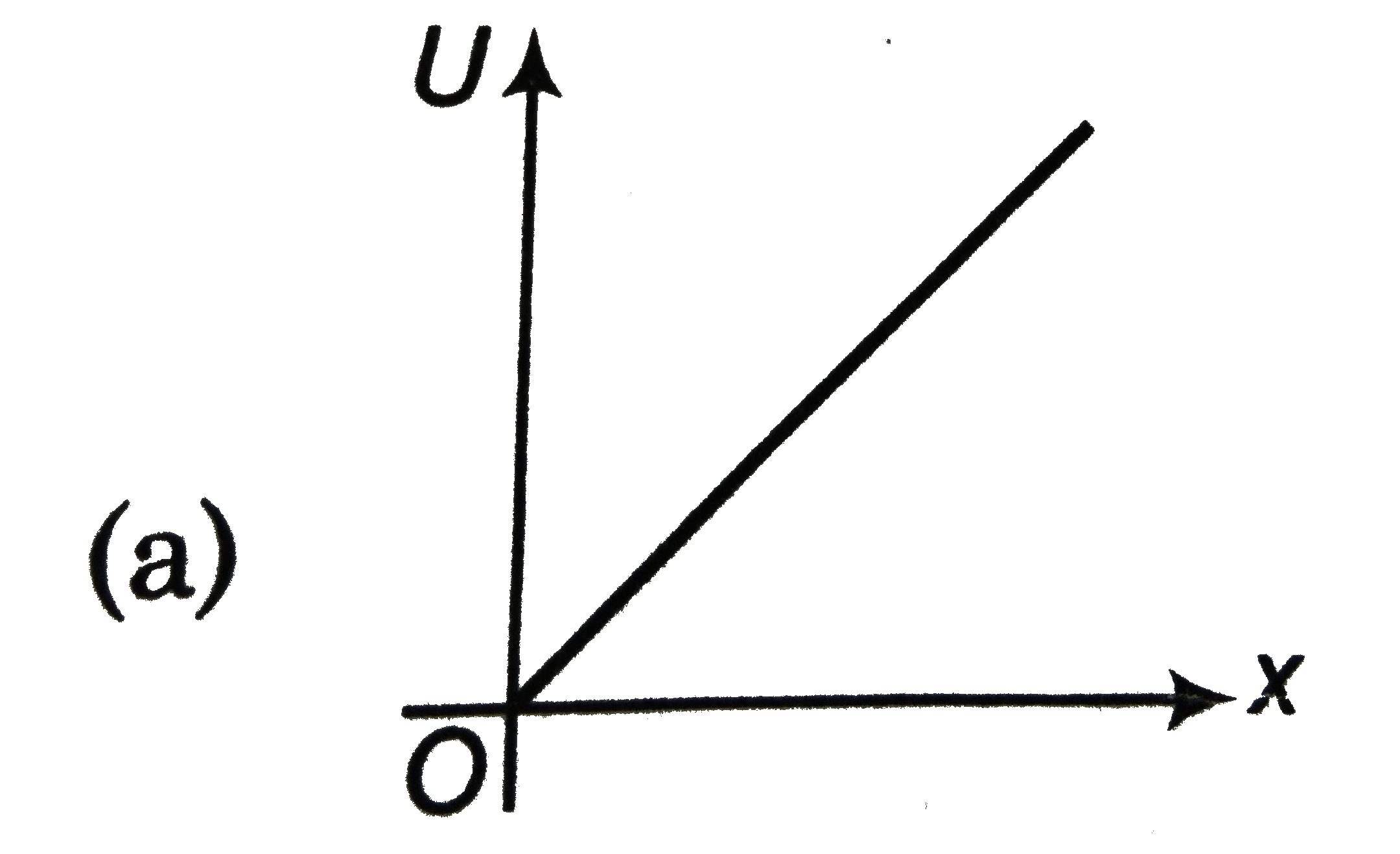
Identify the correct variation of potential energy `U` as a function of displacement `x` from mean position (or `x^(2)`) of a harmonic oscillator (`U` at mean position `= 0`)

A

B

C

D

None of these

Text Solution

AI Generated Solution

The correct Answer is:

To solve the problem of identifying the correct variation of potential energy \( U \) as a function of displacement \( x \) from the mean position of a harmonic oscillator, we can follow these steps: ### Step 1: Understand the Potential Energy Formula The potential energy \( U \) of a harmonic oscillator is given by the formula: \[ U = \frac{1}{2} k x^2 \] where \( k \) is the spring constant and \( x \) is the displacement from the mean position. ### Step 2: Analyze the Potential Energy at the Mean Position At the mean position, the displacement \( x = 0 \). Substituting this into the potential energy formula: \[ U = \frac{1}{2} k (0)^2 = 0 \] This confirms that the potential energy \( U \) is zero at the mean position. ### Step 3: Identify the Relationship Between \( U \) and \( x^2 \) From the formula \( U = \frac{1}{2} k x^2 \), we can see that potential energy \( U \) is directly proportional to the square of the displacement \( x^2 \). This means: \[ U \propto x^2 \] This indicates that if we plot \( U \) against \( x^2 \), we will get a linear relationship. ### Step 4: Graphical Representation When plotting \( U \) against \( x^2 \): - The graph will be a straight line starting from the origin (0,0) because when \( x^2 = 0 \), \( U = 0 \). - The slope of the line will be \( \frac{1}{2} k \), which is a constant. ### Step 5: Conclusion Thus, the correct variation of potential energy \( U \) as a function of \( x^2 \) is a straight line passing through the origin. Therefore, the answer is that \( U \) varies linearly with \( x^2 \).

To solve the problem of identifying the correct variation of potential energy \( U \) as a function of displacement \( x \) from the mean position of a harmonic oscillator, we can follow these steps: ### Step 1: Understand the Potential Energy Formula The potential energy \( U \) of a harmonic oscillator is given by the formula: \[ U = \frac{1}{2} k x^2 \] where \( k \) is the spring constant and \( x \) is the displacement from the mean position. ...
Promotional Banner

Topper's Solved these Questions

  • SIMPLE HARMONIC MOTION

    DC PANDEY|Exercise Level 1 Subjective|39 Videos
  • SIMPLE HARMONIC MOTION

    DC PANDEY|Exercise Level 2 Single Correct|28 Videos
  • SIMPLE HARMONIC MOTION

    DC PANDEY|Exercise Level 1 Assertion And Reason|10 Videos
  • SEMICONDUCTORS AND ELECTRONIC DEVICES

    DC PANDEY|Exercise More than One Option is Correct|3 Videos
  • SOLVD PAPERS 2017 NEET, AIIMS & JIPMER

    DC PANDEY|Exercise Solved paper 2018(JIPMER)|38 Videos

Similar Questions

Explore conceptually related problems

In a simple harmonic oscillator, at the mean position

The velocity of a particle in simple harmonic motion at displacement y from mean position is

The potential energy as a function of displacement for an oscillator u=8x^(2) joule. The magnitude of the force on the oscillator of mass 0.5 kg placed at x = 0.2 m is

Acceleration of a particle in SHM at displacement x=10 cm (from the mean position is a =-2.5 cm//s^(2) ). Find time period of oscillations.

At which position the potential energy of a harmonic oscillator is maximum or minimum ?

A body is executing simple harmonic motion. At a displacement x from mean position, its potential energy is E_(1)=2J and at a displacement y from mean position, its potential energy is E_(2)=8J . The potential energy E at a displacement (x+y) from mean position is

The potential energy of a particle with displacement X is U(X) . The motion is simple harmonic, when (K is a positive constant)

DC PANDEY-SIMPLE HARMONIC MOTION-Level 1 Single Correct
  1. Two simple harmonic motions are given by y(1) = a sin [((pi)/(2))t + p...

    Text Solution

    |

  2. A particle starts performing simple harmonic motion. Its amplitude is ...

    Text Solution

    |

  3. Which of the following is not simple harmonic function ?

    Text Solution

    |

  4. The disperod of a particle varies according to the relation x=4 (cos p...

    Text Solution

    |

  5. Two pendulums X and Y of time periods 4 s and 4.2s are made to vibrate...

    Text Solution

    |

  6. A mass M is suspended from a massless spring. An additional mass m str...

    Text Solution

    |

  7. Two bodies P and Q of equal masses are suspended from two separate mas...

    Text Solution

    |

  8. A disc of radius R is pivoted at its rim. The period for small oscilla...

    Text Solution

    |

  9. Identify the correct variation of potential energy U as a function of ...

    Text Solution

    |

  10. If the length of a simple pendulum is equal to the radius of the earth...

    Text Solution

    |

  11. The displacement - time (x - t) graph of a particle executing simple h...

    Text Solution

    |

  12. In the figure shown the time period and the amplitude respectively, wh...

    Text Solution

    |

  13. The equation of motion of a particle of mass 1g is (d^(2)x)/(dt^(2)) +...

    Text Solution

    |

  14. The spring as shown in figure is kept in a stretched position with ext...

    Text Solution

    |

  15. The mass and diameter of a planet are twice those of earth. What will ...

    Text Solution

    |

  16. The resultant amplitude due to superposition of three simple harmonic ...

    Text Solution

    |

  17. Two SHMs s(1) = a sin omega t and s(2) = b sin omega t are superimpose...

    Text Solution

    |

  18. The amplitude of a particle executing SHM about O is 10 cm. Then

    Text Solution

    |

  19. A particle is attached to a vertical spring and is pulled down a dista...

    Text Solution

    |

  20. A block of mass 1kg is kept on smooth floor of a truck. One end of a s...

    Text Solution

    |
