Home
Class 11
PHYSICS
The spring shown in figure is unstretche...

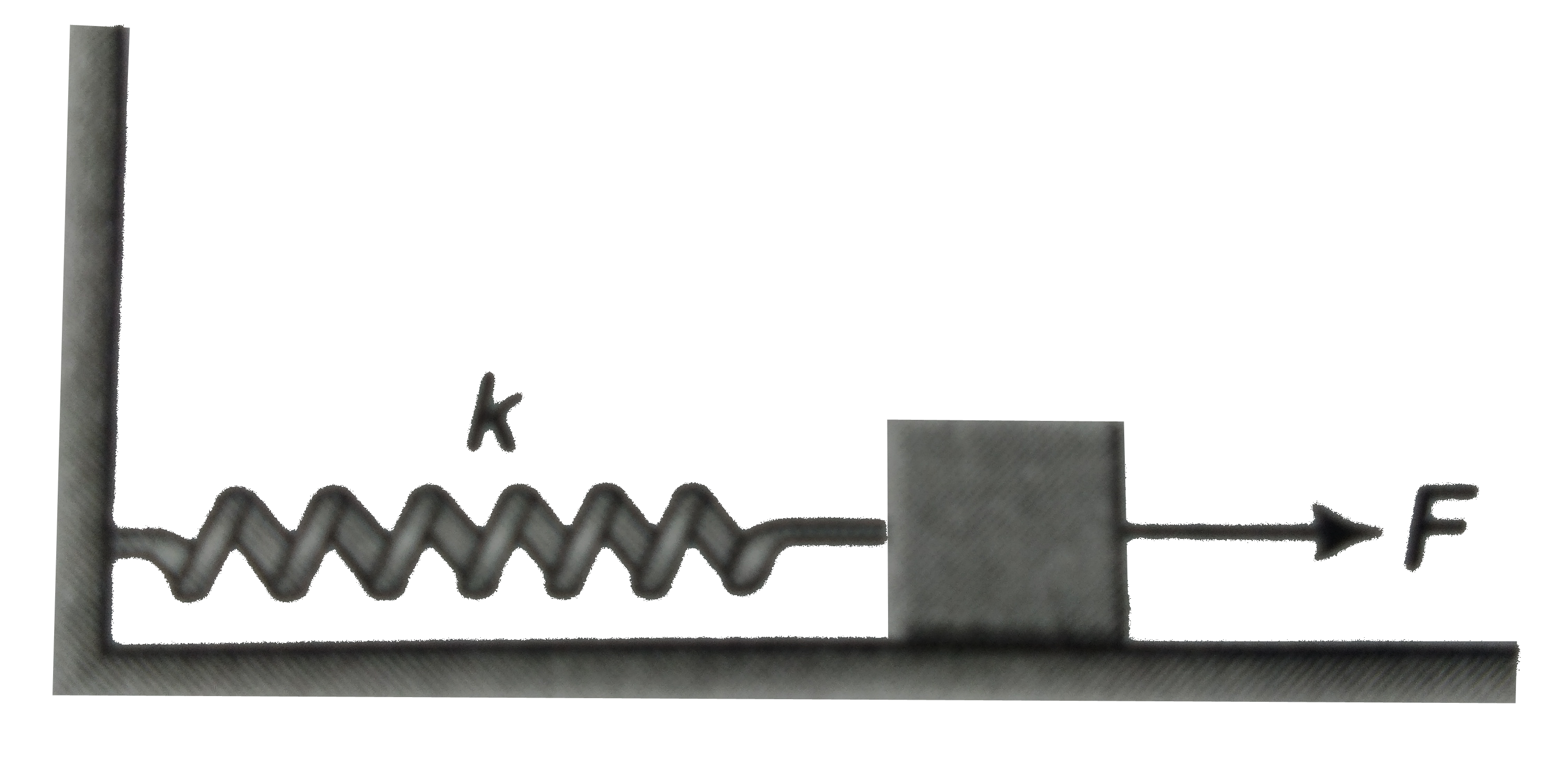
The spring shown in figure is unstretched when a man starts pulling on the cord. The mass of the block is `M`. If the man exerts a constant force `F`, find

(a) the amplitude and the time period of the motion of the block,
(b) the energy stored in the spring when the block passes through the equilibrium position and
(c) the kinetic energy of the block at this position.

Text Solution

Verified by Experts

The correct Answer is:

A, B, C

(a) In equilibrium, let `x_(0)` is the elongation then,
`F = kx_(0)`
`:. x_(0) = (F)/(k)`
This x_(0) is the amplitude
`:. A = x_(0) = (F)/(k)`
`T = 2pi sqrt((M)/(k))`
(b) `E = (1)/(2) kx_(0)^(2) = 1/2k ((F)/(k))^(2) = (F^(2))/(2k)`
(c) Kinetic energy at mean position
`= E = (F^(2))/(2k)`.
Promotional Banner

Topper's Solved these Questions

  • SIMPLE HARMONIC MOTION

    DC PANDEY|Exercise Level 2 Single Correct|28 Videos
  • SIMPLE HARMONIC MOTION

    DC PANDEY|Exercise Level 2 More Than One Correct|8 Videos
  • SIMPLE HARMONIC MOTION

    DC PANDEY|Exercise Level 1 Single Correct|24 Videos
  • SEMICONDUCTORS AND ELECTRONIC DEVICES

    DC PANDEY|Exercise More than One Option is Correct|3 Videos
  • SOLVD PAPERS 2017 NEET, AIIMS & JIPMER

    DC PANDEY|Exercise Solved paper 2018(JIPMER)|38 Videos

Similar Questions

Explore conceptually related problems

The springs shown in the figure are all unstretched in the beginning when a man starts pulling the block. The man exerts a constant force F on the blcok. Find the amplitude and the frequency of the motion of the block.

A spring mass systeam is shown in figure, spring is initially unstretched. A man starts pulling the block with constant force F . Find (a) The amplitude and the time period of motion of the block (b) The K.E. of the block at mean position (c) The energy stored in the spring when the block passes through the mean position

The springs shown in the figure are all upstretched in the beginning when a man starts pulling the block. The man exerts a constant force F on the block.

Find the elastic potential energy stored in each spring shown in figure, when the block is in equilibrium. Also find the time period of vertical oscillation of the block.

In figure, k = 100 N//m, M = 1kg and F = 10 N (a) Find the compression of the spring in the equilibrium position (b) A sharp blow by some external agent imparts a speed of 2 m//s to the block towards left. Find the sum of the potential energy of the spring and the kinetic energy of the block at this instant. (c) Find the time period of the resulting simple harmonic motion. (d) Find the amplitude. (e) Write the potential energy of the spring when the block is at the left estreme. (f) Write the potential energy of the spring when the block is at the right extreme. The answers of (b), (e) and (f) are different. Explain why this does not violate the principle of conservation of energy ?

A block of mass m hangs from a vertical spring of spring constant k. If it is displaced from its equilibrium position, find the time period of oscillations.

A cord is used to vertically lower an initially stationary block of mass M at a constant downward acceleration of g/4. When the block has fallen a distance d, find (a) the work done by the cord's force on the block, (b) the work done by the graviational force on the block, (c) the kinitic energy of the block, and (d) the speed of the block.

A block of mass m held touching the upper end of a light spring of force constant K as shown in figure. Find the maximum potential energy stored in the spring if the block is released suddenly on the spring.

Spring mass system is shown in figure. Find the elastic potential energy stored in each spring when block is at its mean position. Also find the time period of vertical oscillations. The system is in vertical plane.

Spring mass system is shown in figure. Find the elastic potential energy stored in each spring when block is at its mean position. Also find the time period of vertical oscillations. The system is in vertical plane.

DC PANDEY-SIMPLE HARMONIC MOTION-Level 1 Subjective
  1. A body makes angular simple harmonic motion of amplitude pi//10rad and...

    Text Solution

    |

  2. A particle executes simple harmonic motion of period 16 s. Two seconds...

    Text Solution

    |

  3. A simple pendulum consists of a small sphere of mass m suspended by a ...

    Text Solution

    |

  4. Find the period of oscillation of a pendulum of length l if its point ...

    Text Solution

    |

  5. A block with mass M attached to a horizontal spring with force constan...

    Text Solution

    |

  6. A bullet of mass m strikes a block of mass M. The bullet remains embed...

    Text Solution

    |

  7. An annular ring of internal and outer radii r and R respectively oscil...

    Text Solution

    |

  8. A body of mass 200 g oscillates about a horizontal axis at a distance ...

    Text Solution

    |

  9. Show that the period of oscillation of simple pendulum at depth h belo...

    Text Solution

    |

  10. The period of a particle in SHM is 8 s. At t = 0 it is in its equilibr...

    Text Solution

    |

  11. (a) The motion of the particle in simple harmonic motion is given by...

    Text Solution

    |

  12. Show that the combined spring energy and gravitational energy for a ma...

    Text Solution

    |

  13. The masses in figure slide on a frictionless table. m(1) but not m(2),...

    Text Solution

    |

  14. The spring shown in figure is unstretched when a man starts pulling on...

    Text Solution

    |

  15. In figure, k = 100 N//m, M = 1kg and F = 10 N (a) Find the compre...

    Text Solution

    |

  16. Pendulum A is a physical pendulum made from a thin, rigid and uniform ...

    Text Solution

    |

  17. A solid cylinder of mass m is attached to a horizontal spring with for...

    Text Solution

    |

  18. A cord is attached between a 0.50 kg block and a string with force con...

    Text Solution

    |

  19. Two linear SHM of equal amplitudes A and frequencies omega and 2omega ...

    Text Solution

    |

  20. A particle is subjected to two simple harmonic motions given by x(1)...

    Text Solution

    |
