Home
Class 11
PHYSICS
A cord is attached between a 0.50 kg blo...

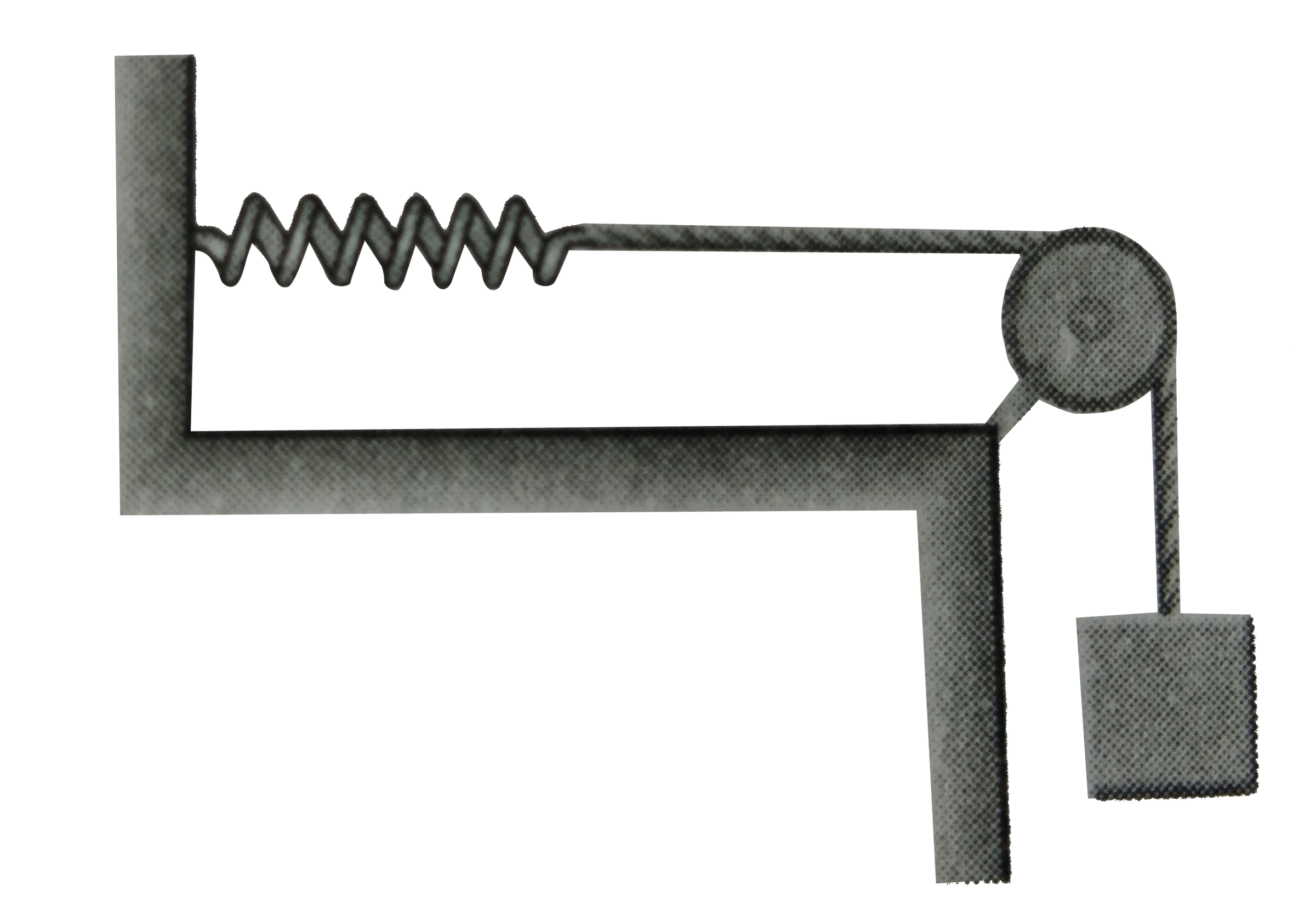
A cord is attached between a 0.50 kg block and a string with force constant `k=20 N//m`.The other end of the spring is attrached to the wall and the cord is placed over a pulley `(I=0.60 MR^2)` of mass 5.0 kg and radius 0.50 m.(See the accompanying figure.) Assuming no slipping occurs what is the frequency of the oscillations when the body is set into motion ?

Text Solution

Verified by Experts

The correct Answer is:

C

In equilibrium
`kx_(0) = mg`
`:. x_(0) = (mg)/(k) = (0.5 xx 10)/(20)`
`= 0.25m`
When displaced downwards by `x` from the mean position, total mechanical energy,
`E = - mgx + (1)/(2)mv^(2) + (1)/(2)Iomega^(2) + (1)/(2)(x + x_(0))^(2)`
Substituting `I = 0.6 MR^(2)` and `omega = (v)/(R)`
We have,
`E = - mgx + (1)/(2)mv^(2) + (1)/(2) (0.6MR^(2)) ((v)/(R))^(2) + (1)/(2)k (x + x_(0))^(2)`
Since E = constant
`:. (dE)/(dt) = 0`
or `0 = - mg ((dx)/(dt)) + (1)/(2)m (2v.(dv)/(dt)) + (0.6M) + (v)(dv)/(dt) + (1)/(2)k[2(x + x_(0))] (dx)/(dt)`
putting `(dx)/(dt) = v, kx_(0) = mg` and `(dv)/(dt) = a`
We have
`0 = (ma + 0.6 Ma) + kx`
or `a = - ((k)/(m + 0.6M))x`
Since, `a prop - x` motion is SHM.
`f = (1)/(2pi) sqrt|(a)/(x)|`
`= (1)/(2pi)sqrt((k)/(m + 0.6M))`
` = (1)/(2pi) sqrt((20)/(0.5 xx 0.6 xx 5))`
` = 0.38 Hz` .
Promotional Banner

Topper's Solved these Questions

  • SIMPLE HARMONIC MOTION

    DC PANDEY|Exercise Level 2 Single Correct|28 Videos
  • SIMPLE HARMONIC MOTION

    DC PANDEY|Exercise Level 2 More Than One Correct|8 Videos
  • SIMPLE HARMONIC MOTION

    DC PANDEY|Exercise Level 1 Single Correct|24 Videos
  • SEMICONDUCTORS AND ELECTRONIC DEVICES

    DC PANDEY|Exercise More than One Option is Correct|3 Videos
  • SOLVD PAPERS 2017 NEET, AIIMS & JIPMER

    DC PANDEY|Exercise Solved paper 2018(JIPMER)|38 Videos

Similar Questions

Explore conceptually related problems

In Fig. 15.29 two springs are joined and connected to a block of mass 0.490kg that is set oscillating over a frictionless floor. The springs each have spring constant k= 5000N/m. What is the frequency of the oscillations?

A block of mass 1 kg is attached to one end of a spring of force constant k = 20 N/m. The other end of the spring is attached to a fixed rigid support. This spring block system is made to oscillate on a rough horizontal surface (mu = 0.04) . The initial displacement of the block from the equilibrium position is a = 30 cm. How many times the block passes from the mean position before coming to rest ? (g = 10 m//s^(2))

If a body of mass 0.98 kg is made to oscillate on a spring of force constant 4.84 N/m the angular frequency of the body is

A mass of 2kg oscillates on a spring with force constant 50 N//m . By what factor does the frequency of oscillation decrease when a damping force with constant b = 12 is introduced ?

A block of mass m is attached to a massless spring of force constant k, the other end of which is fixed from the wall of a truck as shown in figure. The block is placed over a smooth surface and initially the spring is unstretched. Suddenly the truck starts moving towards right with a constant accleration a_(0). As seen from the truck

A long rubber tube having mass 0.9 kg is fastened to a fixed support and the free end of the tube is attached to a cord which passes over a pulley and supports an object, with a mass of 5 kg as shown in figure. If the tube is struck by a transverse blow at one end, find the time required for the pulse to reach the other end.

A 0.500 kg block is attached to a spring with length 0.60m and force constant k=40.0 N//m . The mass of the spring is negligible. You pull the block to the right along the surgace with a constant horizontal force F=20.0 N . (a) What is the block's speed when the block reaches point B,which is 0.25 m to the right of right of point A? (b) What the block reaches point B, you let go off the block. In the subsequent motion, how close dies the block get to the wall where the lift end of the spring is attached? Neglect size of block and friction. .

DC PANDEY-SIMPLE HARMONIC MOTION-Level 1 Subjective
  1. A body makes angular simple harmonic motion of amplitude pi//10rad and...

    Text Solution

    |

  2. A particle executes simple harmonic motion of period 16 s. Two seconds...

    Text Solution

    |

  3. A simple pendulum consists of a small sphere of mass m suspended by a ...

    Text Solution

    |

  4. Find the period of oscillation of a pendulum of length l if its point ...

    Text Solution

    |

  5. A block with mass M attached to a horizontal spring with force constan...

    Text Solution

    |

  6. A bullet of mass m strikes a block of mass M. The bullet remains embed...

    Text Solution

    |

  7. An annular ring of internal and outer radii r and R respectively oscil...

    Text Solution

    |

  8. A body of mass 200 g oscillates about a horizontal axis at a distance ...

    Text Solution

    |

  9. Show that the period of oscillation of simple pendulum at depth h belo...

    Text Solution

    |

  10. The period of a particle in SHM is 8 s. At t = 0 it is in its equilibr...

    Text Solution

    |

  11. (a) The motion of the particle in simple harmonic motion is given by...

    Text Solution

    |

  12. Show that the combined spring energy and gravitational energy for a ma...

    Text Solution

    |

  13. The masses in figure slide on a frictionless table. m(1) but not m(2),...

    Text Solution

    |

  14. The spring shown in figure is unstretched when a man starts pulling on...

    Text Solution

    |

  15. In figure, k = 100 N//m, M = 1kg and F = 10 N (a) Find the compre...

    Text Solution

    |

  16. Pendulum A is a physical pendulum made from a thin, rigid and uniform ...

    Text Solution

    |

  17. A solid cylinder of mass m is attached to a horizontal spring with for...

    Text Solution

    |

  18. A cord is attached between a 0.50 kg block and a string with force con...

    Text Solution

    |

  19. Two linear SHM of equal amplitudes A and frequencies omega and 2omega ...

    Text Solution

    |

  20. A particle is subjected to two simple harmonic motions given by x(1)...

    Text Solution

    |
