Home
Class 11
CHEMISTRY
(a) NaBr on reaction with conc H(2)SO(4)...

(a) `NaBr` on reaction with conc `H_(2)SO_(4)` gives `SO_(2),HBr`, and `Br_(2)`, whereas `NaCl` with conc `H_(2)SO_(4)` gives `HCl` but no `Cl_(2)` or `SO_(2)` is produced. Explain ?
(b) Which of the following reactions occur ?
(i) `Br_2+2NaCltoCl_2+NaBr`
(ii) `Cl_2+NaBrtoBr_2+2NaCl`

Text Solution

Verified by Experts
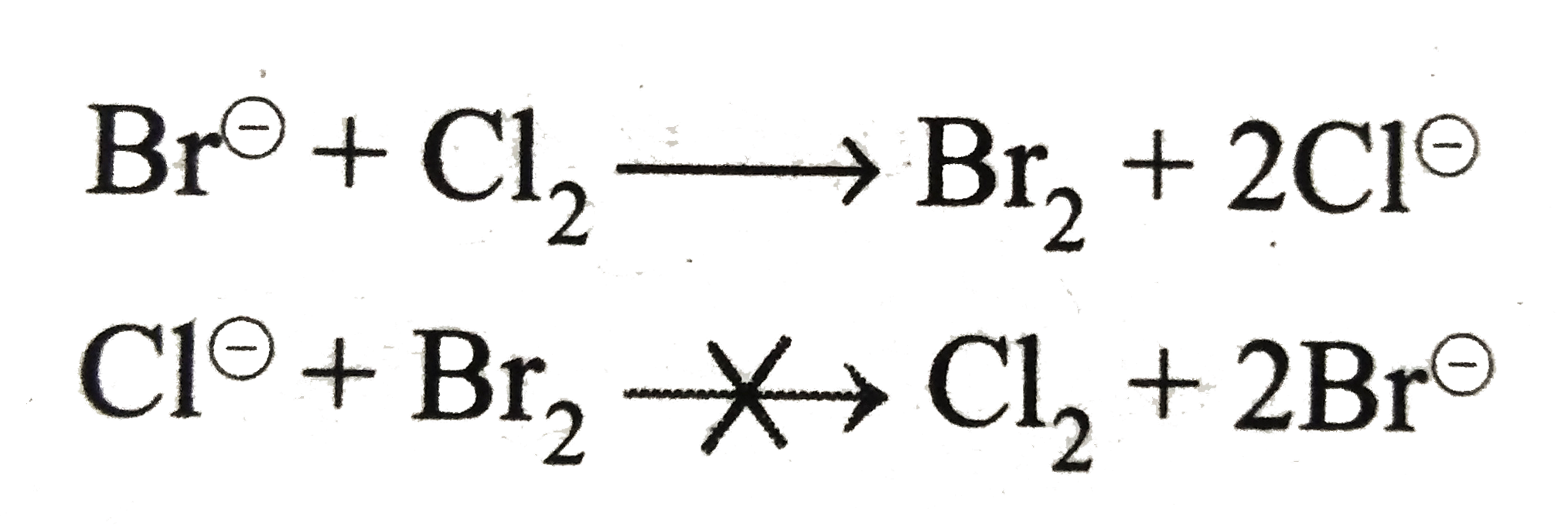
(a) Since the reduction potential of `F_(2) gt Cl_(2) gt Br_(2) gt I_(2),F_(2)` can oxidise `Cl^(ɵ),Br^(ɵ)`, and `I^(ɵ)` but not vice versa. Similarly, `Cl_(2)` can oxidise `I^(ɵ)` only `I^(ɵ)` but not vice vera. `Br^(ɵ)` is more easily oxidised than `Cl^(ɵ)`. So `NaBr(Br^(ɵ))` on reaction with conc `H_(2)SO_(4)`, undergoes oxidation to `Br_(2)` whereas `h_(2)SO_(4)(SO_(4)^(2-))` is reduced to `SO_(2)` So the reaction of `NaBr` with conc `H_(2)SO_(4)` is as follows :
`Br^(ɵ) + H_(2)SO_(4) ("conc") rarr NBr + HSO_(4)^(ɵ)`
`2Br^(ɵ) + 3H_(2) SO_(4) ("conc") rarr Br_(2)+SO_(2) + 2H_(2) O + 2HSO_(4)^(ɵ)`
Reaction of `NaCl` with conc `H_(2)SO_(4)` ltbr. `Cl^(ɵ) +H_(2)SO_(4)("conc") rarr HCl + HSO_(4)^(ɵ)`
(b) From the above equation it is clear that `Br^(ɵ)` is more easily oxidised than `Cl^(ɵ)`
Hence, `Cl_2` will oxidise `Br^(ɵ)` but not vice versa. So reaction (ii) is feasible.
`Br^(ɵ)+Cl_2toBr_2+2Cl^(ɵ)`
Promotional Banner

Topper's Solved these Questions

  • STOICHIOMETRY

    CENGAGE CHEMISTRY|Exercise Ex 3.1|3 Videos
  • STOICHIOMETRY

    CENGAGE CHEMISTRY|Exercise Ex 3.2|3 Videos
  • STATES OF MATTER

    CENGAGE CHEMISTRY|Exercise Exercises (Ture False)|25 Videos
  • THERMODYNAMICS

    CENGAGE CHEMISTRY|Exercise Archives (Subjective)|23 Videos

Similar Questions

Explore conceptually related problems

Anisole with conc. H_(2)SO_(4) gives.

Conc. H_(2)SO_(4) is not

HCOOH reacts with conc. H_(2)SO_(4) to give :

Acetone on heating with conc. H_(2)SO_(4) gives :

KMnO_(4) is heated with conc. H_(2)SO_(4) gives

Oxalic acid on treatment with conc. H_(2) SO_(4) gives

CENGAGE CHEMISTRY-STOICHIOMETRY-Archives Subjective
  1. (a) NaBr on reaction with conc H(2)SO(4) gives SO(2),HBr, and Br(2), w...

    Text Solution

    |

  2. In the analysis of 0.1 of sample of feldspar, 0.118 g of mixture of Na...

    Text Solution

    |

  3. Five millilitires of a gas (A) containing only C and H was mixed with ...

    Text Solution

    |

  4. (a). Take 1 L of a mixture of CO and CO(2) Pass this mixture through a...

    Text Solution

    |

  5. Find out the equivalent weight of H(3) PO(4)in the reaction: Ca(OH)(...

    Text Solution

    |

  6. Hydroxylamine reduces Fe^(3+) accoeding to the following reaction: 2...

    Text Solution

    |

  7. An organic compound (C(x)H(2y)O(y)) was burnt with twice the amount of...

    Text Solution

    |

  8. 4.08 g of a mixture of BaO and an unknown carbonate MCO(3) was heated ...

    Text Solution

    |

  9. When 16.8 g of a white solid X was heated 4.4 g of an acid gas A which...

    Text Solution

    |

  10. 2.68xx10^(-3) moles of solution containing anion A^(n+) require 1.61xx...

    Text Solution

    |

  11. 5 mL of 8 N HNO(3), 4.8 mL of 5N HCl and a certain volume of 17 M H(2)...

    Text Solution

    |

  12. What is the weight of sodium bromate and molarity of solution to prepa...

    Text Solution

    |

  13. A sample of hydrazine sulphate (N(2)H(6)SO(4)) was dissolved in 100 mL...

    Text Solution

    |

  14. An equal volume of reducing agent is titrated separately with 1 M KMnO...

    Text Solution

    |

  15. n-butane is produced by the monobromination of ethane followed by Wurt...

    Text Solution

    |

  16. A mixture of H(2)C(2)O(4) and NaHC(2)O(4) weighing 2.02 g was dissolve...

    Text Solution

    |

  17. A solid mixture 5 g consists of lead nitrate and sodium nitrate was he...

    Text Solution

    |

  18. A solution of 0.2 g of a compound containing Cu^(2+) and C(2)O(4)^(2-)...

    Text Solution

    |

  19. A 1 g sample of Fe(2)O(3) solid of 55.2% purity is dissolved in acid a...

    Text Solution

    |

  20. A 2.0 g sample of a mixture containing sodium carbonate, sodium bicarb...

    Text Solution

    |

  21. 1 g sample of AgNO(3) is dissolved in 50 mL of water, It is titrated w...

    Text Solution

    |

