Home
Class 11
CHEMISTRY
A mixture of CO and CO(2) when treated w...

A mixture of CO and `CO_(2)` when treated with `I_(2)O_(5)` gives `I_(2)` vapours accoeding to the following equation:
`5CO+I_(2)O_(5)to5CO_(2)+I_(2)`
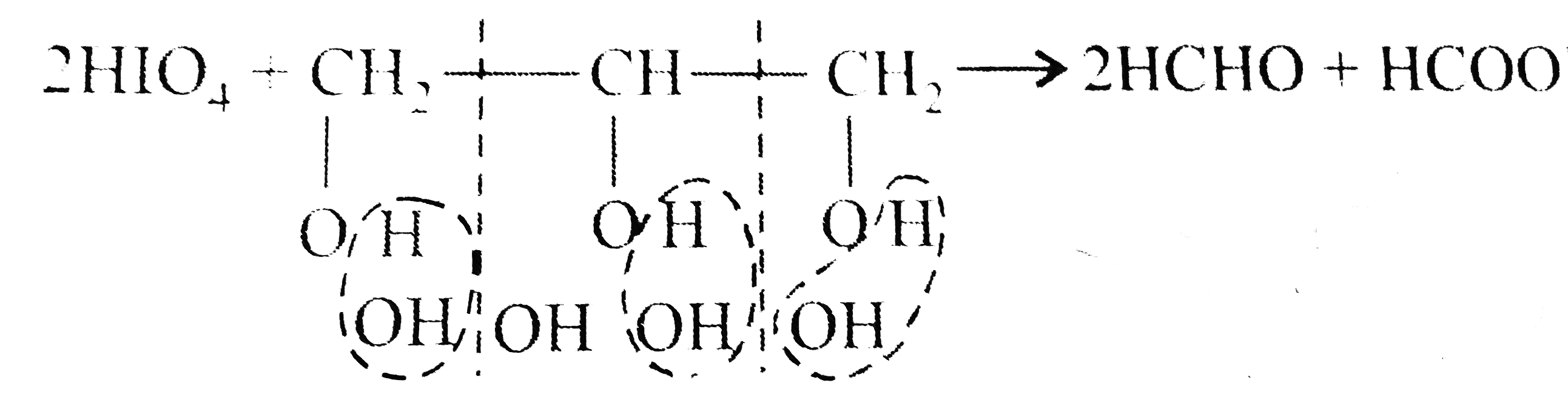
`I_(2)` vapour was separated and treated with `HClO_(4)` and the resultant `HIO_(4)` required 0.001 " mol of "hlycerol for complete oxidation. After treatment with `I_(2)O_(5)` and removal of `I_(2)` ,t he mixture was treated with excess of 0.1 N NaOH solution and finally this solution required 20 " mL of " 1 N HCl to reach end point using phenolphthalein as indicator, followed by methyl orange as indicator after the first end point, 10 " mL of " further HCl was consumed.
Q. The number of moles of CO present initially is

A

0.001

B

0.002

C

0.005

D

0.01

Text Solution

Verified by Experts

The correct Answer is:
C

`5CO+I_(2)O_(5)to5CO_(2)+I_(2)`
`I_(2)+2HClO_(4)to2HIO_(4)+Cl_(2)`
Number of moles of `HIO_(4)` required`=2xx0.001=0.002`
`underset(0.002)(2 " mol of "HIO_(4)=underset(0.001)(1 " mol of "I_(2))=underset(0.001xx5=0.005)(5 " mol of "CO)`
Number of moles of CO present initially`=0.005`
Promotional Banner

Topper's Solved these Questions

  • STOICHIOMETRY

    CENGAGE CHEMISTRY|Exercise Exercises Multiple Correct|30 Videos
  • STOICHIOMETRY

    CENGAGE CHEMISTRY|Exercise Exercises Single Correct|85 Videos
  • STOICHIOMETRY

    CENGAGE CHEMISTRY|Exercise Exercises Subjective|31 Videos
  • STATES OF MATTER

    CENGAGE CHEMISTRY|Exercise Exercises (Ture False)|25 Videos
  • THERMODYNAMICS

    CENGAGE CHEMISTRY|Exercise Archives (Subjective)|23 Videos

Similar Questions

Explore conceptually related problems

A mixture of CO and CO_(2) when treated with I_(2)O_(5) gives I_(2) vapours accoeding to the following equation: 5CO+I_(2)O_(5)to5CO_(2)+I_(2) I_(2) vapour was separated and treated with HClO_(4) and the resultant HIO_(4) required 0.001 " mol of "hlycerol for complete oxidation. After treatment with I_(2)O_(5) and removal of I_(2) ,t he mixture was treated with excess of 0.1 N NaOH solution and finally this solution required 20 " mL of " 1 N HCl to reach end point using phenolphthalein as indicator, followed by methyl orange as indicator after the first end point, 10 " mL of " further HCl was consumed. Q. Total number of millimoles of CO_(2) in the above problem is

A mixture of CO and CO_(2) when treated with I_(2)O_(5) gives I_(2) vapours accoeding to the following equation: 5CO+I_(2)O_(5)to5CO_(2)+I_(2) I_(2) vapour was separated and treated with HClO_(4) and the resultant HIO_(4) required 0.001 " mol of "hlycerol for complete oxidation. After treatment with I_(2)O_(5) and removal of I_(2) ,t he mixture was treated with excess of 0.1 N NaOH solution and finally this solution required 20 " mL of " 1 N HCl to reach end point using phenolphthalein as indicator, followed by methyl orange as indicator after the first end point, 10 " mL of " further HCl was consumed. Q. The total volume of NaOH used in the problem is

XO+I_(2)O_(5)(s) to CO_(2)+I_(2)

What is the molarity of H_(2)O_(2) solution whose 100mL produce the 0.5 moles of I_(2) , when reacted with excess KI solution?

Complete the following equations (i) I_(2)+O_(3)+H_(2)O to HIO_(3)+ ….. , (ii) CaS+H_(2)O + CO_(2) to …. +…..

When solution of KCl, KF and KBr are treated with I_(2) ?

638.0 g of CuSO_(4) solution is titrated with excess of 0.2 M KI solution. The liberated I_(2) required 400 " mL of " 1.0 M Na_(2)S_(2)O_(3) for complete reaction. The percentage purity of CuSO_(4) in the sample is

CENGAGE CHEMISTRY-STOICHIOMETRY-Exercises Linked Comprehension
  1. 20 " mL of " (M)/(60) KBrO3 was reacted with a sample of SeO(3)^(2-) 2...

    Text Solution

    |

  2. 20 " mL of " (M)/(60) KBrO3 was reacted with a sample of SeO(3)^(2-) 2...

    Text Solution

    |

  3. A mixture of CO and CO(2) when treated with I(2)O(5) gives I(2) vapour...

    Text Solution

    |

  4. A mixture of CO and CO(2) when treated with I(2)O(5) gives I(2) vapour...

    Text Solution

    |

  5. A mixture of CO and CO(2) when treated with I(2)O(5) gives I(2) vapour...

    Text Solution

    |

  6. if 20 mL (M)/(10)Ba(MnO(4))(2) compeletely reacts with FeC(2)O(4) in a...

    Text Solution

    |

  7. if 20 mL (M)/(10)Ba(MnO(4))(2) compeletely reacts with FeC(2)O(4) in a...

    Text Solution

    |

  8. if 20 mL (M)/(10)Ba(MnO(4))(2) compeletely reacts with FeC(2)O(4) in a...

    Text Solution

    |

  9. Direct titration of I(2) with a reducing agent is called iodimetry. If...

    Text Solution

    |

  10. 638.0 g of CuSO(4) solution is titrated with excess of 0.2 M KI soluti...

    Text Solution

    |

  11. Direct titration of I(2) with a reducing agent is called iodimetry. If...

    Text Solution

    |

  12. 12 g of impure cyanogen undergoes hydrolysis by two different paths. ...

    Text Solution

    |

  13. 12 g of impure cyanogen undergoes hydrolysis by two different paths. ...

    Text Solution

    |

  14. 12 g of impure cyanogen undergoes hydrolysis by two different paths. ...

    Text Solution

    |

  15. 12 g of impure cyanogen undergoes hydrolysis by two different paths. ...

    Text Solution

    |

  16. In the study of titration of NaOH and Na(2)CO(3). NaOH and NaHCO(3), N...

    Text Solution

    |

  17. In the study of titration of NaOH and Na(2)CO(3). NaOH and NaHCO(3), N...

    Text Solution

    |

  18. H2O2 is reduced rapidly by Sn^(2+). H2O2 is decomposed slowly at room ...

    Text Solution

    |

  19. H2O2 is reduced rapidly by Sn^(2+). H2O2 is decomposed slowly at room ...

    Text Solution

    |

  20. H2O2 is reduced rapidly by Sn^(2+). H2O2 is decomposed slowly at room ...

    Text Solution

    |

