Home
Class 11
PHYSICS
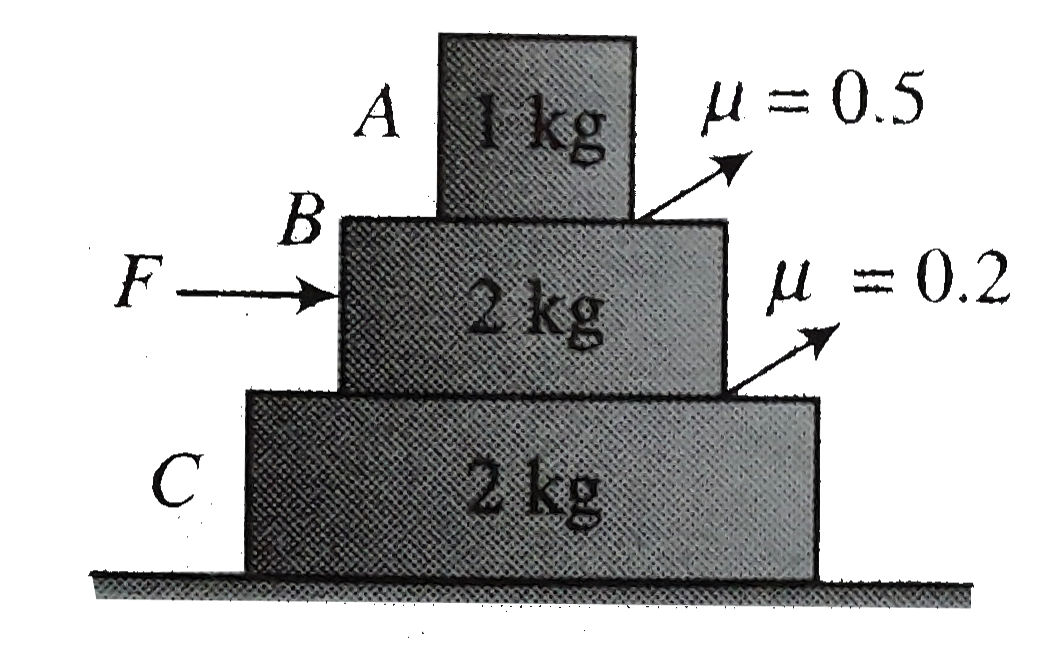
In the sitution shown in figure there i...

In the sitution shown in figure there is no friction between `2 kg` and ground.

a. For what maximum value of force `F` can all three blocks move together?
b. Find the value of force `F` at which sliding starts at other rough surfaces.
c. Find acceleration of all blocks, nature and value of friction force for the following values of force `F` (i) `10N` (ii) `N` and (iii) `25 N`

Text Solution

Verified by Experts
Friction between blocks `A and B`
`f_(l_1) = f_(k_1)= 0.5 xx 1 xx g = 5N`
Friction force between blocks `B` and `C`
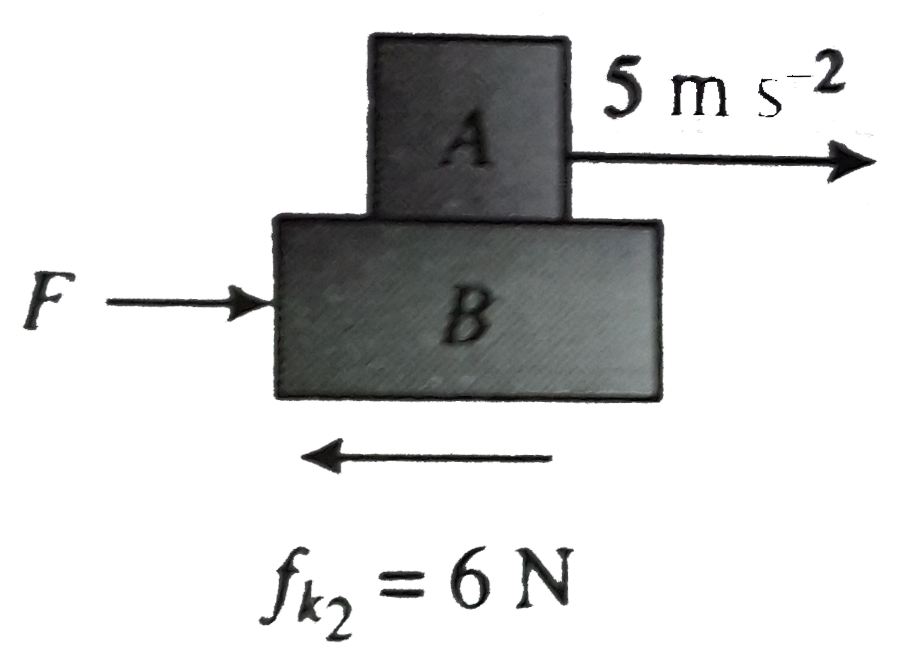
`f_(l_2) = f_(k_2)= 0.2 xx (1 + 2) xx g = 6N`
maximum posible accceleration of blocks `A` can be
`a_(A ,max) = 0.5 g = 5 ms^(-2)`
Maximum posible accceleration of blocks `C`:
`a_(C .max) (f_(l2))/(2)= (6)/(2)= 3 ms^(-2)`
For the entire system to move together, we have to take lesser ecceleration
a. Maximum force `F` that can be applied for the entire system to move togather : `F_("max") = m_("total")a`
`rArr F_("max")= (1 + 2+ 2) xx 3 = 15 N`
b. Sliding will start between blocks `B` and blocks `C` if `F gt 15 N`

For sliding to start between blocks `A` and blocks `B` : This will accur when acceleration of combined blocks` A` and blocks `B` will exceed`5 ms^(-2)`
`F - f_(k_2_) = (m_(A) + m_(B))a`
` F - 6 = ( 1+ 2) xx 5 rArr F = 21 N`
c. i `F = 10N lt 15N` , so entire system will move together with common acceleration

`a = (10)/(1 + 2 + 2) = 2 ms^(-2)`
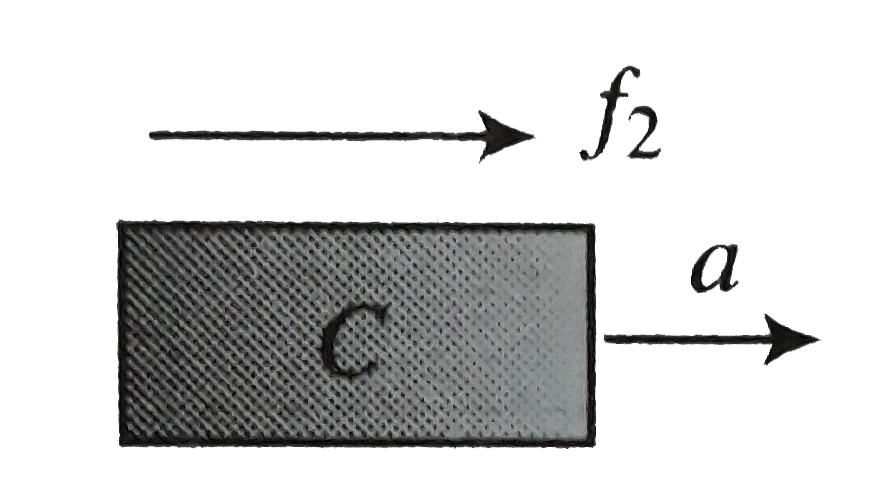
Friction between blocks `B` and blocks `C`
`f_(2) = 2a = 2 xx 2 = 4N`
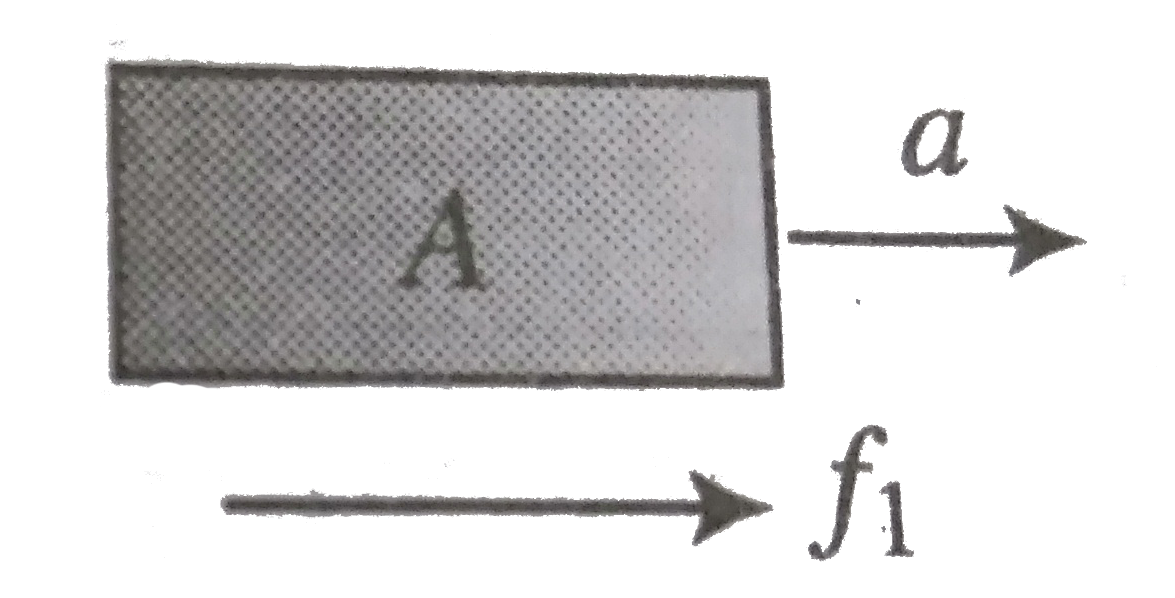
Friction between blocks `A` and blocks `B`
`f_(1) = 1 xx a = 1 xx 2 = 2N`
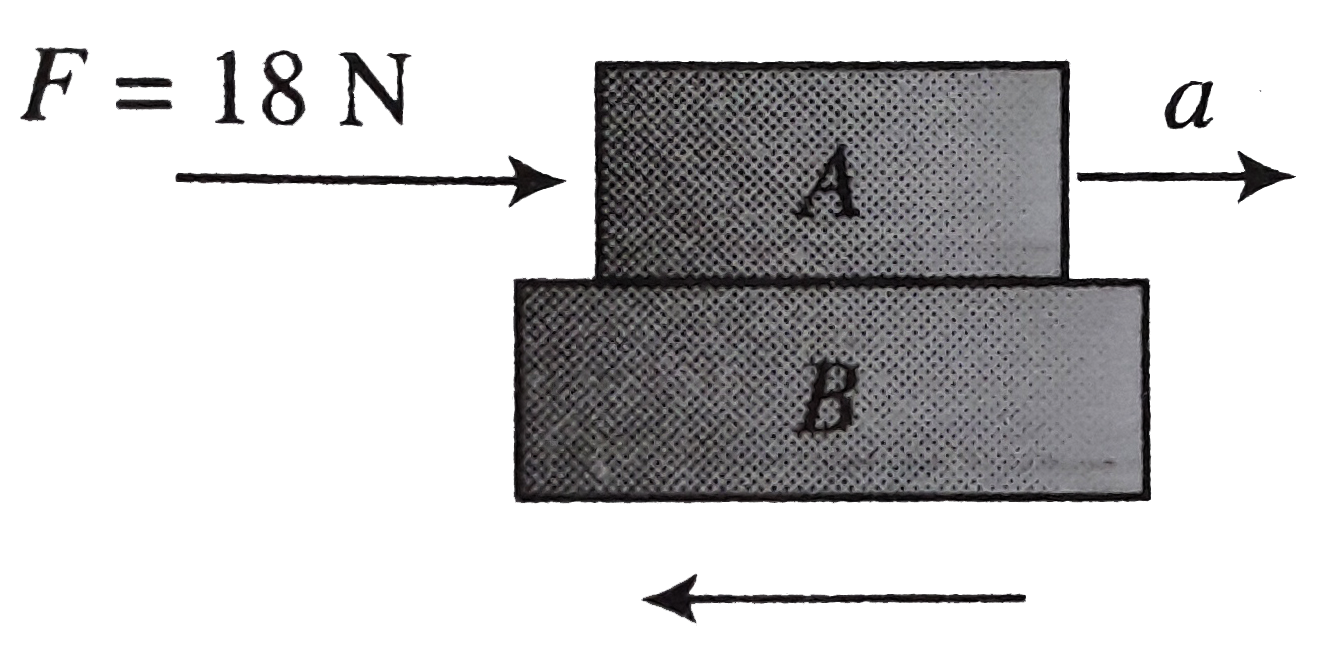
ii . `F = 18 N`, here `15 N lt Flt 21 N`, so sliding start between blocks `B` and blocks `C` and not between blocks `A` and `B`

Acceleration of blocks `C`
`a = - f_(k_2)//m = 6//2 = 3 ms^(-2)`
Acceleration of blocks `A` and `B`
`a = (18 - 6)/(1 + 2) = 4 ms^(-2)` Friction between blocks `C` and ground is
`f_(k_(2)) =6N`
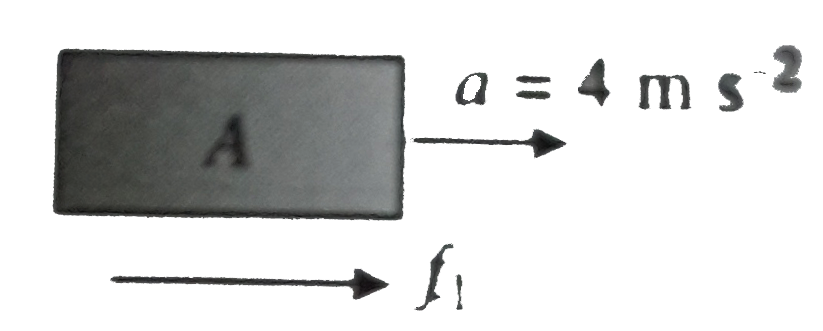
Friction between blocks `A` and `B`:
`f_(1) = 1 xx 4 = 4 N`

iii `F = 25 N gt 21 N`, so sliding occure at all the contact surface friction between blocks `A` and `B` is `f_(k_1) = 5 N`
Friction between blocks `B` and `C` is `f_(k_2) = 6 N`
Accelerations of blocks `A` and `B` are their maximum possible acceleration
Acceleration of block `B` :
`a = (25 - 5 - 6)/(2) = 7ms^(-2)`
Promotional Banner

Topper's Solved these Questions

  • NEWTON'S LAWS OF MOTION 2

    CENGAGE PHYSICS|Exercise Exercise 7.1|25 Videos
  • NEWTON'S LAWS OF MOTION 2

    CENGAGE PHYSICS|Exercise Exercise 7.2|16 Videos
  • NEWTON'S LAWS OF MOTION 2

    CENGAGE PHYSICS|Exercise Integer type|1 Videos
  • NEWTON'S LAWS OF MOTION 1

    CENGAGE PHYSICS|Exercise Integer|5 Videos
  • PROPERTIES OF SOLIDS AND FLUIDS

    CENGAGE PHYSICS|Exercise INTEGER_TYPE|2 Videos

Similar Questions

Explore conceptually related problems

Find the maximum value of force F such that the block shown in the figure does not move

In the three figure shown, find acceleration of block and force of friction on it in each case.

What is the maximum value of the force F such that the block shown in the figure does not move?

The coefficient of friction between the blocks are mu_(s) = 0.3 and mu_(k) = 0.2 . (a) Find the maximum value of F so that the blocks move together. (b) If force F is twice the value found in (a) , find the acceleration of each block.

Consider the situation shown in the figure . The coefficient of friction between the blocks is mu . Find the minimum and the maximum force F that can be applied so that two blocks move together.

What is the maximum value of the force F such that the block shown in the arrangement, does not move ?

What is the maximum value of the force F such that the block shown in the arrangement, does not move?

In the situation shown in fig a. What minimum force F will make any part or whole system move? b. Find the acceleration of two blocks and value of friction at the two surface if F = 6 N

A block is sliding on a rough horizontal surface. If the contact force on the block is sqrt2 times the frictional force, the coefficient of friction is