Home
Class 11
PHYSICS
Consider three blocks placed one over th...

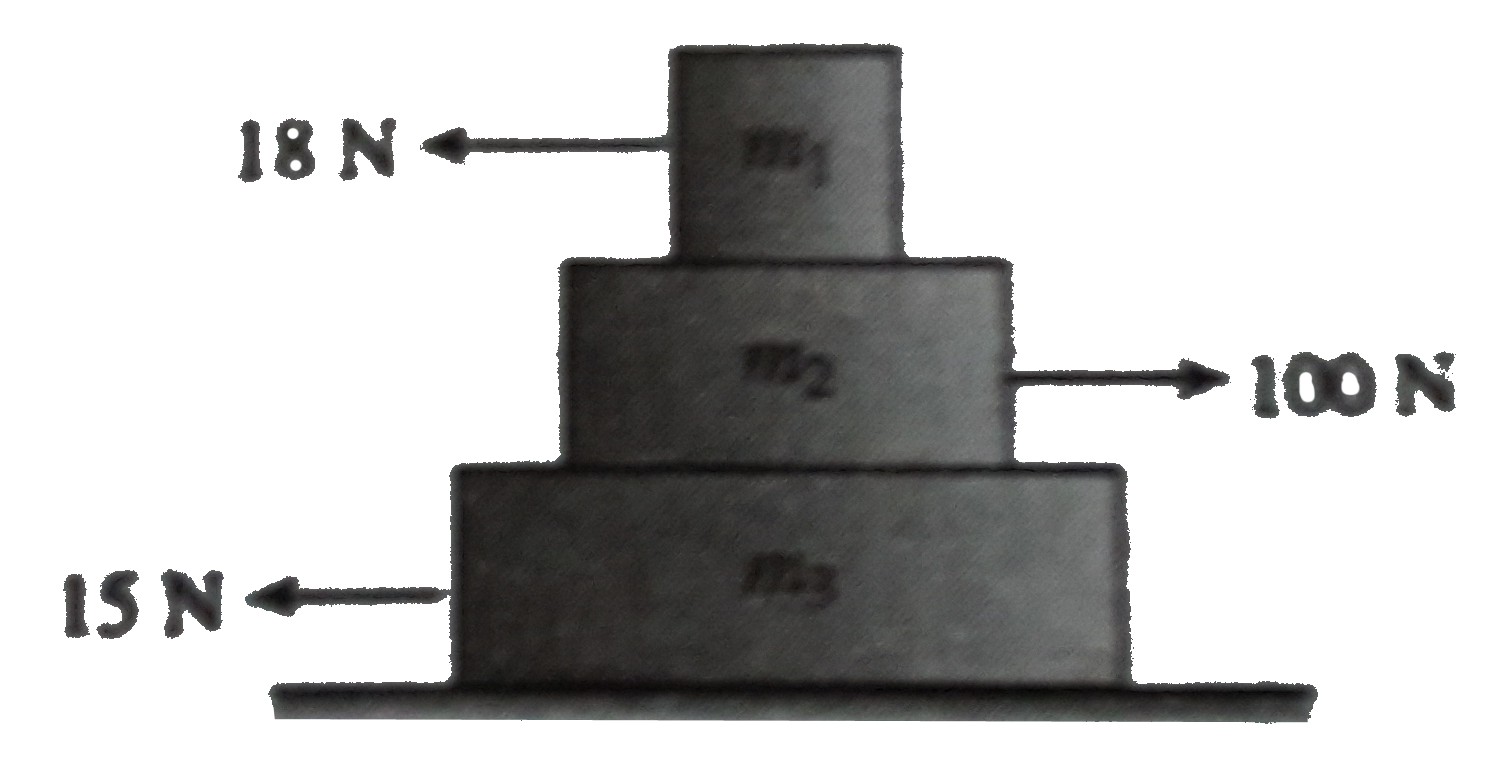
Consider three blocks placed one over the other as shown in Fig. Let as now pull the blocks with the force of magnitudes `18 N, 100 N` and `15 N` Take `m_(1) = m_(2) = m_(3) = 10 kg` If the coefficient of static and kinetic friction between all contacting surface are `mu_(g) = 0.2` respectively find the

(a) Acceleration of the block s
(b) Friction at each surface

Text Solution

Verified by Experts
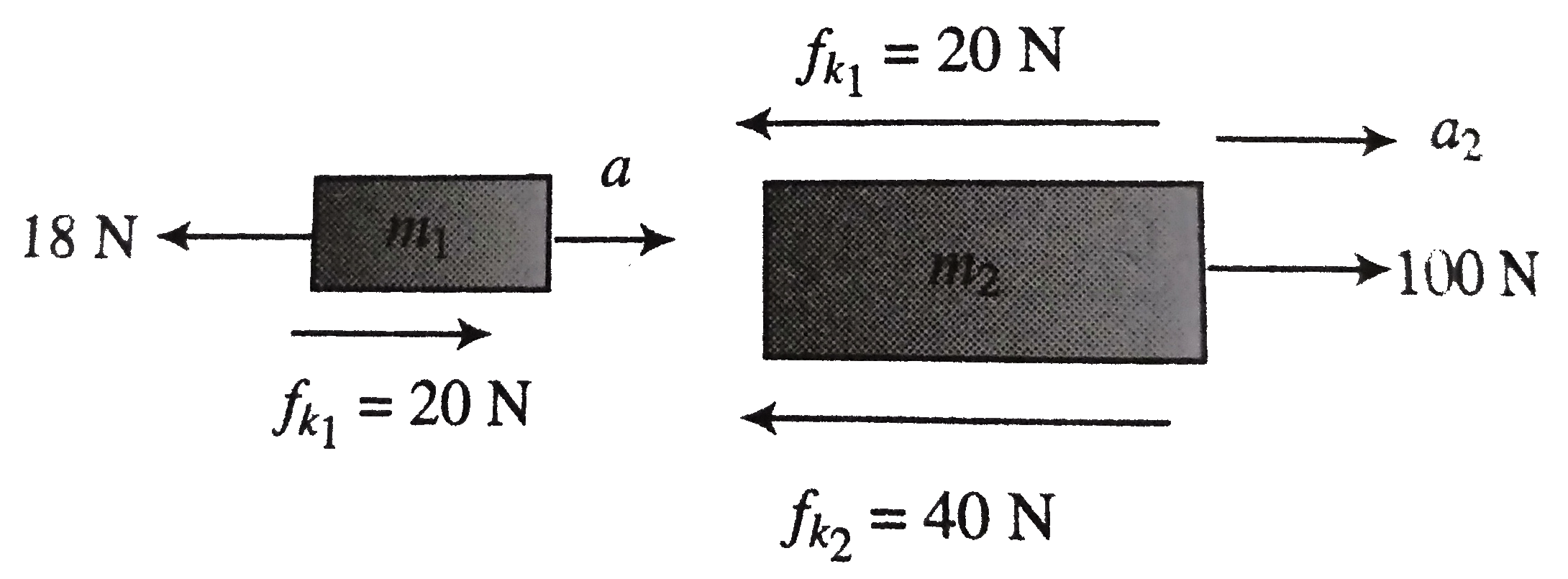
Let us first calculate the limiting and kinetic friction force between various contact surface:
Between `m_(1)` and `m_(2)` :
`f_(t_1) = 0.3 xx 10 g = 30 N`
`f_(k_1) = 0.2 xx 10 g = 20 N`
Between `m_(2)` and `m_(3)` :
`f_(l_2) = 0.3 xx 20 g = 60 N`
`f_(k_2) = 0.2 xx 20 g = 40 N`
Between `m_(3)` ground :
`f_(l_3) = 0.3 xx 30 g = 90 N`
`f_(k_3) = 0.2 xx 30 g = 60 N`
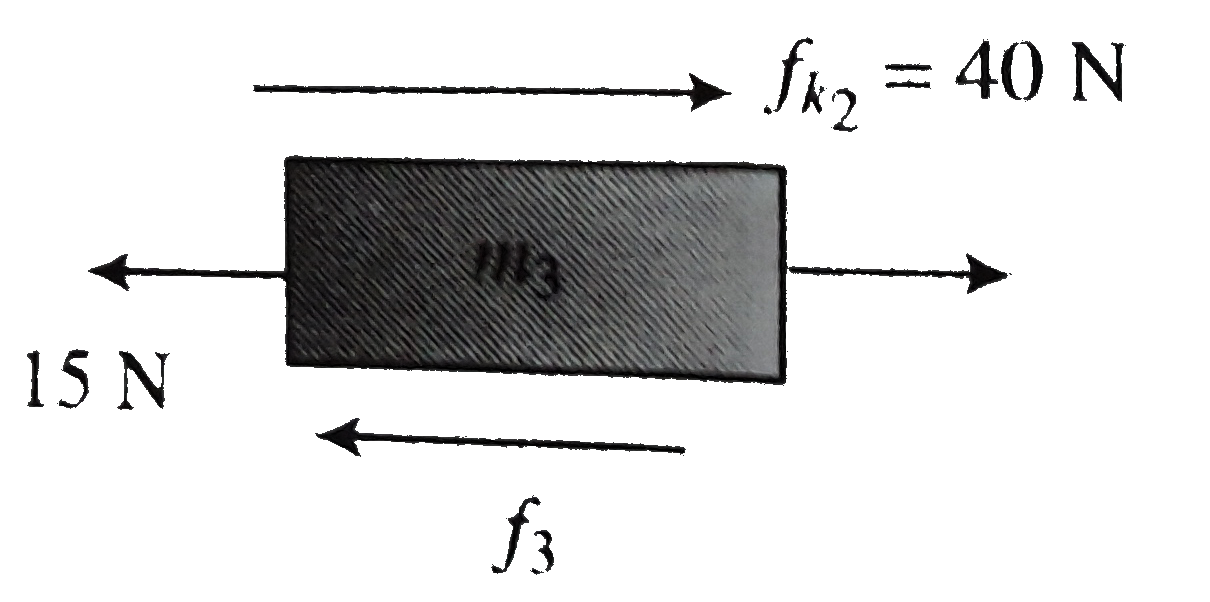
Consider `FBD` of `m_(3)`

Maximum value of `f_(2)` is `f_(t_2) = 60 N` which is less then the maximum value of `15 + f_(3)` which `15 + 90 = 105 N` Hence, `m_(3)` will not acceleration so `a_(3) = 0`
Now assume that `m_(1)` and `m_(2)` move together with common acceleration a

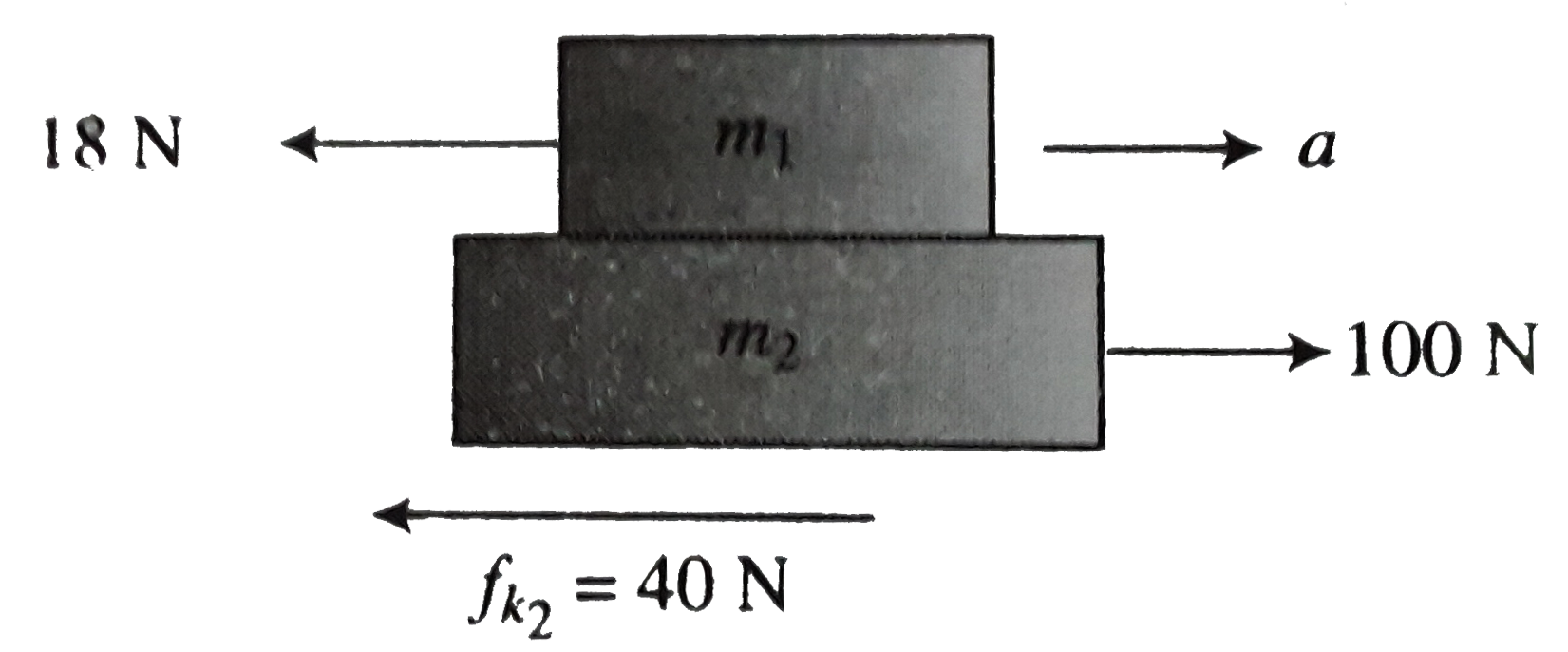
`a= (100 - 18 - 40)/(20) = 2.1ms^(-2)`
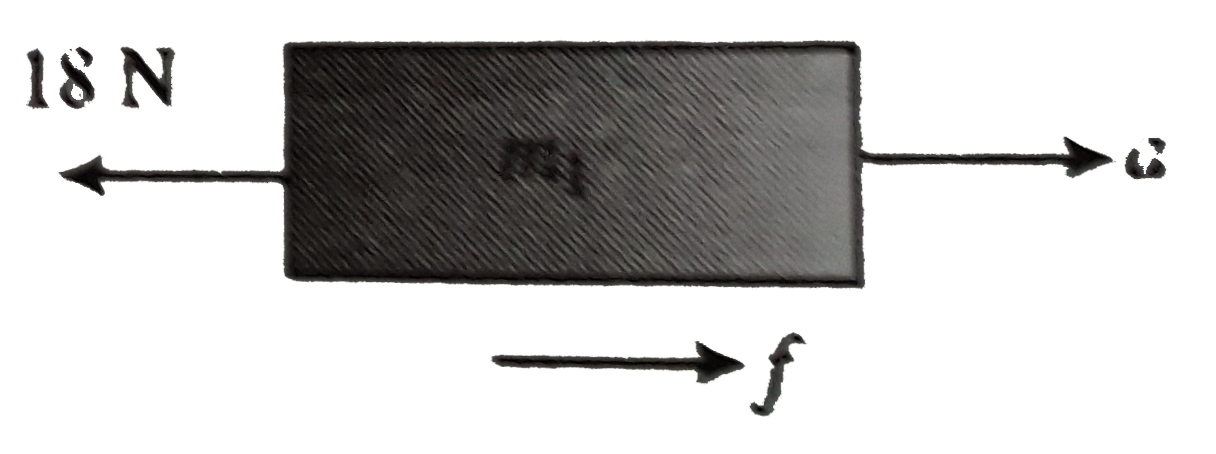
Let us calculate how much friction is required between `m_(1)` and `m_(2)` for common acceleration a for this , consider `FBD` of `m_(1)`

`f_(1) - 18 = 10a rArr f_(1) - 18 = 10 xx 2.1 rArr f_(1) = 39 N`
This is not possible because the maximum value of `f_(l_(1)) =30 N`. Hence, slipping occurs between `m_(1)` and m`_(2)`

`a_(1) = (f_(k_1) - 18)/(10) = (20 - 18)/(10) = 0.2ms^(-2)`
`a_(2) =(100-f_(k_(1))-f_(k_(2)))/(10) (100 - 20 - 40)/(10) = 4 ms^(-2)`
a. So acceleration of `m_(1)` is `a_(1) = 0.2 ms^(-2)`
Acceleration of `m_(2)` is `a_(2) = 4 ms^(-2)`
Acceleration of `m_(3)` is `a_(3) = 0`
Since slipping occure between `m_(1)`and `m_(2)` Friction between `m_(1)`and `m_(2)` is `f_(k_1)= 20 N` Similarly . Slipping accures between `m_(1)`and `m_(2)` and `m_(2)` is `f_(k_2) = 40 N`

To find friction between `m_(3) ` and ground :
`f_(k_2) = 15 + f_(3) rArr 40 = 15 + f_(3) rArr f_(3) = 25 N`
Promotional Banner

Topper's Solved these Questions

  • NEWTON'S LAWS OF MOTION 2

    CENGAGE PHYSICS|Exercise Exercise 7.1|25 Videos
  • NEWTON'S LAWS OF MOTION 2

    CENGAGE PHYSICS|Exercise Exercise 7.2|16 Videos
  • NEWTON'S LAWS OF MOTION 2

    CENGAGE PHYSICS|Exercise Integer type|1 Videos
  • NEWTON'S LAWS OF MOTION 1

    CENGAGE PHYSICS|Exercise Integer|5 Videos
  • PROPERTIES OF SOLIDS AND FLUIDS

    CENGAGE PHYSICS|Exercise INTEGER_TYPE|2 Videos

Similar Questions

Explore conceptually related problems

Block B rests on a smooth surface .The coefficient of static friction between A and B is mu = 0.4 where F = 30 N then Acceleration of lower block is

Block B rests on a smooth surface .The coefficient of static friction between A and B is mu = 0.4 where F = 30 N then Acceleration of upper block is

A force F=2t is spplied at t=0 sec to the block of mass m placed on a rough horizontal surface. The coefficient of static and kinetic friction between the block and surface are mu_S and mu_k rspectively. Which of the following graphs best represents the acceleration vs time of the block (mu_Sgtmu_k) ?

A block of mass m = 2kg is accelerating by a force F = 20N applied on a smooth light pulley as shown in the figure. If the coefficient of kinetic friction between the block and the surface is mu=0.3 , find its acceleration.

Block B rests on surface . If the coefficient of static friction between A and B is mu = 0.4 . Determine the acceleration of each , if (a) F = 30 N and (b) F = 250 N (g = 10 m//s^(2))

A block mass m = 2 kg is accelerating by a force F = 20 N applied on a smooth light pully as shown in fig 7.86 If the coefficient of kinetic friction between the block and the surface is mu = 0.3 find its acceleration

In the figure, m_(1)=m_(2)=10 kg . The coefficients of friction between A, B and B , surface are 0.2 . Find the maximum value of m_(3) so that no block slips ( All the pullies are ideal and strings are massless).

Determine the acceleration of the 5 kg block A . Neglect the mass of the pulley and cords . The block B has a mass of 10 kg , The coefficient of kinetic friction between block B and the surface is mu _(k) = 0.1 (take g = 10 m//s^(2))

A block of mass 1 kg lies on a horizontal surface in a truck. The coefficient of static friction between the block and the surface is 0.6. If the acceleration of the truck is 5m//s^2 , the frictional force acting on the block is…………newtons.

A force F accelerates a block of mass m on horizontal surface. The coefficient of friction between the contact surface is . The acceleration of m will be -