Home
Class 11
PHYSICS
A track consists of two circular pars AB...

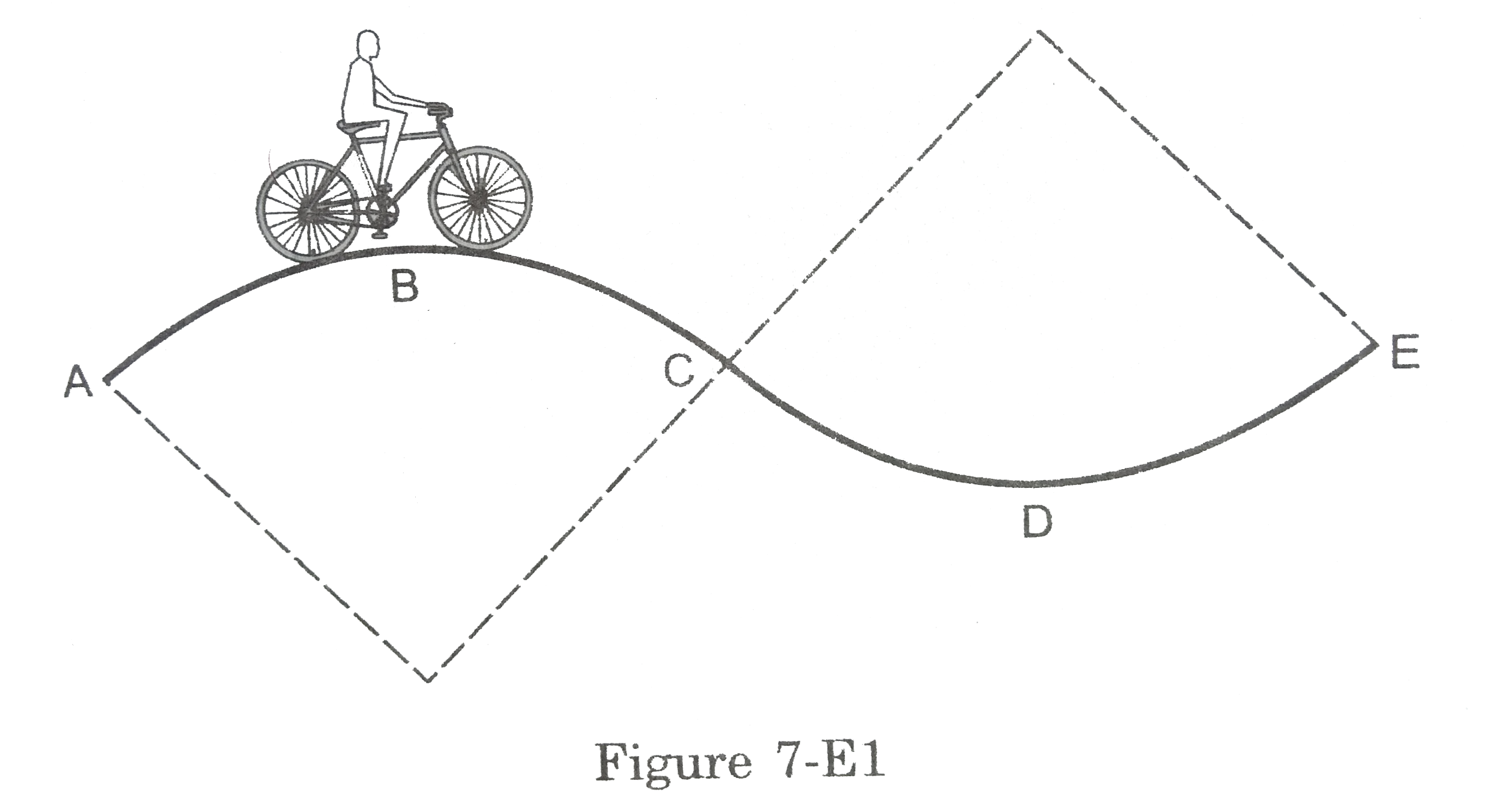
A track consists of two circular pars ABC andCDE of equal rdius 100 m and joined smoothly as shown in figure.Each part sutends a right ngle at its centre. A cycle weighing 100 kg together with rider travels at a constant speed of 18 km/h on the track. A. Findteh nromal contct force by tehroad on the cycle whenit is at B and at D. b.Findteh force of friction exerted by the track on the tyres when the cycle is at B,C and D. c. Find the normal force between teh road and teh cycle just before and just after the cycle crosses C. d. What should be the minimum friction coefficient between the road and the tyre, which will ensure that teh cyclist can move with constant speed? Take `g=10 m/s^2`

Text Solution

Verified by Experts
`v = 18 kmh^(-2) = (1800)/(60 xx 60) = 5ms^(-1)`
a. At point B verious forces acting on the cyclist are
i Weight , `mg` vertically downwards
ii Normal force , `N_(B)` by the road upward
Since under the action of these two forces the cyclist moves in a circular path of radius r from the dynarrics of circular motion .
`(mv^(2))/(r ) = mg - N_(B)`
` rArr N_(B) = m(g - (v^(2))/(r )) = 100 ( 10- (5^(2))/(100)) = 975 N`
At point D various force acting on the cyclist are
i. Weight , `mg` vertically downwards
ii Normal force , `N_(D)` by the road upward
`N_(D) - mg = (mv^(2))/(r )`
` rArr N_(D) = mg (g +(v^(2))/(r )) = 100 (10+ (5^(2))/(100)) = 1025 N`
b. At point B and D. the tracks are almost horizontal therefore , there is no component of g along the track at those point that will changs the speed of the cyclist since the cyclist moves with a constant speed , the friction force the at these two points is neccessarily zero.
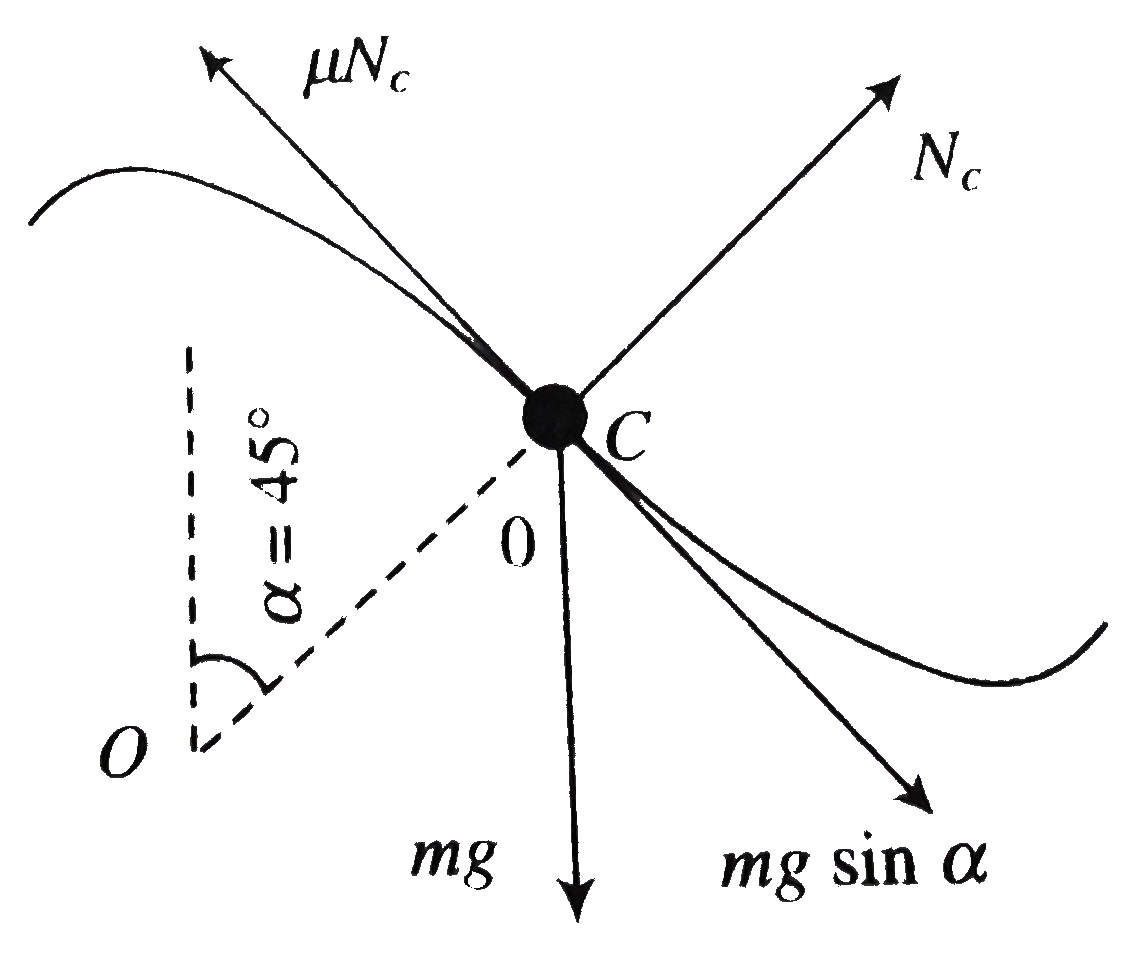
At point C however of `mg` along the track that tends to accelerate the motion of the cyclist ` = mg sin appha`
But since his speed remainn constant , a force equal and opposite to `mg sin alpha` must be acting on it and this force is the force of friction `mu N_(c)` where `mu` is the friction coefficient between the road and the type and `N_(c)` is the normal reaction at point `C`

Hence friction force at C is
`mu N_(c) = mg sin alpha = 100 xx 10 xx sin 45^(@) = 707.12 N`
c. Just before the cyclist crosses point C varius force acting on him are
i. His weight, `mg`, vertically downwards, and
ii. Normal force `N_(b)` of the track
Hence ,from the dynamics of circular motion,we have
`mg cos alpha - N_(b) = (mv^(2))/(r )`
` N_(b) = m( g cos alpha - (v^(2))/(r )) = 682.11 N`
Just after the cyclist crosses the point C varius forces acting on him are
i. Weight, `mg`, vertically downwards, and
ii. Normal force `N_(d)` of the track
Hence ,from the dynamics of circular motion ,
`N_(d) mg cos alpha = (mv^(2))/(r )`
` rArr N_(d) = m( g cos alpha + (v^(2))/(r )) = 7.32.11 N`
d. The tendecy of the cyclist to skid is maximum just before the point C , the point is so because the carve is steepest at this point , Force along the track at this point `= mg sin alpha`
And friction force `= mu N_(b)` where `N_(a)` is the normal force of of the track just before the point C
The cyclist can move with constant speed if the two forces are equal and opposite
`mu N_(b) = mg sin alpha rArr mu = 1.037`
Promotional Banner

Topper's Solved these Questions

  • NEWTON'S LAWS OF MOTION 2

    CENGAGE PHYSICS|Exercise Exercise 7.1|25 Videos
  • NEWTON'S LAWS OF MOTION 2

    CENGAGE PHYSICS|Exercise Exercise 7.2|16 Videos
  • NEWTON'S LAWS OF MOTION 2

    CENGAGE PHYSICS|Exercise Integer type|1 Videos
  • NEWTON'S LAWS OF MOTION 1

    CENGAGE PHYSICS|Exercise Integer|5 Videos
  • PROPERTIES OF SOLIDS AND FLUIDS

    CENGAGE PHYSICS|Exercise INTEGER_TYPE|2 Videos

Similar Questions

Explore conceptually related problems

A track consists of two circular parts ABC and CDE of equal radius R and joined smoothly as shown. Each part subtends an angle 2theta at center. A vehicle of mass m travels with constant force by the road on the vehicle when it is at (i) B (ii) D (iii) just before C and (iv) just after C . (b) find the friction by the track on the vehicle when it is at B , C and D . (c) what should be the minimum friction coefficient between the road and the vehicle, which will ensure that cyclist can move with constant speed.

A cyclist moving on a circular track of radius 100 m completes one revolution in 4 minutes What is his average speed ?

In the figure shown, the force of friction between A and B will be :

A 100 kg car is moving with a maximum velocity of 9 m//s across a circular track of radius 30 m . The maximum force of friction between the road and the car is

A vehicle is moving on a track with constant speed as shown in figure. The apparent weight of the vehicle is

At what should a highway be banked for cars travelling at a speed of 100 km/h if the radius of the road is 400 m and no frictional forces are involved?

The maximum safe speed of a vehicle on a circulartrack is 15km//h . When the track becomes wet, the maximum safe speed is 10 km//h .The ratio of coefficient of friction of dry track to that o0f the wet track is

