Home
Class 11
PHYSICS
Consider the situation shown in Fig. The...

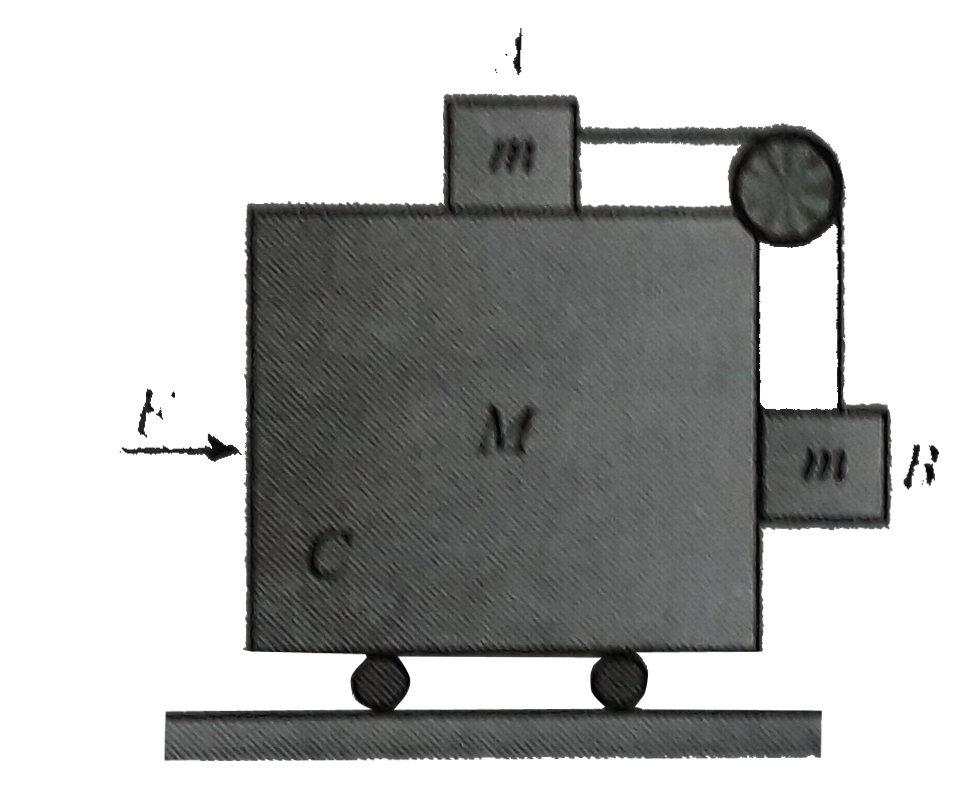
Consider the situation shown in Fig. The hirizontal surface below the bigger block is smooth the coefficient of friction between the block is `mu` find the minimum and the maximum force `F` that can be applied in order to keep the smaller blocks at rest with respoct to the bigger block

Text Solution

Verified by Experts
If no force is applied blocks A will slip on C toward right and block B will move downward Suppose the minimum force needed to prevent slipping is `F` Taking `A + B+ C` as the system is `F` hence , the acceleration of the system is
`a = (F)/(M + 2m)` ...(i)
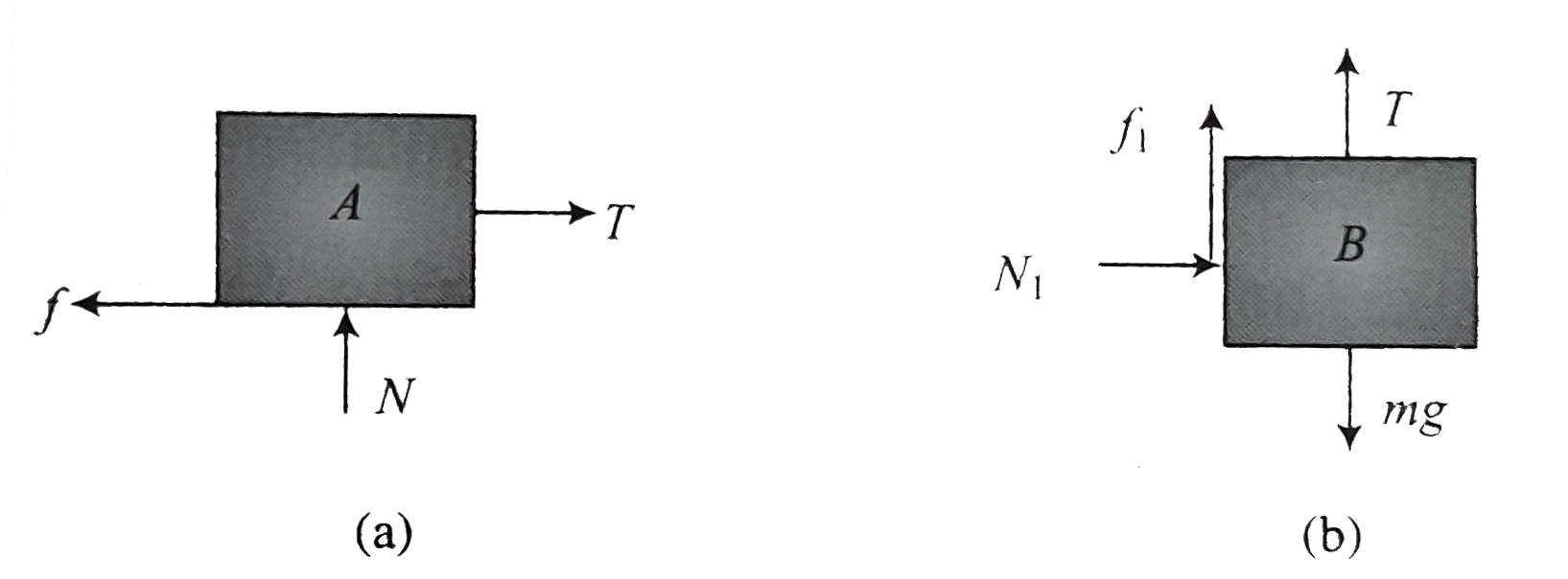
New take the block A as the system . The forces on A are Fig.

a. Tension `T` by the string toward right
b. Friction `f` by the block C towards left
c. Weight `mg` downward and
d. Normal force `N` upward
For vertical equlibrium `N = mg`
As the minimum force needed to prevent all slipping is applied the friction is limiting Thus .
`f = mu N = mu mg`
As the block toward right with an acceleration a
`T - f = ma`
`or T - mu mg = ma ` .....(ii)
Now take block B as the system . The forces are [Fig]
a. Tension `T` upward
b. weight `mg` downward
c. normal force `N` toward right ' , and
d. friction `f` upward.
As the block moves toward right with an acceleration `alpha`
`N = ma`
As the friction is limiting ,`f = mu N '= mu ma`
For vertical equation `T = f = mg`
`T + mu ma = mg`
Eliminating `T` from (ii) and (iii) , we get
`a_("min") = (1 - mu)/(1 + mu) g`.
When a large force is applied block A slip on C toward left and block B slip on C in the upward direction . The friction on A is towards right and that on B is downward solving as above the acceleration in this case is
`a_("max")= (1 +mu)/(1- mu) g`
Thus les between`(1 - mu)/(1+ mu) g` and `(1 + mu)/(1- mu) g`
From (i) , the force `F` should be between `(1 - mu)/(1+ mu) (M + 2m)g` and `(1 + mu)/(1- mu) (M + 2m)g`
Promotional Banner

Topper's Solved these Questions

  • NEWTON'S LAWS OF MOTION 2

    CENGAGE PHYSICS|Exercise Exercise 7.1|25 Videos
  • NEWTON'S LAWS OF MOTION 2

    CENGAGE PHYSICS|Exercise Exercise 7.2|16 Videos
  • NEWTON'S LAWS OF MOTION 2

    CENGAGE PHYSICS|Exercise Integer type|1 Videos
  • NEWTON'S LAWS OF MOTION 1

    CENGAGE PHYSICS|Exercise Integer|5 Videos
  • PROPERTIES OF SOLIDS AND FLUIDS

    CENGAGE PHYSICS|Exercise INTEGER_TYPE|2 Videos

Similar Questions

Explore conceptually related problems

Consider the situation shown in figure. The horizontal surface below the bigger block is smooth. The coefficient of frictioin bewen the blocks is mu . Find the minimum and the maximum force F that can be applied in order to keepthe smaller block at respect to the bigger block.

Consider the situation shwon in Fig. 7.49 . The horizontal surface below the bigger block is smooth . The coefficient of friction between the blocks is mu . Find the minimum and maximum accelerations with which the system should move in order to keep the smaller blocks at rest with respect to the bigger block .

Consider the situation shown in the figure . The coefficient of friction between the blocks is mu . Find the minimum and the maximum force F that can be applied so that two blocks move together.

Find out the range of force for which smaller block is at rest with respect to bigger block.

Consider the situation as shown in the diagram. The coefficient of friction between the block is 0.5 . The acceleration of the lower block is

If coefficient of friction between both the block is mu- (1)/(2) . Find friction force acting between both block.

Consider the situation as shown in the figgure. The coefficent of friction between the blocks is mu . Find the acceleration of each block.

In the adjoining figure, the coefficient of friction between wedge ( of mass M) and block ( of mass m) is mu . Find the minimum horizontal force F rquired to keep the block stationary with respect to wedge

In the adjoining figure, the coefficient of friction between wedge (of mass M ) and block (of mass m ) is mu . Find the minimum horizontal force F required to keep the block stationary with respect to wedge.

Two blocks of Masses M and 2M are connected by a spring of stiffness k .The coefficient of friction between the blocks and the surface is mu Find the minimum constant force F to be applied to 2m in order to slide the mass M .

