Home
Class 11
PHYSICS
Block A as shown in Fig weighs 2.0 N and...

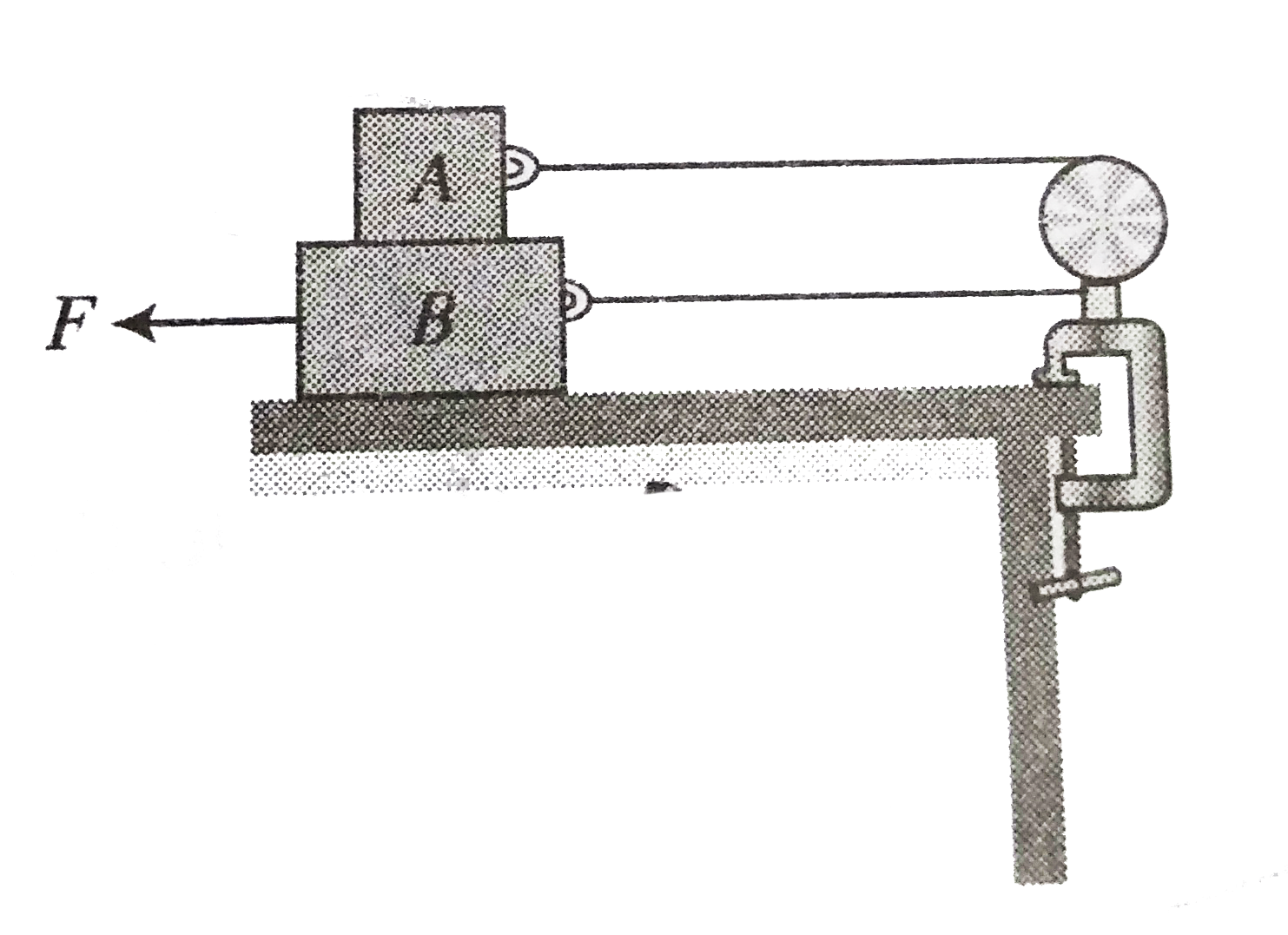
Block A as shown in Fig weighs `2.0 N` and block B weighs `6.0 N` The coefficient of ikinetic friction between all surface is `0.25` Find the magnitude of the horizontal force necessary to drag block B to the left at constant speed if A and B are connected by a light , flxeible cord passing around a fixed, frictionless pulley

A

`2 N`

B

`3N`

C

`5N`

D

`6 N`

Text Solution

Verified by Experts

The correct Answer is:

b

The friction force on block A is `mu_(s)w_(A) = (0.25)(2 N) = 0.5 N` This is the roagnitade of the friction that block A exerts on block B as well as the tension in the string The force F must then have magnitude
`F = mu_(k) (w_(B) + w_(A)) + mu_(k) w_(A) +T `
`= mu_(k) (w_(B) + 3w_(A)) = (0.25)(6N+ 3)(2N))=3 N`
note that the normal force exerted on block B by the table the sum of the weight of the blocks
Promotional Banner

Topper's Solved these Questions

  • NEWTON'S LAWS OF MOTION 2

    CENGAGE PHYSICS|Exercise Multiple Correct|2 Videos
  • NEWTON'S LAWS OF MOTION 2

    CENGAGE PHYSICS|Exercise Linked Comprehension|52 Videos
  • NEWTON'S LAWS OF MOTION 2

    CENGAGE PHYSICS|Exercise Subjective|21 Videos
  • NEWTON'S LAWS OF MOTION 1

    CENGAGE PHYSICS|Exercise Integer|5 Videos
  • PROPERTIES OF SOLIDS AND FLUIDS

    CENGAGE PHYSICS|Exercise INTEGER_TYPE|2 Videos

Similar Questions

Explore conceptually related problems

Block A as shown in figure weight 1.40 N and block B weight 4.20 N The coefficient of kinetic friction between all surface is 0.30 Find the magnitude of the horizontal force necessary to drag block B to the left at constant speed if A and B are connected by a light , fiexible cort passing around a fixed , frictionless pulled.

Block A in figure-2.207 weights 2.7N and block B weighs 5.4 N the coefficient of kinetic friction between all surfaces is 0.25. Find the magnitude of the horizontal force F necessary to drag blocks to the left at constant speed if A and B are connected by a light, flexible cord passing around a fixed frictionless pulley

Block A weights 4 N and block B weights 8 N. The coefficient of kinetic friction is 0.25 for all surfaces. The force F to slide B at a constant speed, when A rests on B and moves with it, is

In the diagram shown, the blocks A, B and C weight, 3kg, 4kg and 5kg respectively. The coefficient of sliding friction between any two surface is 0.25. A is held at rest by a massless rigid rod fixed to the wall while B and C are connected by a light flexible cord passing around a frictionless pulley. Find the force F necessary to drag C along the horizontal surface to the left at constant speed. Assume that the arrangement shown in the diagram, B on C and A on B, is maintained all through. (g=9.8m//s^2)

Block A weighs 4 N and block weigh 8 N The coefficient of kinetic friction is 0.25 for all surface find the force F to slide B at a constant speed when (a) A rest on B and moves with it (b) A is held at rest and (c ) A and B are connected by a light cord passing over a smooth putting as shown in fig 7.31 (a - c) restively.

A block of weight 5 N is pushed against a vertical wall by a force 12 N . The coefficient of friction between the wall and block is 0.6 . Find the magnitude of the force exerted by the wall on the block :

A block of mass 0.1 is held against a wall applying a horizontal force of 5N on block. If the coefficient of friction between the block and the wall is 0.5, the magnitude of the frictional force acting on the block is:

A block of mass 0.1 kg is held against a wall by applying a horizontal force of 5 N on the block. If the coefficient of friction between the block and the wall is 0.5, then the magnitude of the frictional force acting on the block is

The coefficient of friction between the blocks is 0.5 . Find the acceleration of each block if F is (a) 21 N ,(b) 35 N and (c ) 40 N .

CENGAGE PHYSICS-NEWTON'S LAWS OF MOTION 2-Single Correct
  1. If is problem - 57 all situation are same expect force is applied on b...

    Text Solution

    |

  2. A block of mass M is being pulley along horizontal surface .The coeffi...

    Text Solution

    |

  3. Block A as shown in Fig weighs 2.0 N and block B weighs 6.0 N The coef...

    Text Solution

    |

  4. Figure shown a wooden block at rest in equilibrium on a rought horizon...

    Text Solution

    |

  5. A block of mass 2 kg is pushed against a rough vertical wall with a fo...

    Text Solution

    |

  6. A main revolves a stone of mass m tied to the end of a string in a cir...

    Text Solution

    |

  7. A ring of radius r is rotating about a vertical axis along its diamete...

    Text Solution

    |

  8. When the string of a conical pendulum makes an angle of 45^(@) with th...

    Text Solution

    |

  9. Three identical particles are joined together by a thread as shown in ...

    Text Solution

    |

  10. Two identical particles are attached at the end of a light string whic...

    Text Solution

    |

  11. A block of mass m is revolving in a smooth horizontal plane with a con...

    Text Solution

    |

  12. A particle is projected with a speed v(0) = sqrt(gR). The coefficient ...

    Text Solution

    |

  13. A car travels with constant speed on a circular road level ground in f...

    Text Solution

    |

  14. A block of mass m is projected on a smooth horizontal circular track w...

    Text Solution

    |

  15. Two cars A and B start racing at the same on a flat race track which c...

    Text Solution

    |

  16. Consider the setup is of a Ferris wheel in an amusement part. The whee...

    Text Solution

    |

  17. Two blocks of masses m(1) and m(2) are connected through a massless in...

    Text Solution

    |

  18. In Fig if F = 4N , m= 2 kg M = 4 kg then

    Text Solution

    |

  19. A 20 kg blocks is placed on of 50 kg block as shown in figure An horiz...

    Text Solution

    |

  20. Two blocks A and B of masses m(A) and m(B) have velocity v and 2v res...

    Text Solution

    |
