Home
Class 11
PHYSICS
A particle of m(1) moves in a circular p...

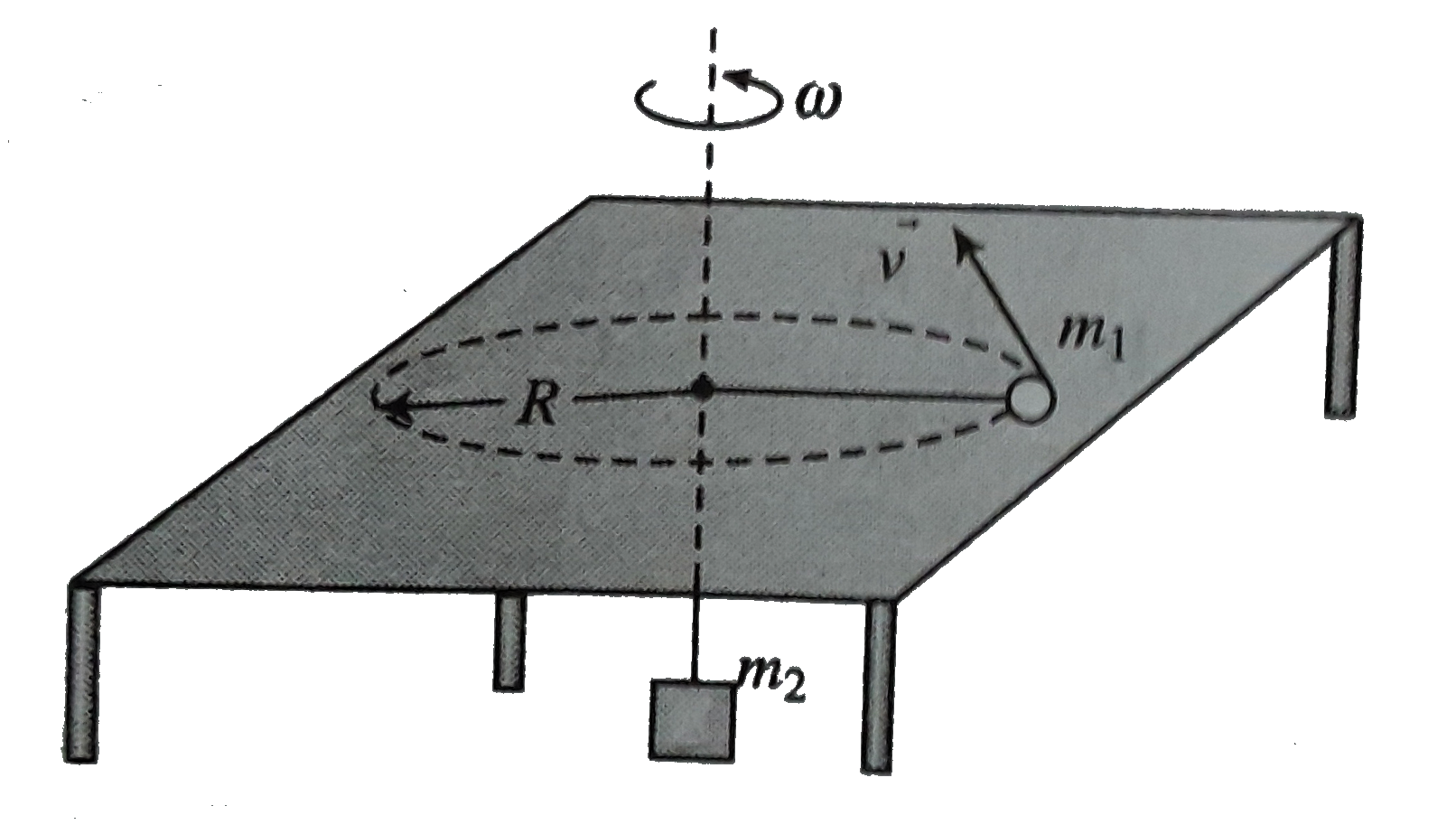
A particle of `m_(1)` moves in a circular path of radius R on a rotating .A string connecting the particles `m_(1)` and `m_(2)` passes over a smooth bole made on the table as shown in figure If mass `m_(1)` does not slide relative to the rotating table , mark the correct option as applicable.

A

The friction force acting on the block `m_(1) is (m_(1) omega^(2)R - m_(2)g)` along radial rotation towards center of rotation

B

The friction force acting on the block `m_(1) is (m_(1) omega^(2)R - m_(2)g)` along tangle direction in the direction oppesite to`vecv`

C

The maximum angular velocity of the particle is `sqrt(((m_(2) + mu m_(1))/(m_(1))) (g)/(R ))`

D

The minimum angular velocity of the particle is `sqrt(((m_(2) + mu m_(1))/(m_(1))) (g)/(R ))`

Text Solution

Verified by Experts

The correct Answer is:
a,c,d

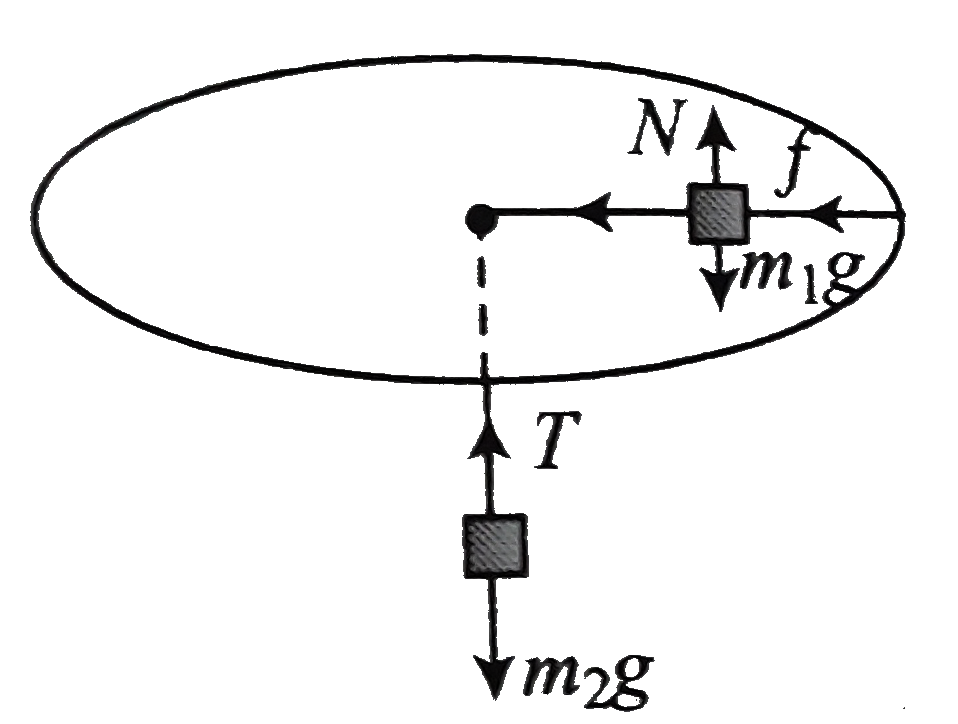
FBD Let the friction radially inward .The force on `m_(1)` are `f larr`(assumed),`T larr N uarr m_(t)g darr` The force on `m_(2)` are `m_(2)g darrand T uarr` as shown in figure
Force equation:
For `m_(1)`:
`sum F_(y) = N -m_(1)g = m_(a)a_(1)y` (i)
`sum F_(r) = f +T = m_(1) a_(r)` (ii)
Fro `m_(2)`:
`sum F_(y) = T -m_(2)g = m_(2)a_(2)y` (iii)
Law of static friction:
`f le mu N`
Kinematics: `a_(1)y = 0`
`a_(r) = (v^(2))/(R)`
`a_(2)y = 0` (vii)
Solving the above equations, we have
`f = (m_(1)v^(2))/(R) - m_(2)g` or `m_(1)omega^(2)R - mg`
Now substituinh the above value of f and `N` in Eq (iv).
we have `((m_(1)v^(2))/(R)-m_(2)g) le mu m_(1)g`
This gives `v_(max) = sqrt(((m_(2)+mum_(1))/(m_(1)))gR)`
Promotional Banner

Topper's Solved these Questions

  • NEWTON'S LAWS OF MOTION 2

    CENGAGE PHYSICS|Exercise Multiple Correct|2 Videos
  • NEWTON'S LAWS OF MOTION 2

    CENGAGE PHYSICS|Exercise Linked Comprehension|52 Videos
  • NEWTON'S LAWS OF MOTION 2

    CENGAGE PHYSICS|Exercise Subjective|21 Videos
  • NEWTON'S LAWS OF MOTION 1

    CENGAGE PHYSICS|Exercise Integer|5 Videos
  • PROPERTIES OF SOLIDS AND FLUIDS

    CENGAGE PHYSICS|Exercise INTEGER_TYPE|2 Videos

Similar Questions

Explore conceptually related problems

A particle moves in a circular path of radius 0.5 m with a linear speed of 2 ms^(-1) ,its angular speed is

A particle of mass m is moving on a circular path of radius r with uniform speed v , rate of change of linear momentum is

A Particle of mass 'M' moves in a uniform circular path of radius 'r' with a constant speed 'v' then its centripetal acceleration is .

A particle of mass m is rotating in a plane in circular path of radius r . Its angular momentum is L . The centripetal force acting on the particle is

If a particle of mass 1 gm is moving along a circular path of radius 1 m with a velocity of 1 m/s, then the its angular momentum is

A particle is moving on a circular path of radius 1 m with 2 m/s. If speed starts increasing at a rate of 2m//s^(2) , then acceleration of particle is

Two blocks of mass m_(1) and m_(2) lie on smooth horizontal table in contact with each other as shown in figure If a force F is applied to the mass m_(1) then the contact force between the block will be

A particle of mass 'm' is moving on a circular path of radius 'r' with uniform speed 'v'. Rate of change of linear momentum is

A particle of mass m moves with constant speed v on a circular path of radius r as shown in figure. The average force on it during its motion from A to B is

CENGAGE PHYSICS-NEWTON'S LAWS OF MOTION 2-Single Correct
  1. A block of mass m is revolving in a smooth horizontal plane with a con...

    Text Solution

    |

  2. A particle is projected with a speed v(0) = sqrt(gR). The coefficient ...

    Text Solution

    |

  3. A car travels with constant speed on a circular road level ground in f...

    Text Solution

    |

  4. A block of mass m is projected on a smooth horizontal circular track w...

    Text Solution

    |

  5. Two cars A and B start racing at the same on a flat race track which c...

    Text Solution

    |

  6. Consider the setup is of a Ferris wheel in an amusement part. The whee...

    Text Solution

    |

  7. Two blocks of masses m(1) and m(2) are connected through a massless in...

    Text Solution

    |

  8. In Fig if F = 4N , m= 2 kg M = 4 kg then

    Text Solution

    |

  9. A 20 kg blocks is placed on of 50 kg block as shown in figure An horiz...

    Text Solution

    |

  10. Two blocks A and B of masses m(A) and m(B) have velocity v and 2v res...

    Text Solution

    |

  11. Two rough blocks A and B ,A placed over B move with acceleration veca(...

    Text Solution

    |

  12. Mark the correct statement (s) regarding friction .

    Text Solution

    |

  13. A 3 kg block of wood is on a level surface where mu(s) = 0.25 and mu(s...

    Text Solution

    |

  14. A block is resting over a rough horizontal floor. At t = 0 a time -ve...

    Text Solution

    |

  15. Two blocks A and B of masses 5 kg and 2 kg respectively connected by a...

    Text Solution

    |

  16. The coefficient of friction between the two two blocks is 0.3 where as...

    Text Solution

    |

  17. A 10 kg block is placed on top of a 40 kg block as shown in figure .A ...

    Text Solution

    |

  18. A car moving along a circular track of radius 50.0m acceleration from ...

    Text Solution

    |

  19. A particle of m(1) moves in a circular path of radius R on a rotating ...

    Text Solution

    |

  20. Block B rests on a smooth surface .The coefficient of static friction ...

    Text Solution

    |

