Home
Class 11
PHYSICS
A block X of mass 0.5 kg is held by a lo...

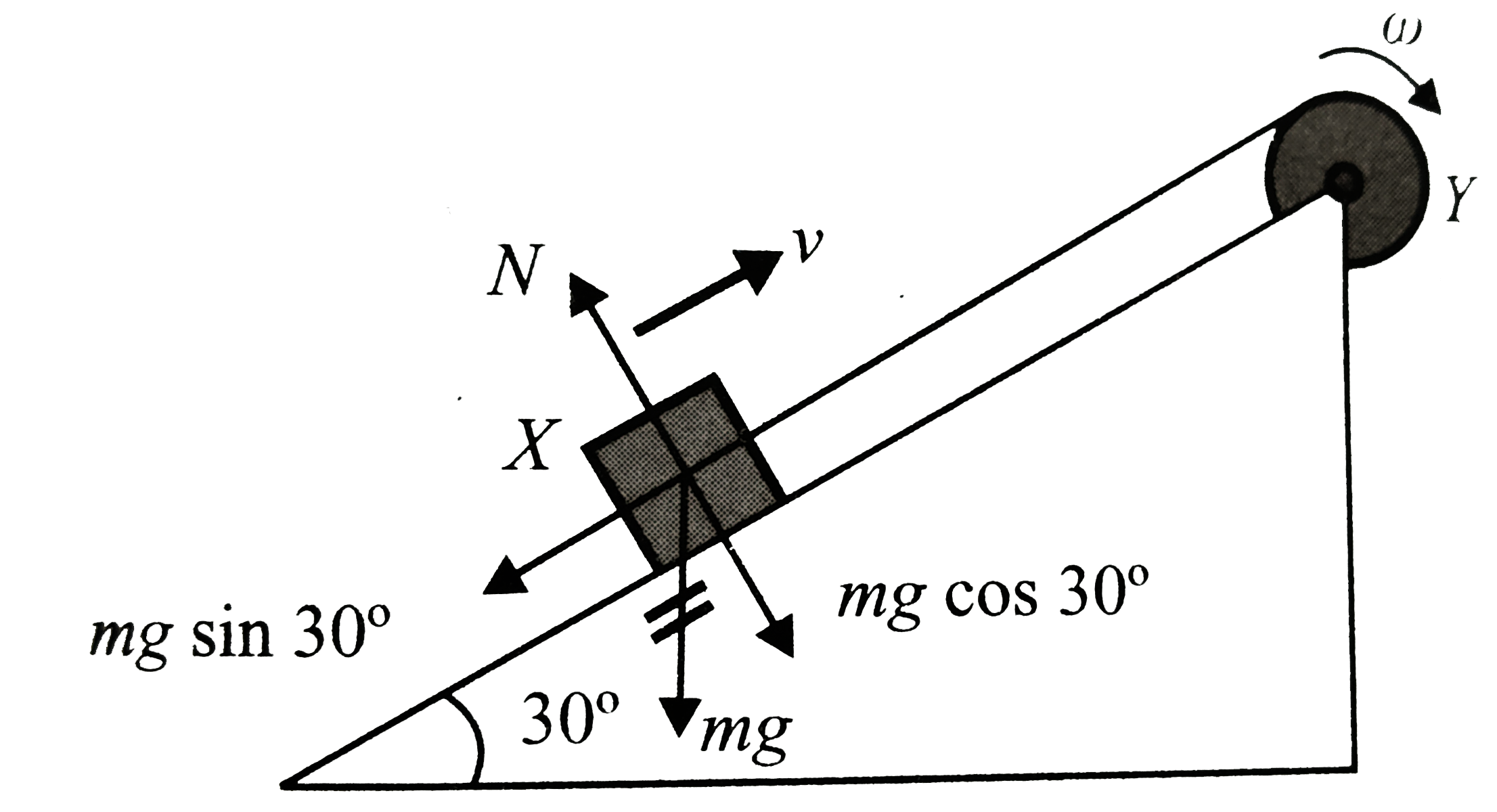
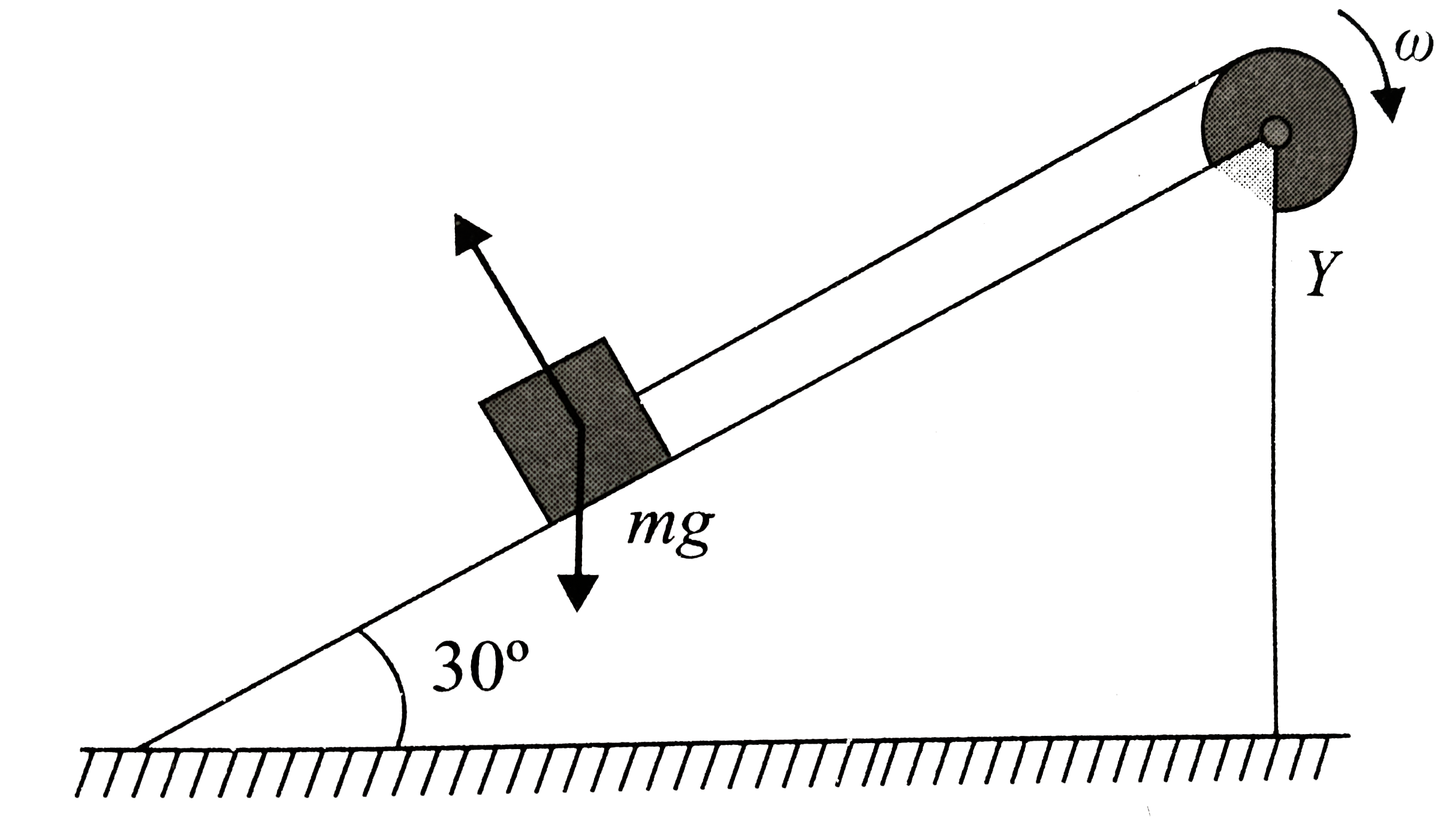
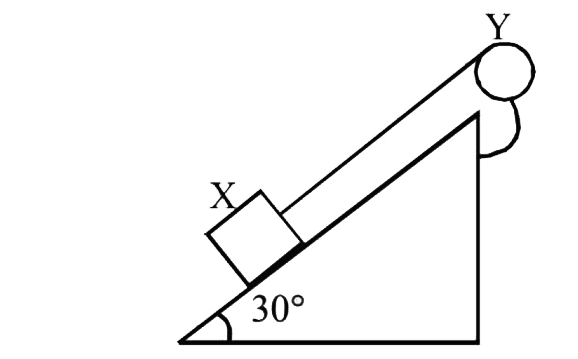
A block X of mass 0.5 kg is held by a long massless string on a frictionless inclined plane of inclination `30^@` to the horizontal. The string is wound on a uniform solid cylindrical drum Y of mass 2kg and of radius 0.2 and of radius 0.2 m as shown in Fingure. The drum is given an initial angular velocity such that the block X starts moving up the plane.
(i) Find the tension in the string during the motion.
(ii) At a certain instant of time the magnitude of the angular velocity of Y s `10 rad s^(-1)` calculate the distance travelled by X from that instant of time until it comes to rest

Text Solution

Verified by Experts
a. i. First Method: "Force/ Torque" Method:
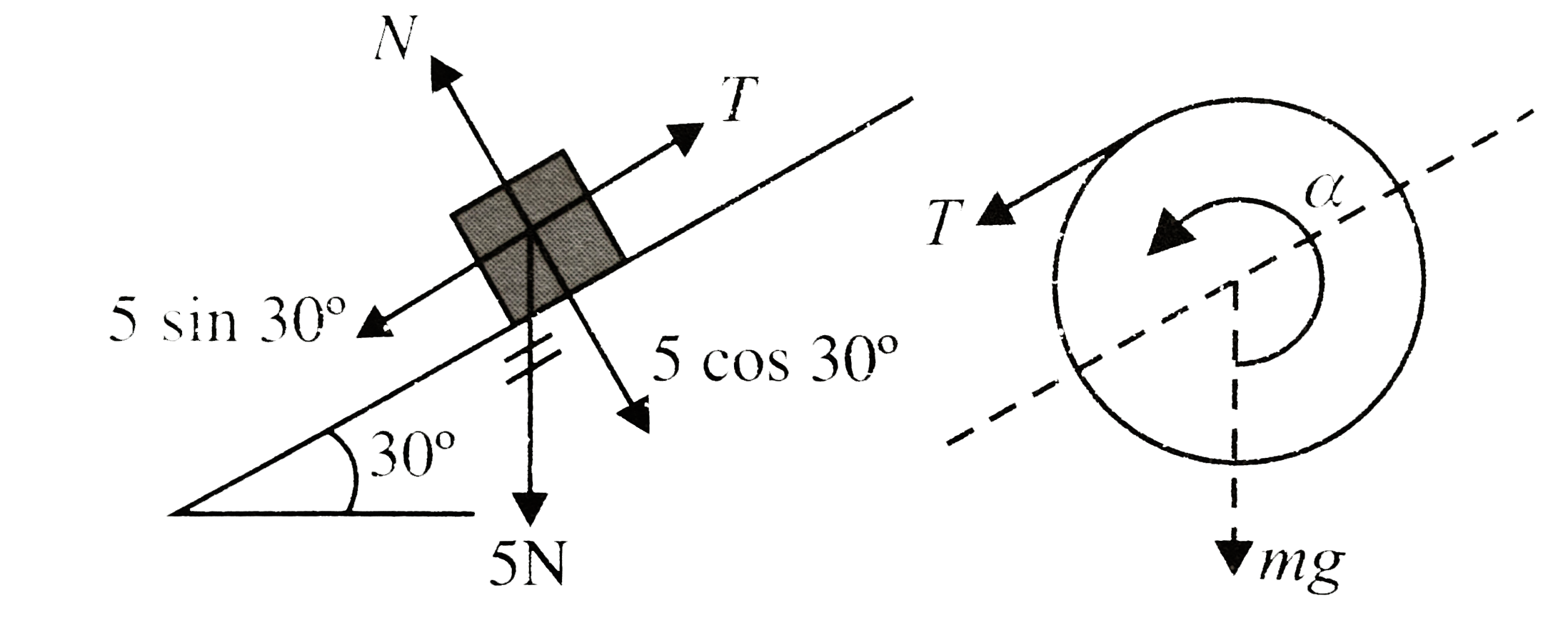
Force equation for the block are as follows:
`N-5cos30^@=0`………..i
`5sin30^@-T=0.5xxa`…………..ii

Torque equatioin for the drum
`TR=(1/2MR^(2))alpha`
`impliesT=1/2MRalpha=1/2xx2xx0.2alphaimplies t=0.2alpha`..........iii
Here `a=Ralpha` (The string does not slip on the drum)
Thus `T=(0.2)(a/R)=0.2(a/0.2)=1xxa` .......i
From eqn ii and iv we get
`a=5/3m/s, T=5/3N`
ii. Second Method: Using the equation `vectau=vec(dL)/dt`
Take both block `X` and drum `Y` as a system.
Torque acting on the system about the centre of mass of the drum `=(mg sin 30^@)R`, anticlockwise . Angular momentum of the system about the centre of mass of the drum,
`L=mvR+1/2MR^(2)omega`
`=m(romega)R+1/2MR^2omega`
`=(mR^(2)+1/2MR^(2))omega`, clockwise

Apply equation `vectau=(vec(dL))/(dt)`
`-mgRsin30@=d/(dt) (mR^(2)omega+1/2MR^(2)omega)`
`=(mR^(2)+1/2MR^(2))(domega)/(dt)`
`implies (domega)/(dt)=(-mgRsin30^@)/((mR^(2)+(MR^(2))/2))`
`implies ((domega)/(dt))_("aniticlockwise")`
`=(mgRsin30^@)/((mR^(2)+(MR^(2))/2))`
(`omega` has been taken in the clockwise sennse `domega/dt` is negative.
So, `domega/dt` is in the anticlockwise sense).
clearly, `tau=IalphaTR=I((domega)/(dt))_("anticlock")`
`=(1/2MR^(2))((mgRsin30^@)/(m+M/2))=5/3N`
b. i. First method:
Angular velocity of `Y=10 rad//s`
Velocity fo block `X=Romega=0.2xx10=2m//s,` along the plane upwards
Acceleration of `X=5/3ms^(2)` along the plane downwards
Using equation `v^(2)=u^(2)-2as,`
`0^(2)=(2)-2xx5/3xxsimpliess=(4xx3)/(2xx5)=1.25m`
ii Second Method:
You can also calculate the distance `X` moves upwards from the energy considerations

`W_(N)+W_(mg)+W_(f)+W_(mg)=K_(2)-K_(1)`
`0-(mgsintheta)s+0+0=(1/2mv^(2)+1/2IOmega^(2))`
`implies (mgsintheta)s=1/2mv^(2)+1/(2Iomega^(2))`
`:. s=(mv^(2)+Iomega^(2))/(2mgsinthetas)`
`= ((0.5)(2)^(2)+2xx2xx(0.2)^(2)xx(10)^(2))/(2x0.5xx10xx1/2)=1.2m`
iii. Third Method: By Mechanical Energy Conservation
Here the only force which does work on the system `mg`, the algebraic work done by other forces is zeros, is conservative in nature, therefore, the mechanical energy of the system will remain constant. Let the distance moved by the block `X` along the plane be `s`.
Gain in gravitational potential energy of `X=mgs sintheta`.
Loss in kinetic energy of the block and the drum is
`1/2mv_(0)^(2)+1/2Iomega_(0)^(2)(v_(0)=omega_(0)r)`
Thus, `mgs sintheta=1/2mv_(0)^(2)+1/2Iomega_(0)^(2)`
`s=(mv_(0)^(2)+Iomega_(0)^(2))/(2mgsitheta)`
After substituting the given values `s=1.02m`
Promotional Banner

Topper's Solved these Questions

  • RIGID BODY DYNAMICS 2

    CENGAGE PHYSICS|Exercise Exercise 3.1|11 Videos
  • RIGID BODY DYNAMICS 2

    CENGAGE PHYSICS|Exercise Exercise 3.2|13 Videos
  • RIGID BODY DYNAMICS 2

    CENGAGE PHYSICS|Exercise Interger|2 Videos
  • RIGID BODY DYNAMICS 1

    CENGAGE PHYSICS|Exercise Integer|11 Videos
  • SOUND WAVES AND DOPPLER EFFECT

    CENGAGE PHYSICS|Exercise Integer|16 Videos