Home
Class 11
PHYSICS
A solid sphere of radius R is set into m...

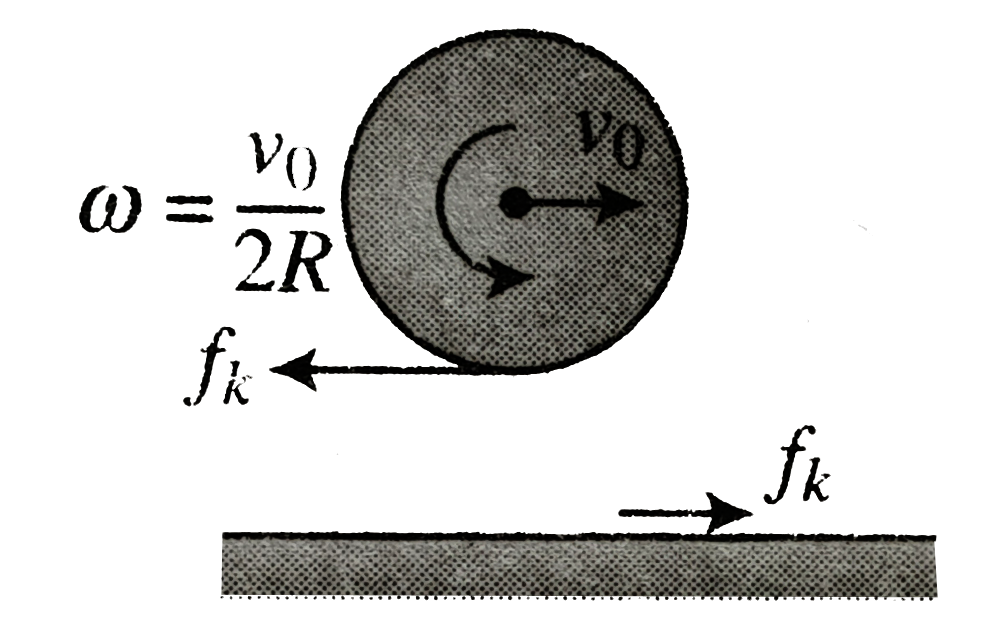
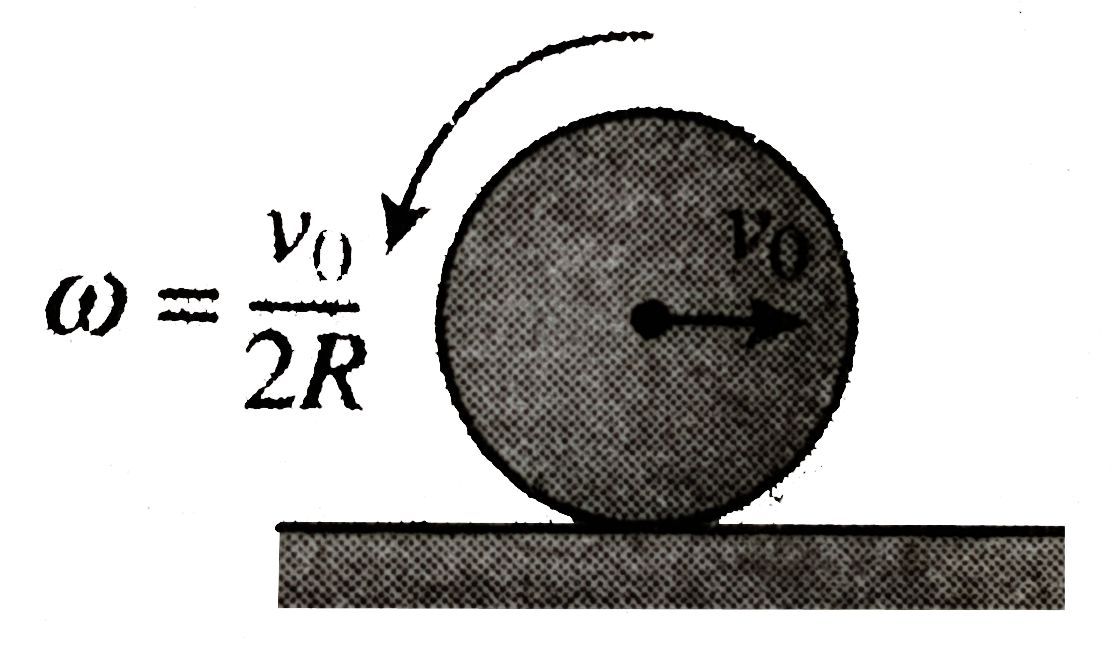
A solid sphere of radius `R` is set into motion on a rough horizontal surface with a linear speed `v_(0)` in forward direction and an angular with a linear speed `v_(0)` in forward direction and an angular velocity `omega_(0)=v_(0)//2R` in counter clockwise direction as shown in figure. If coefficient of friction `mu` then find
a. the time after which sphere starts pure rolling,
b. the linear speed of sphere when it starts rolling and
c. the work down by friction over a long time.

Text Solution

Verified by Experts
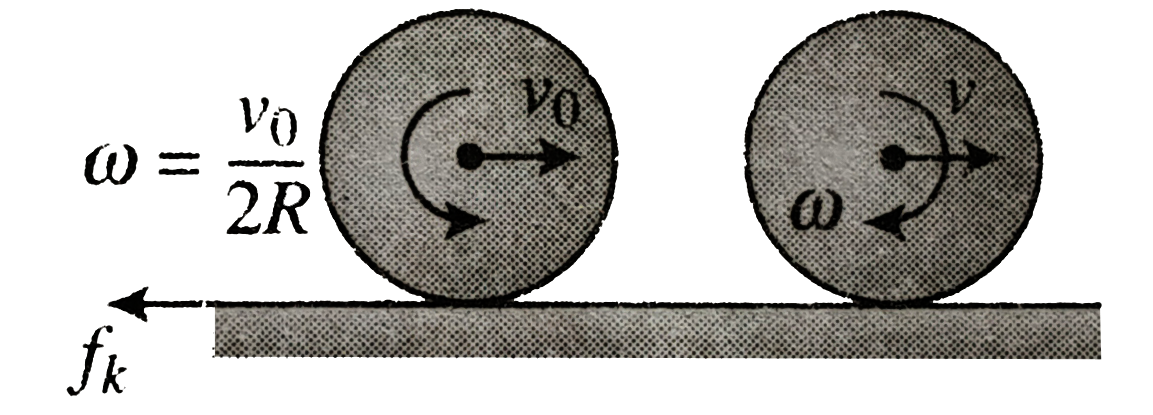
a. Because point of contact is sipping in forward direction relative to the surface kinetic friction `f_(k)` will act in backward direction
`f_(k)=pimg`
`:. "Retardation" , a=(f_(k))/m=mug`

and `alpha=(f_(k)R)/I_(cm) (mumgR)/(2/5mR^(2))=(5mug)/(2R)`
Now let when spehre starts pure rolling its velocity be v.
`:. v=v_(0)-mu"gt" `
`omega-omega_(0)+alphat`
`v=omegaR` for pure rolling
`v_(0)-mugt=(-omega+alphat)R`
`v_(0)-mugt=(-v_(0)/(2R)+(5mugt)/(2R))R`

`(3v_(0))/2=7/2mu"gt"`
`:. t_(0)=(3v_(0))/(7mug)`
b. Linear speed at time `t=(3v_(0))/(7mug)` is
`v=v_(0)-mug(3v_(0))/(7mug)=(4v_(0))/7`
c. Friction will act till the pure rolling starts. Once the pure rolling motion starts, friction will be zero. Hence, friction does work during time interval `0lttlt(3v_(0))/(7mug)` and after `t=(3v_(0))/(7mug)` work done by friction will be zero `0lttlt(3v_(0))/(7mug)` work done by friction will be zero. `:'f=0`
Now, work done by friction over a long time is
`/_\W_("fr")=K_(f)-K_(i)`
`=7/10 mv^(2)-(1/2mv_(0)^(2)+1/2xx2/5mR^(2)omega_(0)^(2))`
`=7/10mxx(16v_(0)^(2))/49-(11mv_(0)^(2))/35-(11mv_(0)^(2))/20`
`(32mv_(0)^(2)=77mv_(0)^(2))/140`
`/_\W_("fr")=-(45mv_(0)^(2))/140=-(9mv_(0)^(2))/28`
Alternate method
a. Since net torque about the axis fixed to the gorund and passing through tho point of contact is zero, using conservation of angular momentum about this axis
`-2/5mR^(2)omega_(0)+mv_(0)R=2/5mR^(2)omega+mvR`
`-1/5mv_(0)R+mv_(0)R=7/5mvrimplies4/5mv_(0)R=7/5mvR`
`:. v=(4v_(0))/7`
b. work done by friction `/_\W_("fr")=K_(f)-K_(i)`
`=7/10 mv^(2)-11/20mv_(0)^(2)=45/140mv_(0)^(2)=-9/28mv_(0)^(2)`
c. Now, `v=v_(0)-mu"gt"implies (4v_(0))/7=v_(0)-mu"gt"`
`: t=(3v_(0))/(7mug)`
Promotional Banner

Topper's Solved these Questions

  • RIGID BODY DYNAMICS 2

    CENGAGE PHYSICS|Exercise Exercise 3.1|11 Videos
  • RIGID BODY DYNAMICS 2

    CENGAGE PHYSICS|Exercise Exercise 3.2|13 Videos
  • RIGID BODY DYNAMICS 2

    CENGAGE PHYSICS|Exercise Interger|2 Videos
  • RIGID BODY DYNAMICS 1

    CENGAGE PHYSICS|Exercise Integer|11 Videos
  • SOUND WAVES AND DOPPLER EFFECT

    CENGAGE PHYSICS|Exercise Integer|16 Videos

Similar Questions

Explore conceptually related problems

A solid sphere is set into motion on a rough horizontal surface with a linear velocity v in the forward direction and an angular velocity v/R in the anticlockwise direction as shown in the figure. Find the linear speed of the sphere, when it stops rotating.

A solid sphere of mass m and radius R rolls without slipping on a horizontal surface such that v_(c.m.)=v_(0) .

A solid sphere is set into motion on a rough horizontal surfce with a linar speed v in the forward direction and an angular speed v/R in the anticlockwise direction as shown infigure . Find the linear speed of the sphere a. where it stops rotating and b. when slipping finally ceases sand pure rolling starts.

A cicular disc of mass m and radius R is set into motion on a horizontal floor with a linear speed v in the forward direction and an angular speed omega=(v)/(R) in clockwise direction as shown in figure. Find the magnitude of the total angular momentum of the disc about bottom most point O of the disc.

A symmetrical body of mass M and radius R is rolling without slipping on a horizontal surface with linear speed v. Then its angular speed is

A disc of radius R is moving on a rough horizontal surface with velocity v and angular speed omega at an instant as shown in figure. Choose the correct statement.

A rigid body I = CMR^(2) is set into a motion on a rough horizontal surface with a linear speed v_(0) in the forward direction at time t = 0 as shown in figure. After what time slipping finally stop and pure rolling starts. Find the linear speed of the body after it starts pure rolling on the surface.

A solid spherical ball of radius R collides with a rough horizontal surface as shown in figure. At the time of collision its velocity is v_(0) at an angle theta to the horizontal and angular velocity omega_(0) as shown . After collision, the angular velocity of ball may

A ring of radius R is first rotated with an angular velocity omega and then carefully placed on a rough horizontal surface. The coefficient of friction between the surface and the ring is mu . Time after which its angular speed is reduced to half is