Home
Class 11
PHYSICS
A ball of radius R=20 cm has mass m=0.75...

A ball of radius `R=20 cm` has mass `m=0.75 kg` and moment of inertia (about its diameter ) `I=0.0125 kgm^(2)`. The ball rolls without sliding over a rough horizontal floor with velocity `v_(0)=10 ms^(-1)` towards a smooth vertical wall if coefficient of restitution between the wall and the ball is `e=0.7`, calculate velocity `v` of the ball long after the collision. `(g=10ms^(-2))`

Text Solution

Verified by Experts
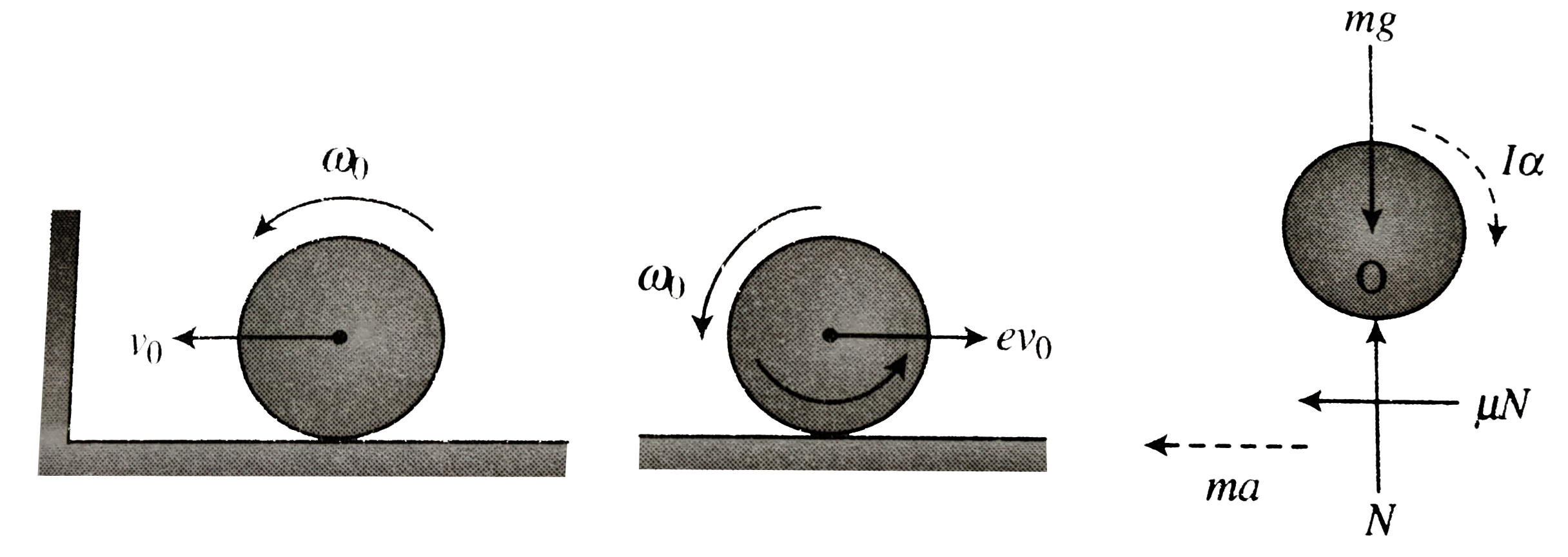
Since the ball is rolling without sliding, therefore, its angular velocity `(omega_(0))` just before collision with wall is,
`(v_(0))/R=10/0.2=50 rads^(-1)`
Translation velocity of centre of ball, just after collision.
`ev_(0)=0.7xx10=7ms^(-1)`(Right wards)
Since the wall is smooth, therefore no tangential force is applied by the wall. Hence angular velocity `w_(0)` of ball remains unchanged during collision. Now surface of ball slides on flor to the right as shown in the figure.
Let coefficient of friction between ball and the floor be m.
Considering free body diagram of ball while sliding.
for verticla forces `N=mg`
For horizontal forces `muN=ma`
Taking moment (about `O`) of forces acting on the ball,
`muNR=Ialpha` or `alpha=120 mu`

Long after the collision there will be no sliding or it wil be pure rolling Let sliding stop after a time `t` after collision, then final translational velocity `v=(7-at)` or `v=7-10mut` and final angular velocity.
`omega=(-omega_(0))+alphat`
`omega=(120mut-50)rads^(-1)` (clockwise)
But at that instant `v=Romega`
`(7-10mut)=0.2(120mut-50)`
`mut=0.5`
`v=2ms^(-1)`
Promotional Banner

Topper's Solved these Questions

  • RIGID BODY DYNAMICS 2

    CENGAGE PHYSICS|Exercise Exercise 3.1|11 Videos
  • RIGID BODY DYNAMICS 2

    CENGAGE PHYSICS|Exercise Exercise 3.2|13 Videos
  • RIGID BODY DYNAMICS 2

    CENGAGE PHYSICS|Exercise Interger|2 Videos
  • RIGID BODY DYNAMICS 1

    CENGAGE PHYSICS|Exercise Integer|11 Videos
  • SOUND WAVES AND DOPPLER EFFECT

    CENGAGE PHYSICS|Exercise Integer|16 Videos

Similar Questions

Explore conceptually related problems

A ball rolls without sliding over a rough horizontal floor with velocity v_(0)=7m//s towards a smooth vertical wall. If coefficient of restitution between the wall and the ball is e=0.7 . Calculate velocity v of the ball long after the collision.

A ball of radius R=20 cm has mass m=0.75 kg and moment of inertia (about its diameter) I=0.0125 kg m^(2) . The balls rolls with velocity V_(0)=10 ms^(-1) towards a smooth vertical wall. If coefficient of restitution between the wall and the ball is e=0.7 , velocity V of the ball after the collision is (g=0ms^(-2))

A ball of mass m moving with a speed 2v_0 collides head-on with an identical ball at rest. If e is the coefficient of restitution, then what will be the ratio of velocity of two balls after collision?

A ball, rolling purely on a horizontal floor with centre's speed v , hits a smooth vertical wall surface elastically. Answer the following questions. Just after the collision is over, the velocity of the lowest point of the ball is

A glass ball collides with an identical ball at rest with v_(0)=2 m/sec. If the coefficient of restitution of collision is e = 0.5, find the velocities of the glass balls just after the collision.

A disc of radius 0.1 m rolls without sliding on a horizontal surface with a velocity of 6 ms^(-1) . It then ascends a smooth continuous track as shown in figure. The height upto which it will ascend is ( g =10 ms^(-2))

A ball moving with velocity 2 ms^(-1) collides head on with another stationary ball of double the mass. If the coefficient of restitution is 0.5 , then their velocities (in ms^(-1) ) after colllision will be

A ball of mass m moving with velocity v collides head-on which the second ball of mass m at rest. I the coefficient of restitution is e and velocity of first ball after collision is v_(1) and velocity of second ball after collision is v_(2) then

A wall moving with velocity 2 cms^(-1) towards the ball and ball is moving towards the wall with a velocity 10 cms^(-1) . It hits the wall normally and makes elastic collision with wall. The velocity of ball after collision with wall in cms^(-1) .

