Home
Class 11
PHYSICS
A glass tube of uniform internal radius(...

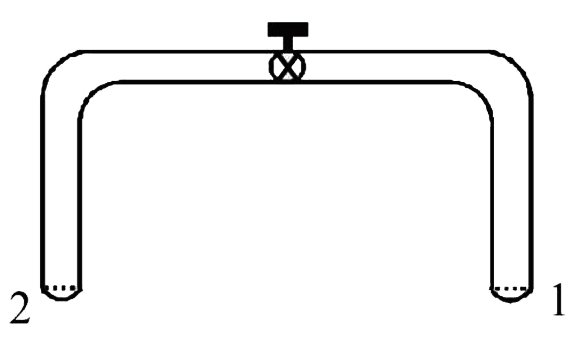
A glass tube of uniform internal radius(r) has a valve separating the two identical ends. Intially, the valve is in a tightly closed position. End 1 has a hemispherical soap bubble or radius r. End 2 has sub-hemispherical soap bubble as shown in figure. Just after opening the valve,

A

Air from end `1` flows towards end `2`. There is no change in the volume of the soap bubble.

B

Air from end `1` flows towards end `2`. Volume of the soap bubble at end `1` decreases.

C

No change occurs.

D

Air from end `2` flows towards end `1`. Volume of the soap bubble at end `1` increases.

Text Solution

Verified by Experts

The correct Answer is:

B

`/_\p_(1)=(4T)/(r_(1))` and `/_\p_(2)=(4T)/(r_(2))`
`r_(1)ltr_(2):./_\p_(1)gt/_\p_(2)`
Therefore air will flow from `1` to `2` and volume of bubble at end `1` will increase.
Promotional Banner

Topper's Solved these Questions

  • PROPERTIES OF SOLIDS AND FLUIDS

    CENGAGE PHYSICS|Exercise LC_TYPE|3 Videos
  • PROPERTIES OF SOLIDS AND FLUIDS

    CENGAGE PHYSICS|Exercise INTEGER_TYPE|2 Videos
  • PROPERTIES OF SOLIDS AND FLUIDS

    CENGAGE PHYSICS|Exercise Fill In The Blanks|1 Videos
  • NEWTON'S LAWS OF MOTION 2

    CENGAGE PHYSICS|Exercise Integer type|1 Videos
  • RIGID BODY DYNAMICS 1

    CENGAGE PHYSICS|Exercise Integer|11 Videos

Similar Questions

Explore conceptually related problems

A glass tube of uniform internal radius (r) has a valve separating the two identical ends. Initially, the valve is in a tightly closed position. End 1 has a hemispherical soap bubble of radius r . End 2 has sub-hemispherical soap bubble as shown in figure. Just after opening the valve.

Two soap bubbles of radius R_1 and R_2 combine isothermally to form a new soap bubble. Find radius of new soap bubble

Two soap bubbles of radii r_(1) and r_(2) are attached as shown. Find the radius of curvature of the common film ACB.

Two spherical soap bubbles of radii r_1 and r_2 in vacuume collapse under isothermal condition. The resulting bubble has radius R such that

Two soap bubbles of radius r_(1) and r_(2) combine. Find radius of curvature of the common surface separating them.

An isolated and charged spherical soap bubble has a radius 'r' and the pressure inside is atmospheric. If 'T' is the surface tension of soap solution, then charge on drop is:

Two spherical soap bubbles of a radii 1 cm and 2 cm vacuum coalesce under isothermal conditions . The resultant bubble has a radius of

A soap bubble A of radius 0.03 m and another bubble B of radius 0.04 m are brought together, so that the combined bubble has a common interface of radius r, then the value of r is

Two soap bubble of different radii R_(1) and R_(2) (ltR_(1)) coalesce to form an interface of radius R as shown in figure. The correct value of R is .
