Home
Class 12
CHEMISTRY
Explain the terms a) Activation energy...

Explain the terms
a) Activation energy `(E_(a))`
b) Collision frequency (Z)
c) Probability factor (P) with respect to Arrhenius equation.

Text Solution

Verified by Experts
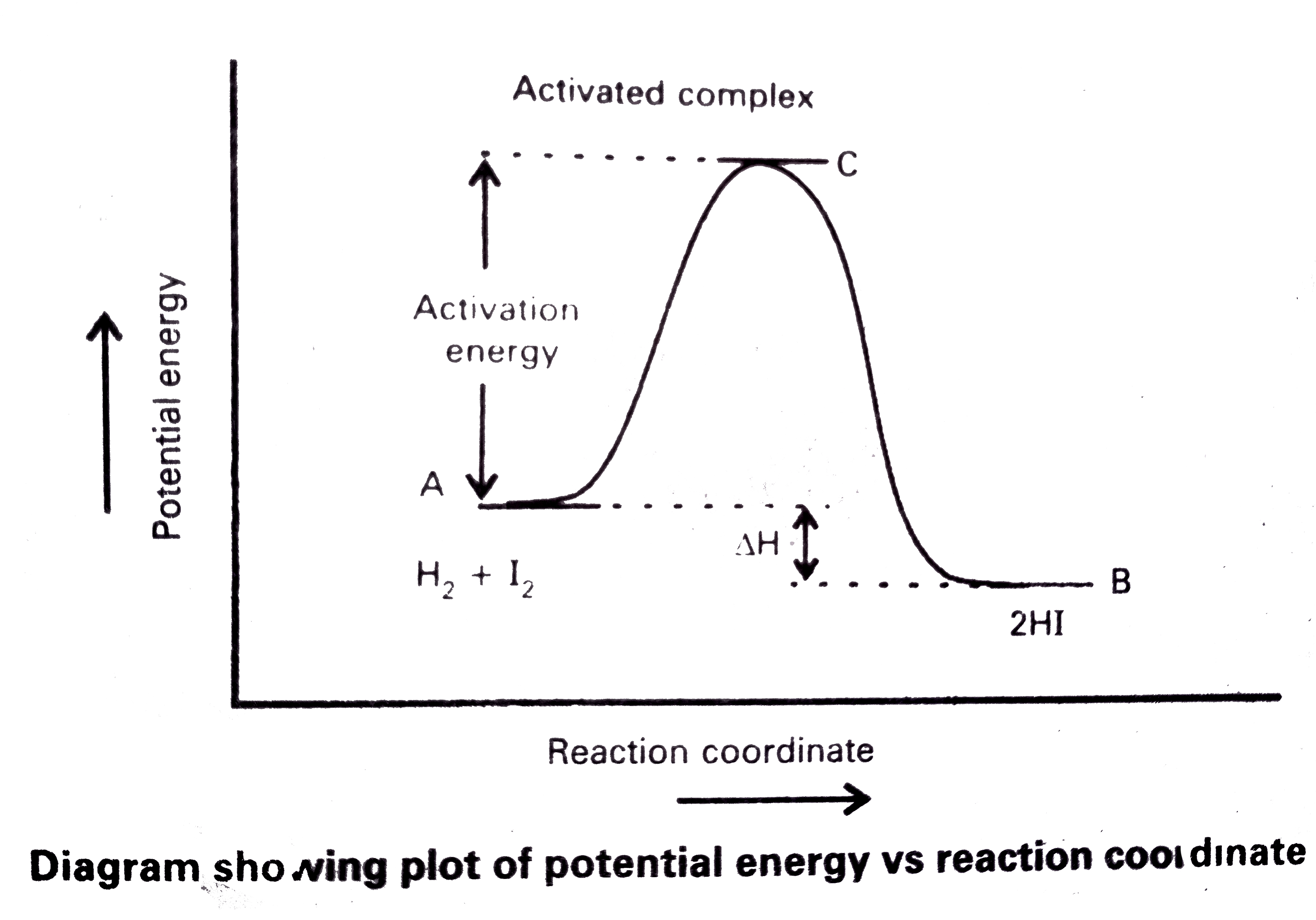
a) Activation Energy, The energy required to for an intermediate called activated complex (C ) during a chemical reaction is called activatin energy.

b) Collision frequency : The number of collisions per second per unit volume of the reaction mixture is called collision frequency (Z). For a bimolecular elementary reactions
`A+B to ` products
Rate `Z_(AB.)e^(-E_(a)//RT)`
c) Probability factor (P) with respect to Arrhenius equation : To account for effective collisions a factor p called to probability factor or steric factor is introduced.
Rate `=P Z _(AB). e^(-Ea//RT.)`
Promotional Banner

Topper's Solved these Questions

  • ELECTROCHEMISTRY & CHEMICAL KINETICS

    VIKRAM PUBLICATION ( ANDHRA PUBLICATION)|Exercise LONG ANSWER QUESTIONS|12 Videos
  • ELECTROCHEMISTRY & CHEMICAL KINETICS

    VIKRAM PUBLICATION ( ANDHRA PUBLICATION)|Exercise INTEXT QUESTIONS|24 Videos
  • ELECTROCHEMISTRY & CHEMICAL KINETICS

    VIKRAM PUBLICATION ( ANDHRA PUBLICATION)|Exercise VERY SHORT ANSWER QUESTIONS|63 Videos
  • D AND F- BLOCK ELEMENTS AND CO-ORDINATION COMPOUNDS

    VIKRAM PUBLICATION ( ANDHRA PUBLICATION)|Exercise INTEXT QUESTIONS|33 Videos
  • GENERAL PRINCIPLES OF MMETALLURGY

    VIKRAM PUBLICATION ( ANDHRA PUBLICATION)|Exercise DAM SURE SAQ|1 Videos

Similar Questions

Explore conceptually related problems

Explain the terms with suitable exapmples. Activation energy of reaction.

Explain the term 'activation energy' of a reaction with a suitable diagram.

Arrhenius studied the effect of temperature on the rate of a reaction and postulated that rate constant varies with temperature exponentially as k=Ae^(-E_(a)//RT) . For most of the reactions it was found that the temperature coefficient of the reaction lies between 2 to 3. The method is generally used for finding the activation energy of a reaction. Keeping temperature constant, the effect of catalyst on the activation energy has also been studied by studying how much the rate of reaction changes in the presence of catalyst. In most of the cases, it is observed that catalyst lowers the activationenergy barrier and increases the rate of reaction. The pre-exponential factor in the Arrhenius equation of a second order reaction has the units

What is collision frequency (Z) of a reaction ? How is rate related to it for the reaction A+B to Products.

A certain endothermic reaction: Ato Product, DeltaH=+ve proceeds ina sequence of three elementary steps with the rate constant K_(1),K_(2) and K_(3) and each one having energy of activation E_(1),E_(2) and E_(3) respectively at 25^(@)C . The observed rate constannt for the reaction is equal to K_(3)sqrt((K_(1))/(K_(2))) . A_(1),A_(2) and A_(3) are Arrhenius parameters respectively. Presence of a catalyst decreasesthe energy of activation of each path by half the value of E_(1) . Assuming the other factors same, the observed energy of activation would be

A certain endothermic reaction: Ato Product, DeltaH=+ve proceeds ina sequence of three elementary steps with the rate constant K_(1),K_(2) and K_(3) and each one having energy of activation E_(1),E_(2) and E_(3) respectively at 25^(@)C . The observed rate constannt for the reaction is equal to K_(3)sqrt((K_(1))/(K_(2))) . A_(1),A_(2) and A_(3) are Arrhenius parameters respectively. The observed energy of activation for the reaction is

A certain endothermic reaction: Ato Product, DeltaH=+ve proceeds ina sequence of three elementary steps with the rate constant K_(1),K_(2) and K_(3) and each one having energy of activation E_(1),E_(2) and E_(3) respectively at 25^(@)C . The observed rate constannt for the reaction is equal to K_(3)sqrt((K_(1))/(K_(2))) . A_(1),A_(2) and A_(3) are Arrhenius parameters respectively. For a reversible Aunderset(K_(2))overset(K_(1))(hArr)B,DeltaH=q if pre exponential factors are same. The correct relation is

A certain endothermic reaction: Ato Product, DeltaH=+ve proceeds ina sequence of three elementary steps with the rate constant K_(1),K_(2) and K_(3) and each one having energy of activation E_(1),E_(2) and E_(3) respectively at 25^(@)C . The observed rate constannt for the reaction is equal to K_(3)sqrt((K_(1))/(K_(2))) . A_(1),A_(2) and A_(3) are Arrhenius parameters respectively. Which represents the correct value if catalyst is not present:

A certain endothermic reaction: Ato Product, DeltaH=+ve proceeds ina sequence of three elementary steps with the rate constant K_(1),K_(2) and K_(3) and each one having energy of activation E_(1),E_(2) and E_(3) respectively at 25^(@)C . The observed rate constannt for the reaction is equal to K_(3)sqrt((K_(1))/(K_(2))) . A_(1),A_(2) and A_(3) are Arrhenius parameters respectively. The observed Arrhebius parameter for the reaction is

A certain endothermic reaction: Ato Product, DeltaH=+ve proceeds ina sequence of three elementary steps with the rate constant K_(1),K_(2) and K_(3) and each one having energy of activation E_(1),E_(2) and E_(3) respectively at 25^(@)C . The observed rate constannt for the reaction is equal to K_(3)sqrt((K_(1))/(K_(2))) . A_(1),A_(2) and A_(3) are Arrhenius parameters respectively. If temperature coefficient of the observed reactionis 2,the numerical value of E_(1)-E_(2)+2E_(3) is

VIKRAM PUBLICATION ( ANDHRA PUBLICATION)-ELECTROCHEMISTRY & CHEMICAL KINETICS-SHORT ANSWER QUESTIONS
  1. How is molar conductivity of an aqueous electrolyte solution measured ...

    Text Solution

    |

  2. Explain the varition of molar conductivity with the charge in the conc...

    Text Solution

    |

  3. State and explain Kohlrausch's law of indendent migration of ions.

    Text Solution

    |

  4. What is electrolysis ? Give Faraday's first law of electrolysis.

    Text Solution

    |

  5. What are the products obtained at the cathode and anode during the ele...

    Text Solution

    |

  6. What are primary and secondary batteries ? Give one example for each.

    Text Solution

    |

  7. What are the fuel cells ? How are they different from galvanic cells ?...

    Text Solution

    |

  8. What is metallic corrosion ? Explain it with respect to iron corrosion...

    Text Solution

    |

  9. Define average rate of a reaction. How is the rate of reaction express...

    Text Solution

    |

  10. What is rate equation ? How is it obtained ? Write the rate equations ...

    Text Solution

    |

  11. Define and explain the order of a reaction. How is it obtained exprime...

    Text Solution

    |

  12. What is "molecularity" of a reaction ? How is it different from the 'o...

    Text Solution

    |

  13. Derive the intergrate rate equation for a zero order rection.

    Text Solution

    |

  14. Derive an integrated rate equatin for a first order reaction.

    Text Solution

    |

  15. Derive an integrated rate equation in terms of total pressure (P) and ...

    Text Solution

    |

  16. What is half-life (t(1//2)) of a reaction ? Derive the equations for t...

    Text Solution

    |

  17. What is Arrhenius equation ? Derive an equation which describes the ef...

    Text Solution

    |

  18. Discuss the effect of catalyst on the kinetics of a chemical reaction ...

    Text Solution

    |

  19. Give a detailed account of the Collision theory of reaction rates of b...

    Text Solution

    |

  20. Explain the terms a) Activation energy (E(a)) b) Collision frequen...

    Text Solution

    |

