Home
Class 12
PHYSICS
Three charges each of value q are placed...

Three charges each of value q are placed at the corners of an equilateral triangle. A fourth charge Q is placed at the center of the triangle.
a. Find the net force on charge q.
b. If `Q = -q`, will the charges at the corners move toward the center or fly away from it ?
c. For what value of Q and O will the charges remain stationary ?
d. In situation (c), how much work is done in removing the charges to infinity ?

Text Solution

Verified by Experts

The correct Answer is:
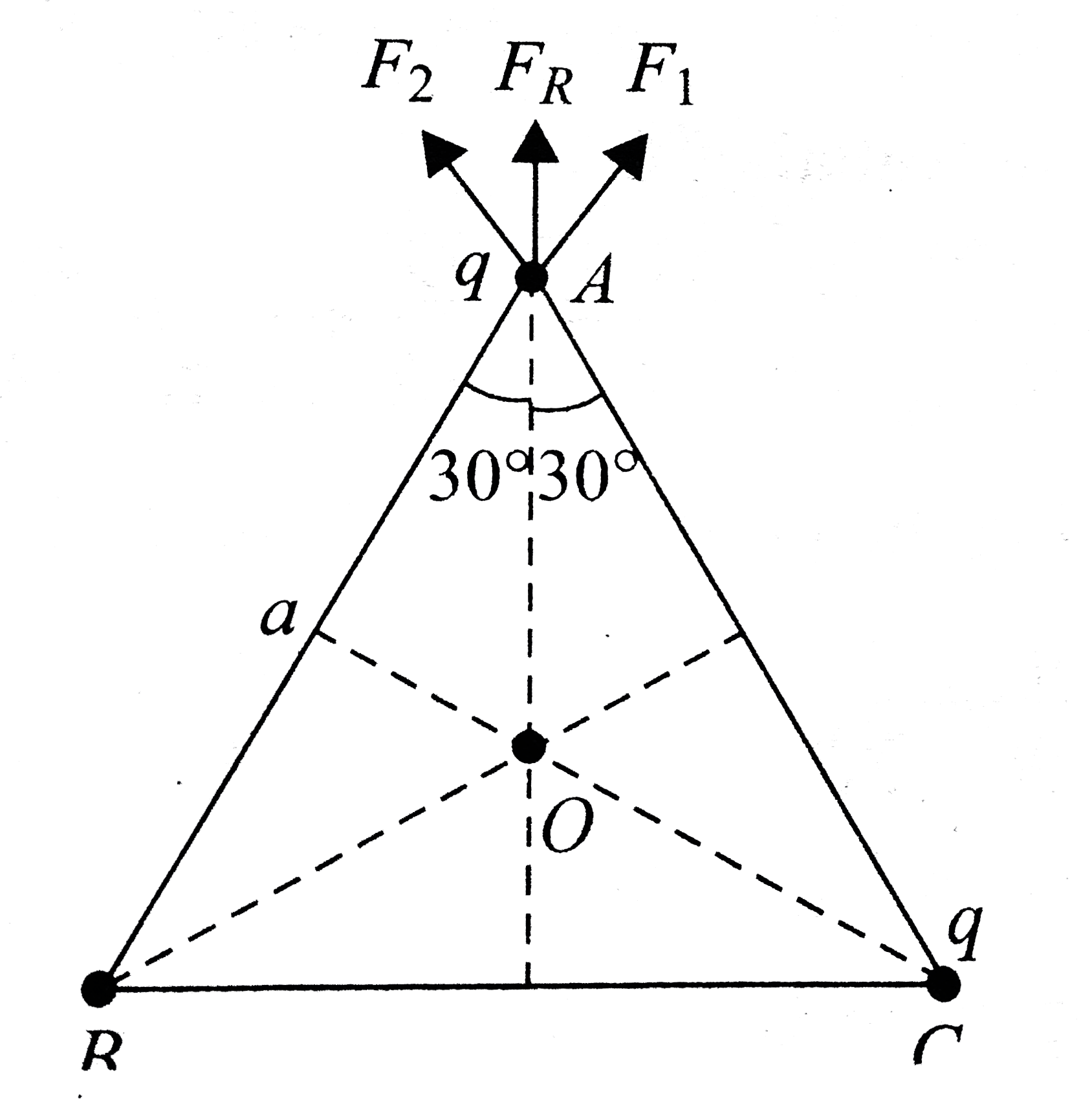
a. `F_R = q/(4 pi epsilon_0 a^2) [sqrt(3) q + 3 Q]` along `vec(O A)`
b. the charges `q` at corners A,B and C will move towards the center `O`.
c. `Q = -(q/sqrt(3))`
d. zero

A If `Q` is a positive charge, the resultant force on q at A will be
`vec F _R = vec F _1 + vec F_2 + vec F_3`
Here, `F_1 = F_2 = (1)/(4 pi epsilon_0) (q^2)/(a^2)`
So, `(vec F_1 + vec F_2) = 2 xx (1)/(4 pi epsilon_0) (q^2)/(a^2) cos 30^(@) = (sqrt(3 q^2))/(4 pi epsilon_0 a^2)` along `vec(O A)`
while `vec F_3 = (1)/(4 pi epsilon_0) (q Q)/((a // sqrt(3))^2) = (3 q Q)/(4 pi epsilon_0 a^2)` along `vec( O A)`
.
So, `F_R = q/(4 pi epsilon_0 a^2) [sqrt(3) q + 3 Q]` along `vec(O A)` .... (i)
b. For `Q = -q`,
`F_R = q/(4 pi epsilon_0 a^2) [sqrt(3)q - 3 a]` along `vec(O A)`
=`(sqrt(3) q)/(4 pi epsilon _0 a^2) [sqrt(3) - 1]` along `vec(A O)`
i.e., the charges `q` at corners A, B and C will move toward the center O.
c. Charges will remain stationary if `F_R = 0`, which Eq. (i) is possible only if
`[(sqrt(3)) q + 3 Q] = 0`, i,e., `Q = -(q/sqrt(3))`
d. Potential energy of the system
`U = (1)/(2) xx (1)/(4 pi epsilon_0) sum_(i ne j)(q_(i)q_(j))/r_(ij) = (1)/(4 pi epsilon_0) [3(q xx q)/a + (3 q(- q // sqrt(3)))/((a//sqrt(3)))] = 0`
And for finite charges, distribution potential energy at infinity is always zero. So
`W = U_F - U_I= 0 - 0 = 0`.
Promotional Banner

Topper's Solved these Questions

  • ELECTRIC POTENTIAL

    CENGAGE PHYSICS|Exercise Single Correct|56 Videos
  • ELECTRIC POTENTIAL

    CENGAGE PHYSICS|Exercise Multiple Correct|10 Videos
  • ELECTRIC POTENTIAL

    CENGAGE PHYSICS|Exercise Exercise 3.3|9 Videos
  • ELECTRIC FLUX AND GAUSS LAW

    CENGAGE PHYSICS|Exercise MCQ s|38 Videos
  • ELECTRICAL MEASURING INSTRUMENTS

    CENGAGE PHYSICS|Exercise M.C.Q|2 Videos

Similar Questions

Explore conceptually related problems

Three charges each of value q are placed at the corners of an equilateral triangle. A fourth charge Q is placed at the centre of the triangle. If Q = -q :

Three charges, each of value q, are placed at the corners of an equilateral triangle. A fourth charge Q is placed at the centre O of the triangle. (a) If Q = -q , will the charges at corners starts to move towards centre of away from it. (b) For what value of Q at O will the charges remain stationary ?

Three equal charges, each +q are placed on the corners of an equilatreal triangel . The electric field intensity at the centroid of the triangle is

Three charges each of magnitude q are placed at the corners of an equilateral triangle, the electrostatic force on the charge place at the centre is (each side of triangle is L )

Three charges +q,+q and -q are located at the corners of an equilaterial triangle of side a. Calculate potential energy of the system.

Three charges +Q each are placed at the corners A,B and C of an equilateral triangle. At the circumcenre, O the electric field wil be

Three charges 2q, -q, and -q are located at the vertices of an equilateral triangle. At the center of the triangle,

Three charge -q,+q and -q are placed at the cornors of an equilateral triangle of side a The resultant electric froce an a charge +q placed at a the centroid O of the triangle is

CENGAGE PHYSICS-ELECTRIC POTENTIAL-Subjective
  1. Two identical thin ring, each of radius R meters, are coaxially placed...

    Text Solution

    |

  2. Three conducting spherical shells have radii (a, b, and c) such that a...

    Text Solution

    |

  3. (Figure 3.114) shows three concentric spherical conductors A, B, and C...

    Text Solution

    |

  4. Two concentric shells of radii R and 2 R are shown in (Fig. 3.115). In...

    Text Solution

    |

  5. Three charges each of value q are placed at the corners of an equilate...

    Text Solution

    |

  6. A small ball of mass 2 xx 10^-3 kg, having a charge 1 mu C, is suspend...

    Text Solution

    |

  7. Two charges -2Q abd Q are located at the points with coordinates (-3a,...

    Text Solution

    |

  8. A point charge q is located at the centre O of a spherical uncharged c...

    Text Solution

    |

  9. Four point + 8 mu C, -1 mu C, -1 mu C, and + 8 mu C are fixed at the p...

    Text Solution

    |

  10. Charges +q and -q are located at the corners of a cube of side as show...

    Text Solution

    |

  11. Two uniformly charged large plane sheets S1 and S2 having charge densi...

    Text Solution

    |

  12. (Figure 3.118) shows two dipole moments parallel to each other and pla...

    Text Solution

    |

  13. Two dipoles p1 and p2 are placed along the same axis at a distance x a...

    Text Solution

    |

  14. A short dipole is placed along the x - axis at x = x (Fig. 3.120). ....

    Text Solution

    |

  15. For the electrostatic charge system as shown in , find . a. the ne...

    Text Solution

    |

  16. Four charge particles each having charge Q=1 C are fixed at the corner...

    Text Solution

    |

  17. Three identical dipoles with charges q and -q, and separation A betwee...

    Text Solution

    |

  18. A radioactive source, in the form of a metallic sphere of radius 10^(-...

    Text Solution

    |

  19. Three charges 0.1 coulomb each are placed on the corners of an equila...

    Text Solution

    |

  20. When a small uncharged conducting ball of radius a = 1 cm and mass m =...

    Text Solution

    |

