Home
Class 12
PHYSICS
A small ball of mass 2 xx 10^-3 kg, havi...

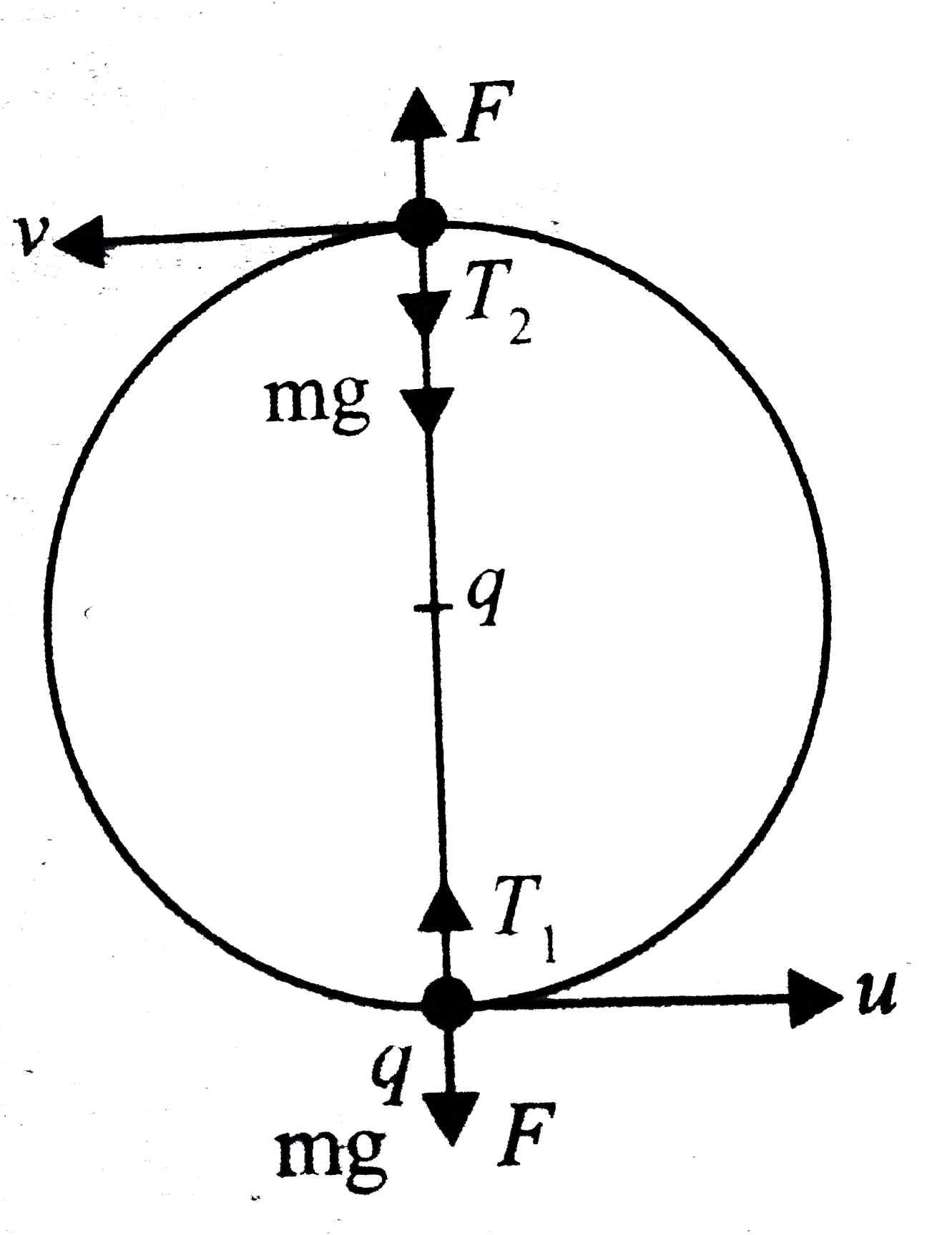
A small ball of mass `2 xx 10^-3 kg`, having a charge `1 mu C`, is suspended by a string of length `0.8 m`. Another identical ball having the same charge is kept at the point of suspension. Determine the minimum horizontal velocity that should be imparted to the lower ball so that it can make a complete revolution.

Text Solution

Verified by Experts

The correct Answer is:
`u = sqrt(5 g l - (q^2)/(4 pi epsilon_0 m l)) = ((275)/(8))^(1//2)m//s`

If the ball has just complete the circle, then the tension must vanish at the topmost point, i.e., A. From Newton's second law
`T_2 + m g - (q^2)/(4 pi epsilon_0 l^2) = (m v^2)/(l)` ...(i)
At the topmost point, `T_2 = 0`. So
`mg -(q^2)/(4 pi epsilon_0 l^2) = (m v^2)/(l)` ... (ii)
From energy conservation,
Energy at lowest point = Energy at topmost point
or `(1)/(2) m u^2 = (1)/(2) m v^2 + m g 2 l` ...(iii)
or `v^2 - u^2 = -4 g l` ...(iv)
From Eq. (ii), `v^2 = g l -(q^2)/(4 pi epsilon_0 m l)` ...V
From Eqs. (iv) and V,
`u = sqrt(5 g l-(q^2)/(4 pi epsilon_0 m l)) = ((275)/(8))^(1//2) = 5.86 ms^-1`.
.
Promotional Banner

Topper's Solved these Questions

  • ELECTRIC POTENTIAL

    CENGAGE PHYSICS|Exercise Single Correct|56 Videos
  • ELECTRIC POTENTIAL

    CENGAGE PHYSICS|Exercise Multiple Correct|10 Videos
  • ELECTRIC POTENTIAL

    CENGAGE PHYSICS|Exercise Exercise 3.3|9 Videos
  • ELECTRIC FLUX AND GAUSS LAW

    CENGAGE PHYSICS|Exercise MCQ s|38 Videos
  • ELECTRICAL MEASURING INSTRUMENTS

    CENGAGE PHYSICS|Exercise M.C.Q|2 Videos

Similar Questions

Explore conceptually related problems

A small ball if mass 2 xx 10^(-3) Kg having a charges of 1 mu C is suspended by a string of length 0. 8 m Another identical ball having the same charge is kept at the point of suspension . Determine the minimum horizontal velocity which should be imparted to the lower ball so tht it can make complete revolution .

A small ball of mass m having charge q is suspended by a string of length L . Another identical ball having the same charge is kept at the point of suspension. Determine the minimum horizontal velocity which should be imparted to ball at lowest point so that it can make complete revolution.

A ball of mass m is attached to one end of a light rod of length l , the other end of which is hinged. What minimum velocity v should be imparted to the ball downwards, so that it can complete the circle ?

The bob of a simple prendulum is suspended by a strinng of length 80 cm . What minimum horizontal velocity should be imparted to the bob so that it reaches it reaches the height of suspension point ? (g=10 m//s^(2))

A small ball having charge +q and mass m is suspended at one end of a light string of length and can rotate in vertical plane.A uniform electric field E exists in the region in vertically upward direction (mg>qE) .The minimum velocity required to be imparted to the ball at the lowest position in order to successfully negotiate the circular loop is sqrt(x(g-(qE)/(my))) then find x+y . x & y are lowest possible integer.

The bob of a pendulum has mass m= 1kg and charge q= 40 muC . Length of the pendulum is l=0.9m . The point of suspension also has the same charge 40 mu C . What the minimum speed u should be imparted to the bob so that it can complete verticel circel ?

A ball of mass m is suspended by a thread of length l. With what minimum velocity has the point of suspension to be shifted in the horizontal direction for the ball to move along the circle about that point? What will be the tension of the thread at the moment it will be passing the horizontal position?

A small positively charged ball of mass m is suspended by an insulating thread of length L. This ball remains in equilibrium with string horizontal when another small charged ball is placed exactly at a distance L below the point of suspension of the first ball. The second ball is slowly moved away from the first ball to a far away point. (The second ball is moved horizontally so that the first ball does not accelerate). As a result the first ball lowers down to the original position of the second ball and the string become vertical. Find the work done by the external agent in removing the second ball.

A small cork ball A of mass m is suspended by a thread of length I. Another ball B is fixed at a distance I from point of suspension and distance l/2 from thread when is vertical, as shown in figure-1.444. Balls A and B have charges (+ q) each. Ball A is held by an external force such that the thread remains vertical. When ball A is released from rest, thread deflects through a . maximum angle of beta = 30^(@) , calculate m in terms of other parameters

CENGAGE PHYSICS-ELECTRIC POTENTIAL-Subjective
  1. Two identical thin ring, each of radius R meters, are coaxially placed...

    Text Solution

    |

  2. Three conducting spherical shells have radii (a, b, and c) such that a...

    Text Solution

    |

  3. (Figure 3.114) shows three concentric spherical conductors A, B, and C...

    Text Solution

    |

  4. Two concentric shells of radii R and 2 R are shown in (Fig. 3.115). In...

    Text Solution

    |

  5. Three charges each of value q are placed at the corners of an equilate...

    Text Solution

    |

  6. A small ball of mass 2 xx 10^-3 kg, having a charge 1 mu C, is suspend...

    Text Solution

    |

  7. Two charges -2Q abd Q are located at the points with coordinates (-3a,...

    Text Solution

    |

  8. A point charge q is located at the centre O of a spherical uncharged c...

    Text Solution

    |

  9. Four point + 8 mu C, -1 mu C, -1 mu C, and + 8 mu C are fixed at the p...

    Text Solution

    |

  10. Charges +q and -q are located at the corners of a cube of side as show...

    Text Solution

    |

  11. Two uniformly charged large plane sheets S1 and S2 having charge densi...

    Text Solution

    |

  12. (Figure 3.118) shows two dipole moments parallel to each other and pla...

    Text Solution

    |

  13. Two dipoles p1 and p2 are placed along the same axis at a distance x a...

    Text Solution

    |

  14. A short dipole is placed along the x - axis at x = x (Fig. 3.120). ....

    Text Solution

    |

  15. For the electrostatic charge system as shown in , find . a. the ne...

    Text Solution

    |

  16. Four charge particles each having charge Q=1 C are fixed at the corner...

    Text Solution

    |

  17. Three identical dipoles with charges q and -q, and separation A betwee...

    Text Solution

    |

  18. A radioactive source, in the form of a metallic sphere of radius 10^(-...

    Text Solution

    |

  19. Three charges 0.1 coulomb each are placed on the corners of an equila...

    Text Solution

    |

  20. When a small uncharged conducting ball of radius a = 1 cm and mass m =...

    Text Solution

    |

