Home
Class 12
PHYSICS
Four point + 8 mu C, -1 mu C, -1 mu C, a...

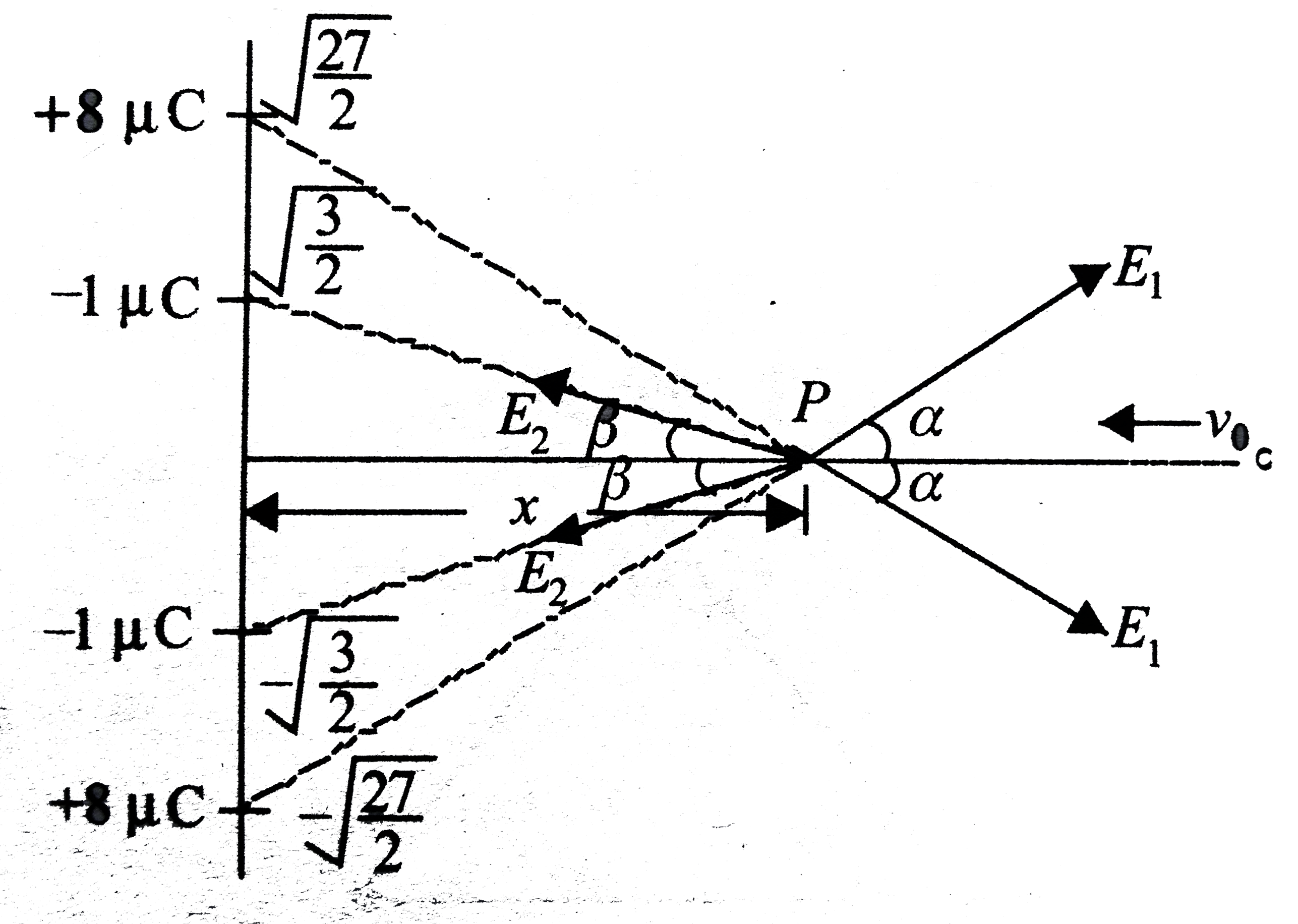
Four point `+ 8 mu C, -1 mu C, -1 mu C`, and `+ 8 mu C` are fixed at the points `-sqrt(27//2) m, - sqrt(3//2) m, +sqrt(3//2) m`, and `+sqrt(27//2) m`, respectively, on the y - axis. A particle of mass `6 xx 10^-4 kg` and charge `+ 0.1 mu C` moves along the x- direction. Its speed at `x = + oo` is `V_0`. Find the least value of `V_0` for which the particle will cross the origin. Find also the kinetic energy of the particle at the origin. Find also the kinetic energy of the particle at the origin. Assume that space is gravity free. Given `(1// 4 pi epsilon_0) = 9 xx 10^9 Nm^2 C^-2`.

Text Solution

Verified by Experts

The correct Answer is:
`3 m//s, 3 xx 10^-4 J`

Let electric field atv P due to all four charges be zero.
.
`2 E_1 cos alpha = 2 E_2 cos beta`
or `(2 k xx 8 xx 10^-6 x)/((x^2 + 27 // 2)^(3//2))= (2 k xx 1 xx 10^-6 x)/((x^2 + 3 // 2)^(3//2))` or `x = sqrt((5)/(2)) m`
Beyond P, E is toward right. To the left of `P, E` is toward left Once the charge crosses point P, attractive forces will pull the charge to origin. Applying conservation of energy between `oo` and P, we get
`(1)/(2) mv_0^2 = 2k [(8 xx 10^6)/(sqrt(27/(2) + (5)/(2)))- (1 xx 10^6)/(sqrt((3)/(2)+ (5)/(2)))] xx 0.1 xx 1 xx 10^6`
or `v_0 = 3 ms^-1`
To find K E at origin, apply conservation of energy between `oo` and origin.
`K E_(x = 0) = 2 k xx 0.1 xx 10^-12 [(8)/(sqrt(27 //2)) -(1)/(sqrt(3 // 2))] = (1)/(2) m v_0^2`
=`2.5 xx 10^-4 J`.
Promotional Banner

Topper's Solved these Questions

  • ELECTRIC POTENTIAL

    CENGAGE PHYSICS|Exercise Single Correct|56 Videos
  • ELECTRIC POTENTIAL

    CENGAGE PHYSICS|Exercise Multiple Correct|10 Videos
  • ELECTRIC POTENTIAL

    CENGAGE PHYSICS|Exercise Exercise 3.3|9 Videos
  • ELECTRIC FLUX AND GAUSS LAW

    CENGAGE PHYSICS|Exercise MCQ s|38 Videos
  • ELECTRICAL MEASURING INSTRUMENTS

    CENGAGE PHYSICS|Exercise M.C.Q|2 Videos

Similar Questions

Explore conceptually related problems

Four point charges +8muC,-1muC,-1muC and , +8muC are fixed at the points -sqrt(27//2)m,-sqrt(3//2)m,+sqrt(3//2)m and +sqrt(27//2)m respectively on the y-axis. A particle of mass 6xx10^(-4)kg and +0.1muC moves along the x-direction. Its speed at x=+ infty is v_(0) . find the least value of v_(0) for which the particle will cross the origin. find also the kinetic energy of the particle at the origin in tyhis case. Assume that there is no force part from electrostatic force.

Four point charges, +0.1 mu C,-0.1 mu C,-0.1 mu C and +0.1 mu C are kept at points A(0, 2 m), B(0, -2 m), C (- sqrt2 m, sqrt2 m) and D ( sqrt2 m, - sqrt2 m) respectively. Calculate the resultant dipole moment of the combination.

Electric charges of + 10 mu C, + 5mu C, - 3mu C and +9 mu C are placed at the corners of a square of side sqrt(2) m the potential at the centre of the square is

Two point charges each 50 mu C are fixed on y -axis at y = + 4 m and y = - 4m . Another charged particle having charge -50 mu C and mass 20 g is moving along the positive x -axis. When it is at x = -3 m , its speed is 20 m//sec . Find the speed of charged particle when it reaches to origin. Also , find distance of charged particle from origin , when its kinetic energy becomes zero.

A point charge of 0.01 mu C is placed at the origin. Calculate the electric field at another point charge of 0.05 mu C placed at (0 m, 5 m).

Four point charges q_(A) = 2 mu C , q_(B) = -5 mu C, q_(C) = -2 mu C and q_(D) = -5 mu C are located at the corners of a square ABCD of side 10 cm. What is the force on a charge of 1 mu C placed at the center of the square ?

CENGAGE PHYSICS-ELECTRIC POTENTIAL-Subjective
  1. Two identical thin ring, each of radius R meters, are coaxially placed...

    Text Solution

    |

  2. Three conducting spherical shells have radii (a, b, and c) such that a...

    Text Solution

    |

  3. (Figure 3.114) shows three concentric spherical conductors A, B, and C...

    Text Solution

    |

  4. Two concentric shells of radii R and 2 R are shown in (Fig. 3.115). In...

    Text Solution

    |

  5. Three charges each of value q are placed at the corners of an equilate...

    Text Solution

    |

  6. A small ball of mass 2 xx 10^-3 kg, having a charge 1 mu C, is suspend...

    Text Solution

    |

  7. Two charges -2Q abd Q are located at the points with coordinates (-3a,...

    Text Solution

    |

  8. A point charge q is located at the centre O of a spherical uncharged c...

    Text Solution

    |

  9. Four point + 8 mu C, -1 mu C, -1 mu C, and + 8 mu C are fixed at the p...

    Text Solution

    |

  10. Charges +q and -q are located at the corners of a cube of side as show...

    Text Solution

    |

  11. Two uniformly charged large plane sheets S1 and S2 having charge densi...

    Text Solution

    |

  12. (Figure 3.118) shows two dipole moments parallel to each other and pla...

    Text Solution

    |

  13. Two dipoles p1 and p2 are placed along the same axis at a distance x a...

    Text Solution

    |

  14. A short dipole is placed along the x - axis at x = x (Fig. 3.120). ....

    Text Solution

    |

  15. For the electrostatic charge system as shown in , find . a. the ne...

    Text Solution

    |

  16. Four charge particles each having charge Q=1 C are fixed at the corner...

    Text Solution

    |

  17. Three identical dipoles with charges q and -q, and separation A betwee...

    Text Solution

    |

  18. A radioactive source, in the form of a metallic sphere of radius 10^(-...

    Text Solution

    |

  19. Three charges 0.1 coulomb each are placed on the corners of an equila...

    Text Solution

    |

  20. When a small uncharged conducting ball of radius a = 1 cm and mass m =...

    Text Solution

    |

