Home
Class 12
PHYSICS
What amount of heat will be generated in...

What amount of heat will be generated in a coil of resistance `R` due to a charge q passing through it if the current in the coil
a. decreases down to zero uniformly during a time interval `t_0`?
b. decrases down to zero having its value every `t_0` seconds?

Text Solution

Verified by Experts
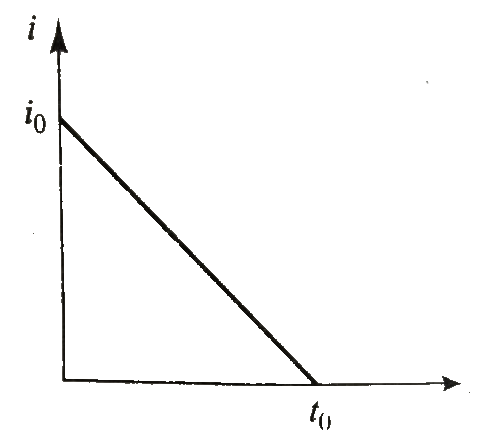
(i) The current decreases uniformly with time , therefore , `i` vs. `t` curve is a straight line as shown in fig. `7.20` with slope `m = -i_(0)//t_(0)`. Current as afunction of time can be written as
`I = i_(0) - ((i_(0))/(t_(0))) t` …(i)
Area under the `i - t` graph gives the flow of charge `q`, therefore,
`q = (1)/(2) (t_(0)) (i_(0)) or i_(0) = ( 2q) /( t_(0))`
Substituting in Eq.(i), we get
`i = ( 2q)/(t_(0)) (1-(t)/(t_(0))) = ( 2 q )/( t_(0)) - (2 qt)/(t_(0)^(2))`
Heat produced in a time interval `t_(0)` is
(ii) ` int dH = int i^(2) R dt`
or ` H = int_(0)^(t_(0)) ((2q)/( t_(0)) - ( 2qt)/( t_(0)^(2)))^(2) R dt = (4)/(3) (q^(2) R)/( t_(0))`
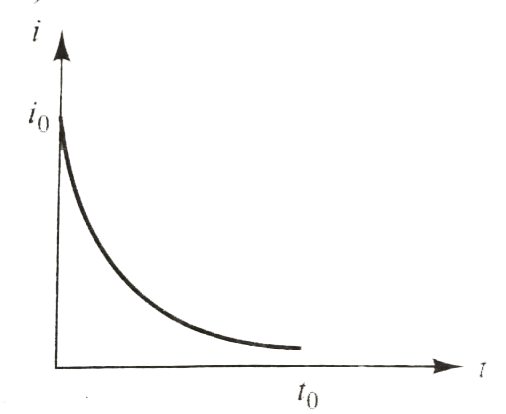
(ii) Here, current decreases from `i_(0)` to zero expontially with half - life of `t_(0)`. The `i - t` equation in this case is an exponential function like the radioactive decay law.
`i = i_(0)e^(-lambda t)`
where `lambda = "In"(2)//(t_(0))`
Total charge `q = int _(0)^(oo) i dt = int_(0)^(oo) i_(0) e ^(-lambda t) dt = ((i_(0))/(lambda))`
or `i_(0) = lambdaq or i = (lambda q)e^(- lambdat)`
Heat produced in time interval `dt` is
`dH = i^(2) R dt = lambda^(2) q^(2) e^(-2 lambda t) R dt `
or `H = lambda^(2)q^(2) R int _(0)^(oo) dt = ( q^(2) lambda R)/(2) = ( q^(2) R In(2))/(2 t_(0))`

Promotional Banner

Topper's Solved these Questions

  • HEATING EFFECT OF CURRENT

    CENGAGE PHYSICS|Exercise Exercise 7.1|22 Videos
  • HEATING EFFECT OF CURRENT

    CENGAGE PHYSICS|Exercise Subjective|8 Videos
  • HEATING EFFECT OF CURRENT

    CENGAGE PHYSICS|Exercise Thermal Power in Resistance Connected in Circuit|28 Videos
  • GRAVITATION

    CENGAGE PHYSICS|Exercise Question Bank|39 Videos
  • INDUCTANCE

    CENGAGE PHYSICS|Exercise Concept Based|9 Videos

Similar Questions

Explore conceptually related problems

What amount of heat will be generated in a coil resistance R due to a charge q passing through it if the current in the coil decreases down to zero uniformly during a time interval Deltat ?

If current in a conductor linearly drops to zero from initial magnitude i_0 in time interval t_0 what amount of charge must have passed through the conductor ?

At t=0 , an inductor of zero resistance is joined to a cell of emf varepsilon through a resistance. The current increases with a time constant tau . The emf across the coil after time t is

A current passing through a resistance R decreases uniformly to zero in a time internal T and a total charge q passes through resistance. Find the total heat produced in resistance in this process.

A magnetic flux through a stationary loop with a resistance R varies during the time interval tau as phi=at(tau-t) . Find the amount of the generated in the loop during that time

The current in a coil of self-inductance 2.0 H is increasing according to I=2 sin t^(2) ampere. Find the amount of energy spent during the period when the current charges from zero to 2A.

The amount of charge Q passed in time t through a cross-section of a wire is Q=5t^(2)+3t+1 . The value of current at time t=5 s is

A coil with active resistance R and inductance L was connected at the moment t=0 to a source of voltage V=V_(m)cos omegat. Find the current in the coil as a function of time t .