Home
Class 11
PHYSICS
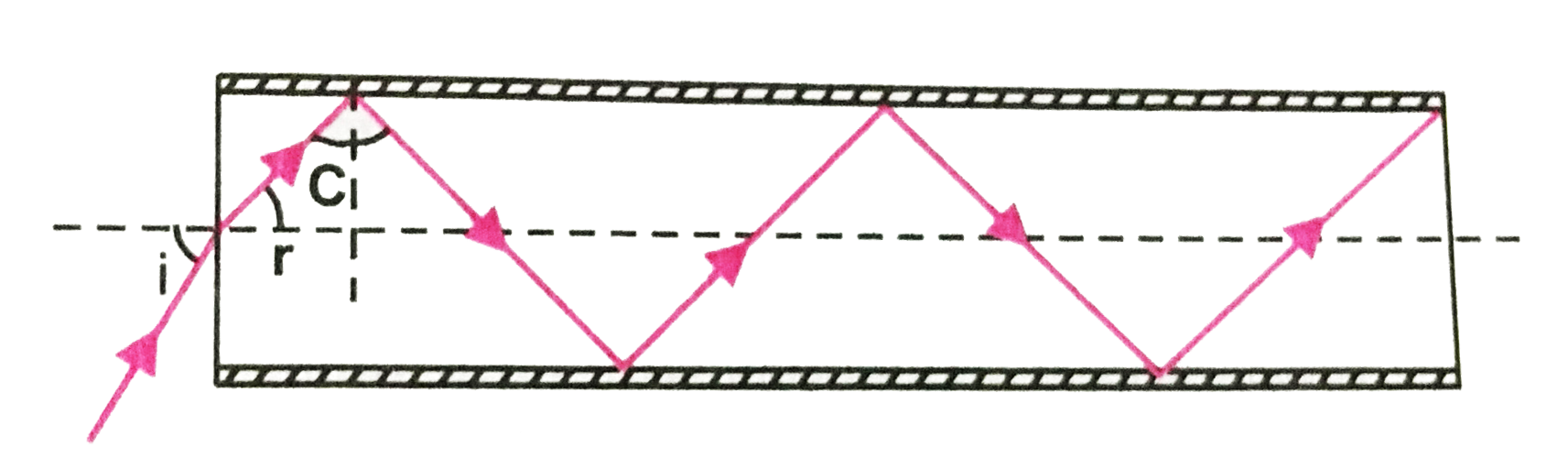
(a) Fig. shows a cross-section of a 'lig...

(a) Fig. shows a cross-section of a 'light pipe' made of a glass fibre of refractive index `1.68`. The outer covering of the pipe is made of a material of refractive index `1.44`. What is the axis of the pipe for which total reflection inside the pipe take place as shwon.
(b) What is the answer if there is no outer covering if the pipe ?

Text Solution

Verified by Experts

Here, `mu_2 = 1.68, mu_1 = 1.44`
As `mu = (mu_2)/(mu_1) = (1)/(sin C) :. sin C = (mu_1)/(mu_2) = (1.44)/(1.68) = 0.8571 :. C = sin^-1 (0.0871) = 59^@`
Total internal reflection would take place when `I gt C` i.e., `I gt 50^@` or when `r lt r_(max)`, where
`r_(max) = 90^@ - C = 90^@ - 59^@ = 31^@`
As `(sin i_(max))/(sin r_(max)) = 1.68`
`:. sin i_(max) = 1.68 sin r_(max) = 1.68 sin 31^@ = 1.68 xx 0.5156 = 0.8662 :. i_(max) = 60^@`
Hence all rays which are incident in the range `/_ i lt 60^@` will suffer total internal reflection in the pipe.
It should be noted that lower limit of `i` is not `0^@`. It will be determined by the ratio of diameter to the length of pipe.
(b) If there is no outer coating of pipe, `mu_2 = 1.68, mu_1 = 1`
As `sin C' = (1)/(mu)=(mu_1)/(mu_2)=(1)/(1.68) = 0.5952 :. C' = sin^-1(0.5952)=36.5^@`
Now, `i = 90^@` will have `r = 36.5^@` `("from"(sin i)/(sin r) = mu = 1.68)`
`:. i' = 90^@ - 36.5^@ = 53.5^@`, which is greater than `C'`. Thus all rays incident at angles in the rage zero to `906@` will suffer total internal reflection.
Promotional Banner

Topper's Solved these Questions

  • RAY OPTICS

    PRADEEP|Exercise Higher Thinking Order|5 Videos
  • RAY OPTICS

    PRADEEP|Exercise Sample Problem(a)|5 Videos
  • RAY OPTICS

    PRADEEP|Exercise (NCERT)Long Answer|5 Videos
  • PROPERTIES OF BULK MATTER

    PRADEEP|Exercise Multiple choice questions|7 Videos
  • SYSTEMS OF PARTICLES AND ROTATIONAL MOTION

    PRADEEP|Exercise Assertion- Reason Type questions|20 Videos

Similar Questions

Explore conceptually related problems

An optical fibre is made of glass fibre of refractive index 1.68. The outer coating of the glass fibre is made of material of refractive index 1.44. What is the range of angles of the incident rays with the axis of the pipe for which total internal reflection inside the optical fibre takes place?

Find the angle of minimum deviation for an equilateral prism made of a material of refractive index 1-732. What is the angle of incidence for this deviation ?

Cross section of a light pipe is shown in the following figure : Inner core is material of refractive index 1.68 and its outer covering is a material of refractive index 1.44. Find the maximum angle at which the ray can be incident with the axis of pipe for which total internal reflection occurs inside the pipe.

A ray of light is icident on a glass plate of refractive index 1.5. The angle between the reflected and refracted rays is 90^@ . What is the ratio of wavelengtth of reflected t refracted rays ?

A ray of light is incident on a glass plate of refractive index 1.5. The angle between the reflected and refracted rays is 90^(@) . What is the ratio of wavelenth of reflected to refracted rays?

Light is incident normally on face AB of a prism as shown in Figure. A liquid of refractive index mu is placed on face AC of the prism. The prism is made of glass of refractive indes 3//2 . Find the limits of mu for which total internal reflection takes place on the face AC.

A capillary tube is made of glass of refractive index n' . The outer radius of the tube is R . The tube is filled with a liquid of refractive index n lt n' . What should be the minimum internal radius of the tube so that any ray that hits the tube would enter the liquid.

There is a thin prism of angle 5^(@) made of material having refractive index 1.6. There is another thin prism made of material of refractive index 1.8. These two prisms are combined in such a manner that they may produce dispersion without mean deviation. What should be the angle of second prism ?

A plano-concave lens is made of glass of refractive index 1.5 and the radius of curvature of its curved face is 100 cm. What is the power of the lens?

PRADEEP-RAY OPTICS-(NCERT)Exercise With Solution
  1. Use the mirror equation to deduct that : (a) an object between f and...

    Text Solution

    |

  2. A small pin fixed on a table top is viewed from above from a distance ...

    Text Solution

    |

  3. (a) Fig. shows a cross-section of a 'light pipe' made of a glass fibre...

    Text Solution

    |

  4. Answer the following questions : (a) You have learnt that plane and ...

    Text Solution

    |

  5. The image of a small electric bulb fixed on the wall of a room is to b...

    Text Solution

    |

  6. A screen is placed 90 cm from an object. The image of the object on th...

    Text Solution

    |

  7. a) Determine the effective focal length of the combination of the two ...

    Text Solution

    |

  8. At what angle should a ray of light be incident on the face of a prism...

    Text Solution

    |

  9. You are given prism made of crown glass and flint glass with a wide va...

    Text Solution

    |

  10. For a normal eye, the far point is at infinity and the near point of d...

    Text Solution

    |

  11. Does short sightedness (myopia) or long sightedness (hypermetropia) im...

    Text Solution

    |

  12. A myopia person has been using spectacles of power - 1.0 dioptre for d...

    Text Solution

    |

  13. A person looking at a person wearing a shirt with a pattern comprisin...

    Text Solution

    |

  14. A man with normal near point (25 cm) reads a book with small print usi...

    Text Solution

    |

  15. A cardsheet divided into squares each of size 1 mm^(2) is being viewed...

    Text Solution

    |

  16. (i) At what distance should the lens be held from the card sheet in or...

    Text Solution

    |

  17. What should be the distance between the object and magnifying glass i...

    Text Solution

    |

  18. a) The anlge subtended at the eye by an object is equal to the angle s...

    Text Solution

    |

  19. An angular magnification (magnifying power) of 30 X is desired using a...

    Text Solution

    |

  20. A small telescope has an objective lens of focal length 140 cm and eye...

    Text Solution

    |
