A
B
C
D
Text Solution
Verified by Experts
The correct Answer is:



Topper's Solved these Questions
Similar Questions
Explore conceptually related problems
RESONANCE-TEST PAPERS-PART - I MATHMATICS
- If M & alpha are twin prime &alpha+M=7 then the greatest integral valu...
Text Solution
|
- If M & alpha are twin prime &alpha+M=7 then the greatest integral valu...
Text Solution
|
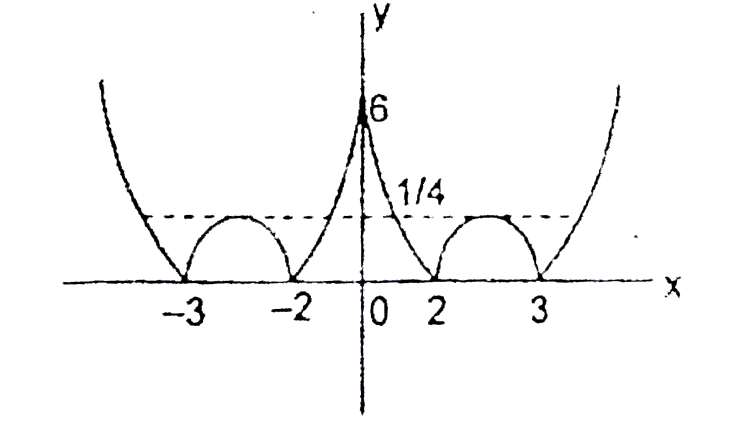
- Let f(x) = x^(2) - 5x + 6, g(x) = f(|x|), h(x) = |g(x)| The set of v...
Text Solution
|
- Let f(x) = x^(2) - 5x + 6, g(x) = f(|x|), h(x) = |g(x)| The set of v...
Text Solution
|
- The sum (2^(1))/(4^(1) - 1) + (2^(2))/(4^(2) - 1) + (2^(4))/(4^(4) - 1...
Text Solution
|
- Least positive inegral value of x satisfying |4x + 3| + |3x - 4| = |...
Text Solution
|
- The value {:((100),(0):}){:((100),(150):})+{:((100),(1):}){:((200),(15...
Text Solution
|
- Number of solution(s) of the equation (sinx)/(cos3x)+(sin3x)/(cos9x)+(...
Text Solution
|
- If a, b, c are non-zero than minimumm value of expression (((a^(4)+3...
Text Solution
|
- Let L denots value of cos^(2)(alpha - beta) if sin2alpha + sin2beta = ...
Text Solution
|
- Find the value of (sin30^(@).tan330^(@).sec420^(@))/(tan135^(@).sin135...
Text Solution
|
- If 2010 is a root of x^(2)(1 - pq) - x(p^(2) + q^(2)) - (1 + pq) = 0 a...
Text Solution
|
- The number of all possible ordered pairs (x, y), x, y in R satisfying ...
Text Solution
|
- The remainder when (1!)^(2) + (2!)^(2) + (3!)^(2) + ….. + (100!)^(2) i...
Text Solution
|
- Let f(n)(theta) = sum(n=0)^(n) (1)/(4^(n))sin^(4)(2^(n)theta). Then wh...
Text Solution
|
- If a, b, c are distinct positive real numbers such that the quadratic ...
Text Solution
|
- If S(n) = sum(n=1)^(n) (2n + 1)/(n^(4) + 2n^(3) + n^(2)) then S(10) is...
Text Solution
|
- If p, q, r each are positive rational number such tlaht p gt q gt r an...
Text Solution
|
- If (2tan^(2)theta(1)tan^(2)theta(2)tan^(2)theta(3)+tan^(2)theta(1)tan^...
Text Solution
|
- The expression cos^(2)(alpha + beta + gamma) + cos^(2)(beta + gamma) +...
Text Solution
|