Home
Class 12
MATHS
Let M(2,13/8) is the circumcentre of D...

Let `M(2,13/8)` is the circumcentre of `DeltaPQR` whose sides `PQ and PR` are represented by the straight lines `4x-3y = 0 and 4x + y = 16` respectively. The orthocentre of `DeltaPQR` is

A

orthocentre of `DeltaPQR` is `(3, (3)/(4))`

B

orthocentre of `DeltaPQR` is `((7)/(3), (4)/(3))`

C

orthocentre of `DeltaPQR` is `((4)/(3), (7)/(3))`

D

coordinates of point `R` is `(4, 0)`

Text Solution

Verified by Experts

The correct Answer is:
A, D


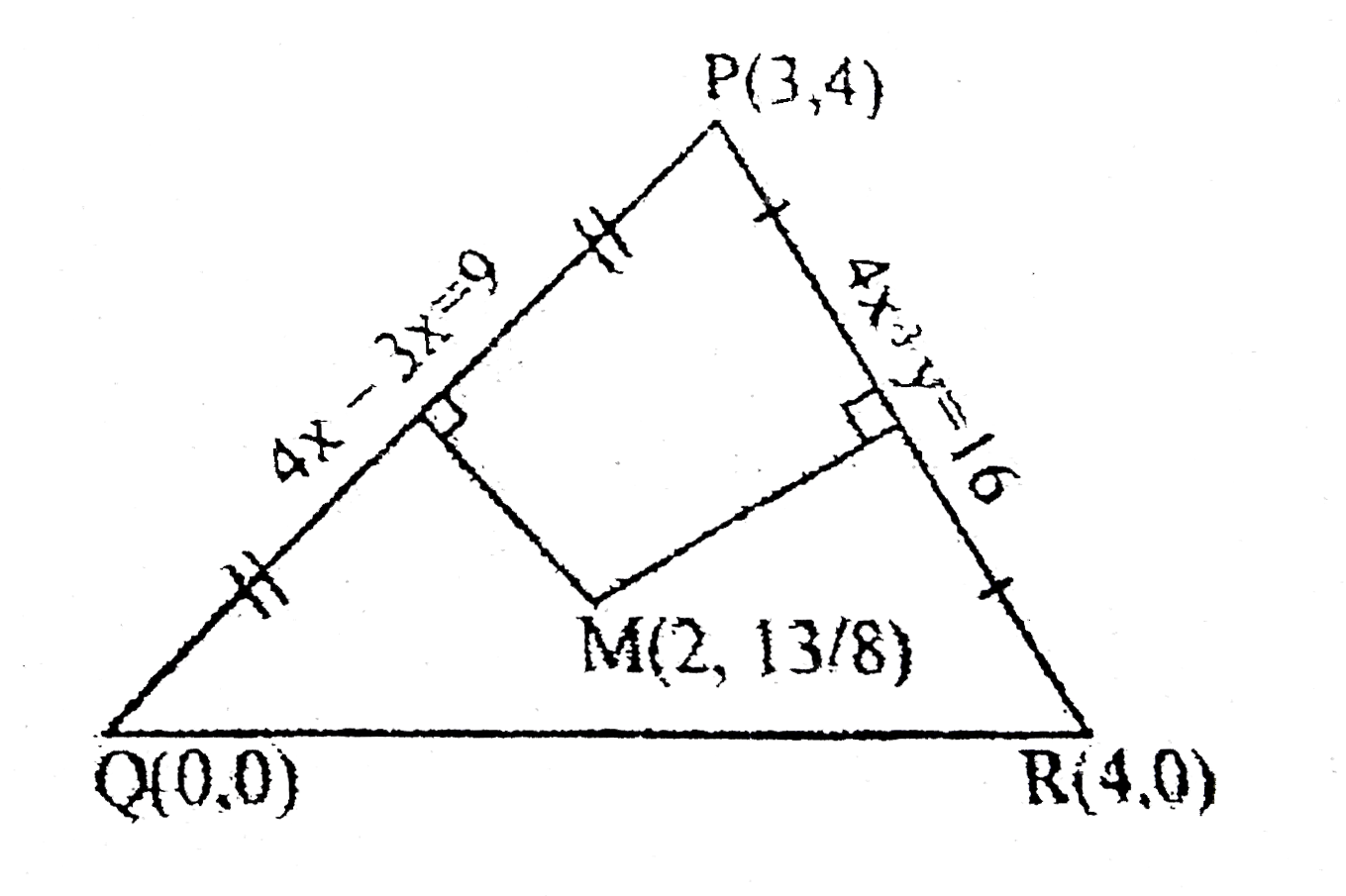
On solving `4x - 3y = 0` and `4x + y = 16`, we get `P(3,4)`.
The equation of lines perpendicular to `PQ` is `3x + 4y = k`
As above line passes through `M(2, (13)/(8))`
So `3(2) + 4((13)/(8)) = k rArr k = (25)/(2)`
`:.` Equation of `AM` is `3x + 4y = (25)/(2)`
Similarly, the equation of line perpendicular to
`PR` is `x - 4y = lambda`
As above line passes through `M(2, (13)/(8))`,
So `2 - 4((13)/(8)) = lambda rArr lambda = -(9)/(2)`
`:.` Equation of `CM` is `x - 4y = -(9)/(2)`
Now, on solving `4x - 3y = 0` and `3x + 4y = (25)/(2)`,
We get `A((3)/(2),2)`
Also on solving `4x + y = 16` and `x - 4y = -(9)/(2)`,
we get `C((7)/(2),2)`
As `A` is midpoint of `PQ`, so `Q = (0,0)` and `C` is the midpoint of `PR`, so `R = (4, 0)`

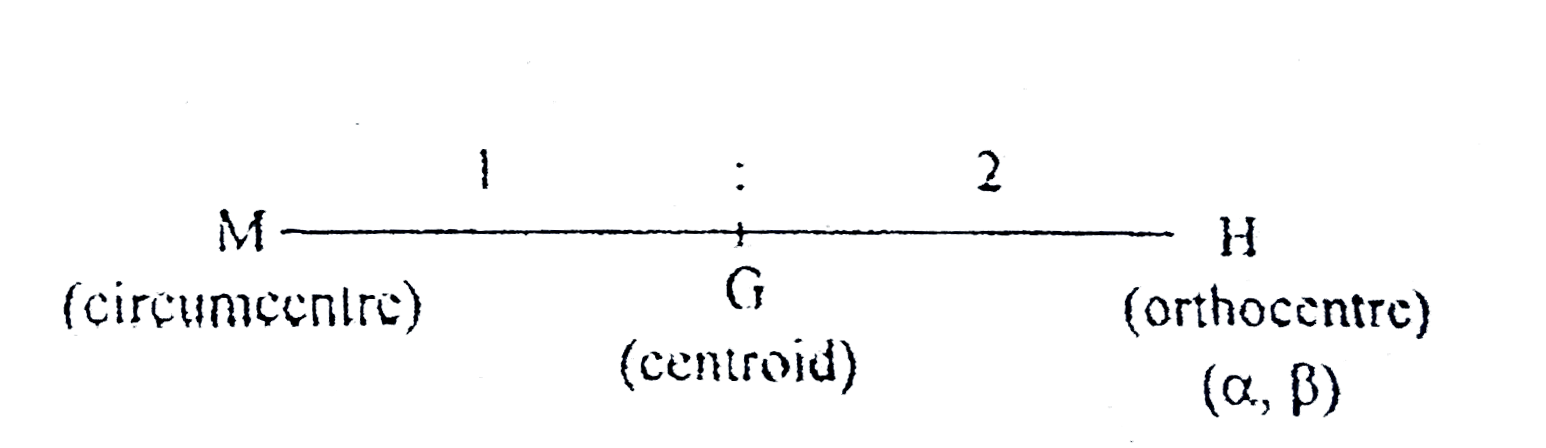
`(2, (13)/(8)) , ((7)/(3), (4)/(3))`
`:.` By applicant of section formula, we get
`(1(alpha) + 2(2))/(1 + 2) = (7)/(3)`
`rArr alpha = 7 - 4 = 3`
And `(1(beta) + 2((13)/(8).))/(1 + 2) = (4)/(3)`
`rArr beta 4 -(13)/(4) = (16 - 13)/(4) = (3)/(4)`
Hence orthocentre of `DeltaPQR` is `(3, (3)/(4))`
Promotional Banner

Topper's Solved these Questions

  • TEST PAPERS

    RESONANCE|Exercise Math|105 Videos
  • TEST PAPERS

    RESONANCE|Exercise MATHEMATICS|263 Videos
  • TEST PAPERS

    RESONANCE|Exercise PART - I MATHEMATICS SEC - 2|1 Videos
  • TEST PAPER

    RESONANCE|Exercise CHEMISTRY|37 Videos
  • TEST SERIES

    RESONANCE|Exercise MATHEMATICS|131 Videos

Similar Questions

Explore conceptually related problems

Let M(2,(13)/(8)) is the circumcentre of Delta PQR whose sides PQ and PR are represented by the straight lines 4x-3y=0 and 4x+y=16 respectively. The orthocentre of Delta PQR is

Consider a /_ABC whose sides BC, CA and AB are represented by the straight lines x-2y+5=0,x+y+2=0 and 8x-y-20=0 respectively.The area of /_ABC equals

Consider a Delta ABC whose sides AB,BC and CA are represented by the straight lines 2x+y=0,x+py=q and x-y=3 respectively.The point P is (2,3). If P is orthocentre,then find the value of (p+q) is

The perimeter of a parallelogram whose sides are represented by the lines x+2y+3=0 , 3x+4y-5=0,2x+5=0 and 3x+4y-10=0 is equal to

The straight lines 4x-3y-5=0, x-2y=0, 7x+y-40=0 and x+3y+10=0 from

Two straight line paths are represented by the equation 2x-y=2 and -4x+2y=6 . Then the paths will

Prove that the straight lines 4x+7y=9, 5x-8y+15=0 and 9x-y+6=0 are concurrent.

RESONANCE-TEST PAPERS-PART - I MATHMATICS
  1. Let alpha, beta are the root of equation acostheta + bsintheta = c. ...

    Text Solution

    |

  2. Let alpha, beta are the root of equation acostheta + bsintheta = c. ...

    Text Solution

    |

  3. Let M(2,13/8) is the circumcentre of DeltaPQR whose sides PQ and PR ...

    Text Solution

    |

  4. Let M(2,13/8) is the circumcentre of DeltaPQR whose sides PQ and PR ...

    Text Solution

    |

  5. Consider a plygon of sides 'n' which satisflies the equation 3. .^(n)p...

    Text Solution

    |

  6. Consider a plygon of sides 'n' which satisflies the equation 3. .^(n)p...

    Text Solution

    |

  7. In the expansion of (3^(-x//4)+3^(5x//4))^(pi) the sum of binomial coe...

    Text Solution

    |

  8. In the expansion of (3^(-x//4)+3^(5x//4))^(pi) the sum of binomial coe...

    Text Solution

    |

  9. . Let A be the centre of the circle x^2+y^2-2x-4y-20=0 Suppose that th...

    Text Solution

    |

  10. Lines 5x + 12y - 10 = 0 and 5x - 12y - 40 = 0 touch a circle C1 of dia...

    Text Solution

    |

  11. Circles with radii 3, 4 and 5 touch each other externally. If P is the...

    Text Solution

    |

  12. The extremities of a diagonal of a rectangle are (-4, 4) and (6, -1). ...

    Text Solution

    |

  13. 0.9 + 0.99 + 0.999 + ……. up to 51 terms = 51 - (1)/(p)(1-(1))/(10^(q)...

    Text Solution

    |

  14. If A, B, C are the angles of triangle ABC and tan A, tan B, tan C are ...

    Text Solution

    |

  15. The value of [100(x-1)] is where [x] is the greatest integer less tha...

    Text Solution

    |

  16. The ordinate of a point P on the line 6x + y = 9 which si closest to p...

    Text Solution

    |

  17. . Two opposits vertices of a rectangle are (1, 3) and (5, 1). The othe...

    Text Solution

    |

  18. If (t, t^(2)) falls inside the angle made by the lines y = x//2, x gt ...

    Text Solution

    |

  19. The sides of a triangle have the combined equation x^2-3y^2-2x y+8y-4=...

    Text Solution

    |

  20. If the equation x^(2) - 3x + b = 0 and x^(3) - 4x^(2) + qx = 0, where ...

    Text Solution

    |