Home
Class 12
CHEMISTRY
According to VSEPR model, molecules adop...

According to VSEPR model, molecules adopt geometries in which their valence electron pairs position themselves as far from each other as possible. The VSEPR model considers double and triple bonds to have slightly greater repulsive effects than single bonds because of the repulsive effect of `pi` -electrons. However the lone pair creates the maximum repulsive effect.
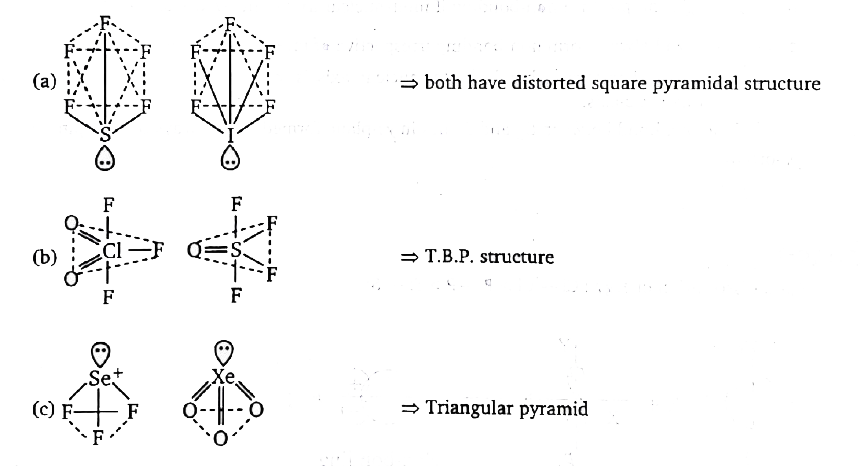
Which of the following does not represent the isostructural pair ?

A

`SF_(5)^(-) and IF_(5)`

B

`ClO_(2)F_(3) and SOF_(4)`

C

`SeF_(3)^(+) and XeO_(3)`

D

None

Text Solution

Verified by Experts

The correct Answer is:
D

Promotional Banner

Topper's Solved these Questions

  • CHEMICAL BONDING (BASIC)

    VK JAISWAL|Exercise Level 3 (Passive 2)|6 Videos
  • CHEMICAL BONDING (BASIC)

    VK JAISWAL|Exercise Level 3 (Passive 7)|6 Videos
  • CHEMICAL BONDING (BASIC)

    VK JAISWAL|Exercise Level 3 (Passive 11)|6 Videos
  • CHEMICAL BONDING (ADVANCED)

    VK JAISWAL|Exercise SUBJECTIVE PROBLEMS|72 Videos
  • CO-ORDINATION COMPOUNDS

    VK JAISWAL|Exercise ASSERTION-REASON TYPE QUESTIONS|26 Videos

Similar Questions

Explore conceptually related problems

According to VSEPR model, molecules adopt geometries in which their valence electron pairs position themselves as far from each other as possible. The VSEPR model considers double and triple bonds to have slightly greater repulsive effects than single bonds because of the repulsive effect of pi -electrons. However the lone pair creates the maximum repulsive effect. Which of the following statement is false ?

According to VSEPR model, molecules adopt geometries in which their valence electron pairs position themselves as far from each other as possible. The VSEPR model considers double and triple bonds to have slightly greater repulsive effects than single bonds because of the repulsive effect of pi -electrons. However the lone pair creates the maximum repulsive effect. Select the incorrect statement with respect to SO_(2)Cl_(2) molecule :

Assertion : In IOF_(4)^(-) a single lone pair is present an iodine atom trans to oxygen to have minimum repulsion between the I=0 and the lone pair of electrons. Reason : The VSEPR model consider double and triple bonds to have slightly greater repulsive effect then single bonds bonds because of the repulsive effective pi electrons

Amines are basic in nature due to the presence of lone pair of electrons on N atom of -NH_(2) group. The basic strength of amines can be expressed by their dissociation constant, K_(b) or pK_(b) . RNH_(2) + H_(2) to R NH_(3)^(+) + OH^(-) K_(b) = ([RHH_(3)^(+)][OH^(-)])/([RNH_(2)]) and pK_(b) = -log K_(b) Greater the K_(b) value or smaller the pK_(b) value, more is the basic strength of amine. Aliphatic amines are stronger bases than ammonia due to the electron releasing effect of alkyl groups. The basic strength among amines decreases as : 2^(@) gt 1^(@) gt 3^(@) Aryl amines such as aniline are less basic than aliphatic amines due to the involvement of lone pair of electrons on N atom with the resonance in benzene. In derivatives of aniline, the electron releasing groups increase the basic strength while electron withdrawing groups decrease the basic strength. The base weakening effect of electron withdrawing group and base strengthening effect of electron releasing group is more marked at p-position than at m-position. Every o- substituted aniline is less basic than aniline due to ortho effect. Which of the following group does not decrease the basic strength of aniline ?

The approximate shape of a molecule can often be predicted by using what is called the valence-shell electron-pair repulsion (VSEPR) model. Electrons in bonds and in lone pairs can be thought of a ''charge cloud'' that repel one another nad stay as far apart as possible, thus causing molecules to assume specific shapes. The repulsive interactions of electron pairs decrease in the order: Lone pair - Lone pair gt Lone pair - Bond pair gt Bond pair - Bond pair These repulsive effects result in deviations from idealised shapes and alteration in bond angles in molecules. Which of the following statement is correct with respect ot bond angles?

The approximate shape of a molecule can often be predicted by using what is called the valence-shell electron-pair repulsion (VSEPR) model. Electrons in bonds and in lone pairs can be thought of a ''charge cloud'' that repel one another nad stay as far apart as possible, thus causing molecules to assume specific shapes. The repulsive interactions of electron pairs decrease in the order: Lone pair - Lone pair gt Lone pair - Bond pair gt Bond pair - Bond pair These repulsive effects result in deviations from idealised shapes and alteration in bond angles in molecules. Which of the following statements is incorrect?

