Home
Class 12
CHEMISTRY
D(+) Glucose has melting point 140^(@)C ...

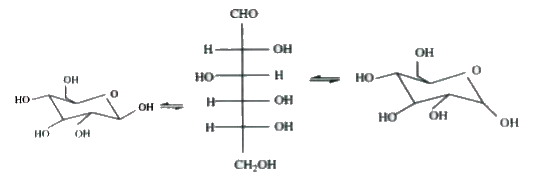
`D(+)` Glucose has melting point `140^(@)C` and specific rotation `[a]_(D)^(25)` is `112^(@)C`. Another D(+) Glucose has melting point `150^(@)C` and specific rotation `[a]_(D)^(25)` is `+18.7^(@)C`. The two form have significantly different optical rotation but when an aqueous solution of either form is allowed to stand, it rotation changes. The specific rotation of one form decreases and rotation of other increases until both solution show the same value `+52.7^(@)`. The change in rotation towards an equilibrium value is called mutarotation

`[alpha]_(D)^(25) = +18.7^(@)C " " [alpha]_(D)^(25) = +112^(@)C`
Mutarotation is characteristic feature of

A

Epimer

B

Enantiomer

C

Anomer

D

Ring chain isomer

Text Solution

Verified by Experts

The correct Answer is:

C

Mutarotation
Promotional Banner

Topper's Solved these Questions

  • CARBOHYDRATES

    AAKASH SERIES|Exercise Practice Sheet-4|30 Videos
  • CARBOHYDRATES

    AAKASH SERIES|Exercise Practice Sheet-5|30 Videos
  • CARBOHYDRATES

    AAKASH SERIES|Exercise Practice Sheet-2|30 Videos
  • BIOMOLECULES

    AAKASH SERIES|Exercise OBJECTIVE EXERCISE-4 (ASSERTION (A) & REASON (R) TYPE QUESTIONS :)|84 Videos
  • CARBOXYLIC ACIDS

    AAKASH SERIES|Exercise PRACTICE SHEET-4 (Integer Type Questions)|9 Videos

Similar Questions

Explore conceptually related problems

D(+) Glucose has melting point 140^(@)C and specific rotation [a]_(D)^(25) is 112^(@)C . Another D(+) Glucose has melting point 150^(@)C and specific rotation [a]_(D)^(25) is +18.7^(@)C . The two form have significantly different optical rotation but when an aqueous solution of either form is allowed to stand, it rotation changes. The specific rotation of one form decreases and rotation of other increases until both solution show the same value +52.7^(@) . The change in rotation towards an equilibrium value is called mutarotation [alpha]_(D)^(25) = +18.7^(@)C " " [alpha]_(D)^(25) = +112^(@)C For mannose the mutarotation can be shown in brief as follow

D(+) Glucose has melting point 140^(@)C and specific rotation [a]_(D)^(25) is 112^(@)C . Another D(+) Glucose has melting point 150^(@)C and specific rotation [a]_(D)^(25) is +18.7^(@)C . The two form have significantly different optical rotation but when an aqueous solution of either form is allowed to stand, it rotation changes. The specific rotation of one form decreases and rotation of other increases until both solution show the same value +52.7^(@) . The change in rotation towards an equilibrium value is called mutarotation [alpha]_(D)^(25) = +18.7^(@)C " " [alpha]_(D)^(25) = +112^(@)C What percentage of beta-D-(+) glucopyranose found at equilibrium in the aqueous solution?

The specific rotation of aqueous sucrose is

Change in optical rotation of sucrose solution due to hydrolysis is called

Change in optical rotation of sucrose solution due to hydrolysis is called

In the representation of specific rotation ([alpha]_(D)^(250C)) , .D. indicates

A racemic mixture has a net rotation

The specific rotation of a freshly prepared solution of alpha-D- Glucose changes from a value of x^(@) to a constant value of y^(@) . The values of x and y are respectively

AAKASH SERIES-CARBOHYDRATES-Practice Sheet-3
  1. The correct statement about the following disaceharide is

    Text Solution

    |

  2. Which of the following is/are true regarding mutarotaion?

    Text Solution

    |

  3. What is/are true regarding epimers and epimerization?

    Text Solution

    |

  4. What is /are true regarding (+) maltose-a disaccharide?

    Text Solution

    |

  5. The correct statement is/are

    Text Solution

    |

  6. What is /are true regarding amylose?

    Text Solution

    |

  7. D(+) Glucose has melting point 140^(@)C and specific rotation [a](D)^(...

    Text Solution

    |

  8. D(+) Glucose has melting point 140^(@)C and specific rotation [a](D)^(...

    Text Solution

    |

  9. D(+) Glucose has melting point 140^(@)C and specific rotation [a](D)^(...

    Text Solution

    |

  10. P and Q are isomers C(4)H(4)O(4) of dicarboxylic acid both decolorise ...

    Text Solution

    |

  11. P and Q are isomers C(4)H(4)O(4) of dicarboxylic acid both decolorise ...

    Text Solution

    |

  12. Match the following columns

    Text Solution

    |

  13. Match the following columns

    Text Solution

    |

  14. Match the following columns

    Text Solution

    |

  15. Number of ATP molecules involved in the synthesis of each molecule of ...

    Text Solution

    |

  16. How many of them are non reducing sugars among the following: Glucose,...

    Text Solution

    |

  17. When glucose is reacted with bromine water the major product is 'x', i...

    Text Solution

    |

  18. In lactose Number of mono saccharide units are present

    Text Solution

    |

  19. Number of Functional groups are present is saccharides (comonly)

    Text Solution

    |

  20. In the formation of Raffinose how many water molecules are eliminated ...

    Text Solution

    |
