Home
Class 11
PHYSICS
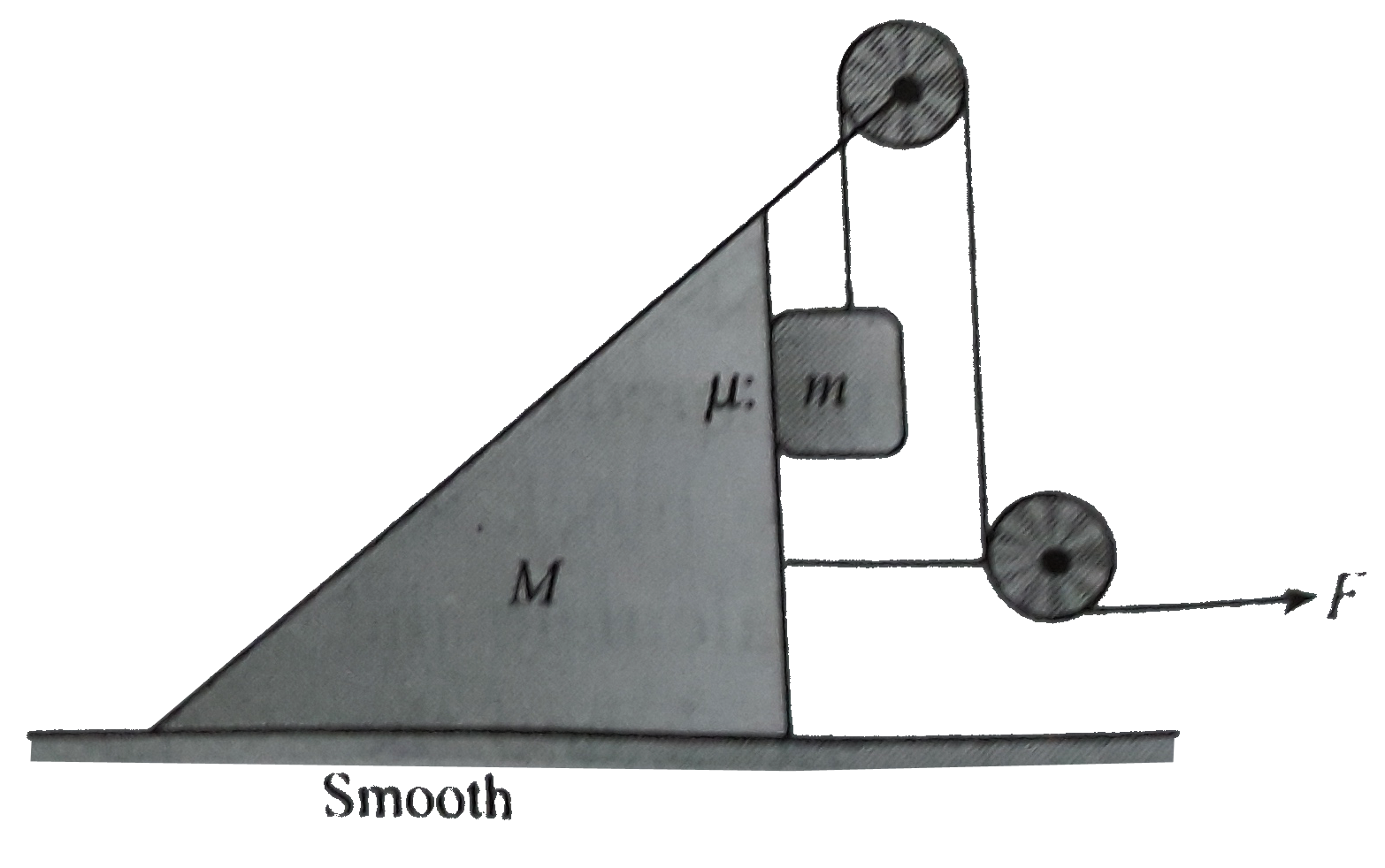
The mass of the wedge shown in fig is M...

The mass of the wedge shown in fig is `M = 4 kg` and that of block is `m = 1 kg` The horizontal surface beneath the wedge is smooth while the wedge and block is equal to `mu = 0.1` Taking `g = 9.8 ms^(-2)` and assuming puylley to be massless and friction . calculate maximum posible value of force `F` upto while the block will remain stationary relative to the wedge

Text Solution

Verified by Experts

The correct Answer is:
`10 N`

Since thread is pulled to the force `F` therefore tension in it is also equal to F. This tension acts on the block vertically upward Hence , it has the tendency to slip up along the vertical surface of the wedge hence the friction on the block will act vertical downward .
Since the horizontal force acting on the system on the wedge and block is F therefore the system will acceleration horizontally rigthward and block remain stationary ralative to wedge therefore the acceleration of block and the wedge is identical this acceleration `a = (F)/(m + M)`
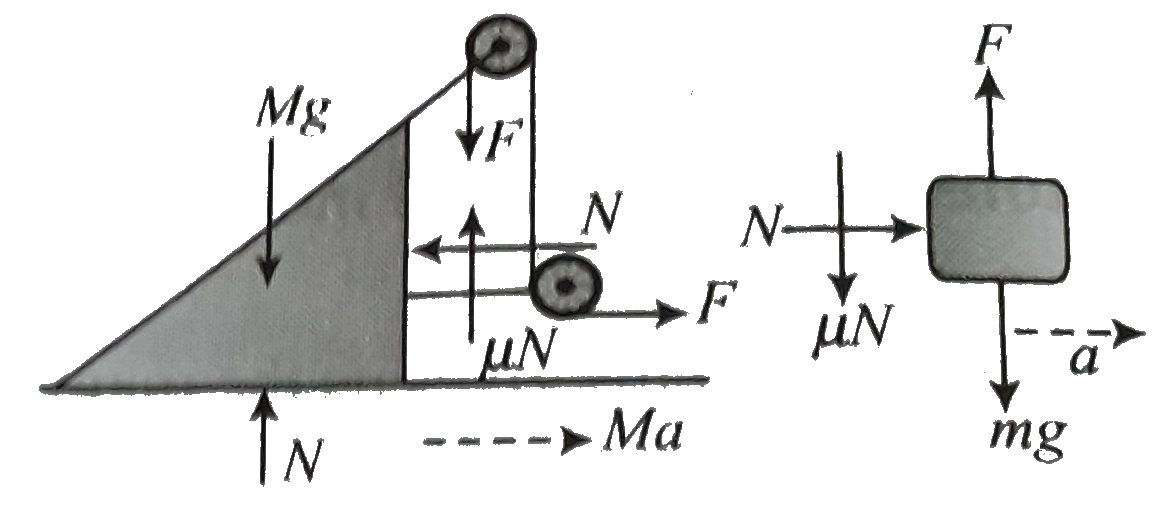
Maximum value of force `F` will correpond to limiting friction hence `FBD` will be as shown in figure

For horizontal force on the block `N = ma`
`N = (mF)/(m + M)` or `N = (F)/(5)`
For vertical equilibrium of the block
`F = mu N + mg or F = 10 N`
Promotional Banner

Topper's Solved these Questions

  • NEWTON'S LAWS OF MOTION 2

    CENGAGE PHYSICS ENGLISH|Exercise Single Correct|87 Videos
  • NEWTON'S LAWS OF MOTION 2

    CENGAGE PHYSICS ENGLISH|Exercise Multiple Correct|2 Videos
  • NEWTON'S LAWS OF MOTION 2

    CENGAGE PHYSICS ENGLISH|Exercise Exercise 7.3|27 Videos
  • NEWTON'S LAWS OF MOTION 1

    CENGAGE PHYSICS ENGLISH|Exercise Integer|5 Videos
  • PROPERTIES OF SOLIDS AND FLUIDS

    CENGAGE PHYSICS ENGLISH|Exercise INTEGER_TYPE|2 Videos

Similar Questions

Explore conceptually related problems

An arrangement is shown in the figure . The mass of the wedge is 4 kg and that of the block is 1 kg . There is no friction between wedge and ground , but coefficient of friction between vertical surface of the wedge and to the block is mu= 0.1. . (Assume ideal pulley and string) (g = 10 m//s^(2)) and assuming the pulley to be massless and friction. calucalate the maximum possible values of force upto while bock remain stationary relative to wedge.

A horizontal force F pushes wedge of mass M on a smooth horizontal surface. A block of mass m is stationary to the wedge, then:

In the arrangement shown in fig. the block of mass m=2kg lies on the wedge of mass M=8kg . The initial acceleration of the wedge, if the surfaces are smooth, is

A block of mass 'm' is kept on a smooth moving wedge. If the acceleration of the wedge is 'a'

A block of mass m is placed on the inclined sufrace of a wedge as shown in fig. Calculate the acceleration of the wedge and the block when the block is released. Assume all surfaces are frictionless.

A block of mass m is placed at rest on a smooth wedge of mass M placed at rest on a smooth horizontal surface. As the system is released

A block of mass m rests on a stationary wedge of mass M. The wedge can slide freely on a smooth horizontal surface as shown in figure. If the block starts from rest

Calculate angle of friction between wedge and block system is at rest M coefficient of friction between wedge and block.

In the diagram shown in figure wedge of mass M is stationary. Block of mass m=2 kg is slipping down. Force of friction on the wedge from ground is (g=10 m//s^(2))

A block of mass m is placed on a wedge of mass M. Coefficient between then is mu lt cot theta . The wedge is given an acceleration to its left. Find the maximum acceleration at which block apears stationary relative to wedge.

CENGAGE PHYSICS ENGLISH-NEWTON'S LAWS OF MOTION 2-Subjective
  1. Block A as shown in figure weight 1.40 N and block B weight 4.20 N The...

    Text Solution

    |

  2. Two block , with masses m(1) and m(2) are staked as shown in fig and p...

    Text Solution

    |

  3. Block A has a mass of 30 kg and block B has a mass of 15 kg . The coef...

    Text Solution

    |

  4. Block A weight 20 kg placed on a smooth surface. Weight B of 2 kg is m...

    Text Solution

    |

  5. In figure find the acceleration of m assuming that there is friction b...

    Text Solution

    |

  6. The masses of the block A and B are m and M Between A and B there is a...

    Text Solution

    |

  7. Two block of masses m and M are connected by a chord passing around a ...

    Text Solution

    |

  8. A block with mass m(1) is placed on an inclined plane with slope angle...

    Text Solution

    |

  9. Consider three blocks placed one over the other as shown in Fig. Let a...

    Text Solution

    |

  10. Four block are arranged on a smooth horizontal surface as shown in fi...

    Text Solution

    |

  11. A block of mass m is pressed against a wall which is moving with an ac...

    Text Solution

    |

  12. In the arrangement shown in figure pulleys are mass of block A,b and C...

    Text Solution

    |

  13. In the arrangement shown in figure mass of blocks A,B and C is 18.5 kg...

    Text Solution

    |

  14. A cubical block is experiencing three forces F(1) = 20 N acts at angle...

    Text Solution

    |

  15. A block of mass m = 3 kg is resting over a rough horizontal surface ha...

    Text Solution

    |

  16. The mass of the wedge shown in fig is M = 4 kg and that of block is m...

    Text Solution

    |

  17. Block B of mass m(B) = 0.5 kg rests on block A, with mass m(A) = 1.5kg...

    Text Solution

    |

  18. With two hands you hold a cone motionless upside doen , as shown in fi...

    Text Solution

    |

  19. A prismatic block of mass m is kept on a groove . The bottom line of t...

    Text Solution

    |

  20. A block of mass m(1) connected with another of mass m(2) by a light s...

    Text Solution

    |

