Home
Class 11
PHYSICS
A particle P is sliding down a frictionl...

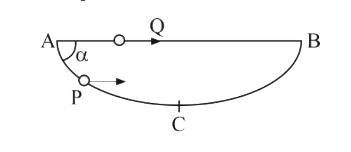
A particle P is sliding down a frictionless hemispherical bowl. It passes the point A at t = 0. At this instant of time, the horizontal component of its velocity is v. A bead Q of the same mass as P is ejected from A at t = 0 along the horizontal string AB, with a speed v. Friction between the bead and the string may be neglected. Let tP and tQ be the respective times taken by P and Q to reach the point B. Then:

A

`t_(p) lt t_(Q)`

B

`t_(p) = t_(Q)`

C

`t_(p) gt t_(Q)`

D

`(t_(p))/(t_(Q)) = ("Length of are" ACB)/("Length of" AB)`

Text Solution

Verified by Experts

The correct Answer is:
a

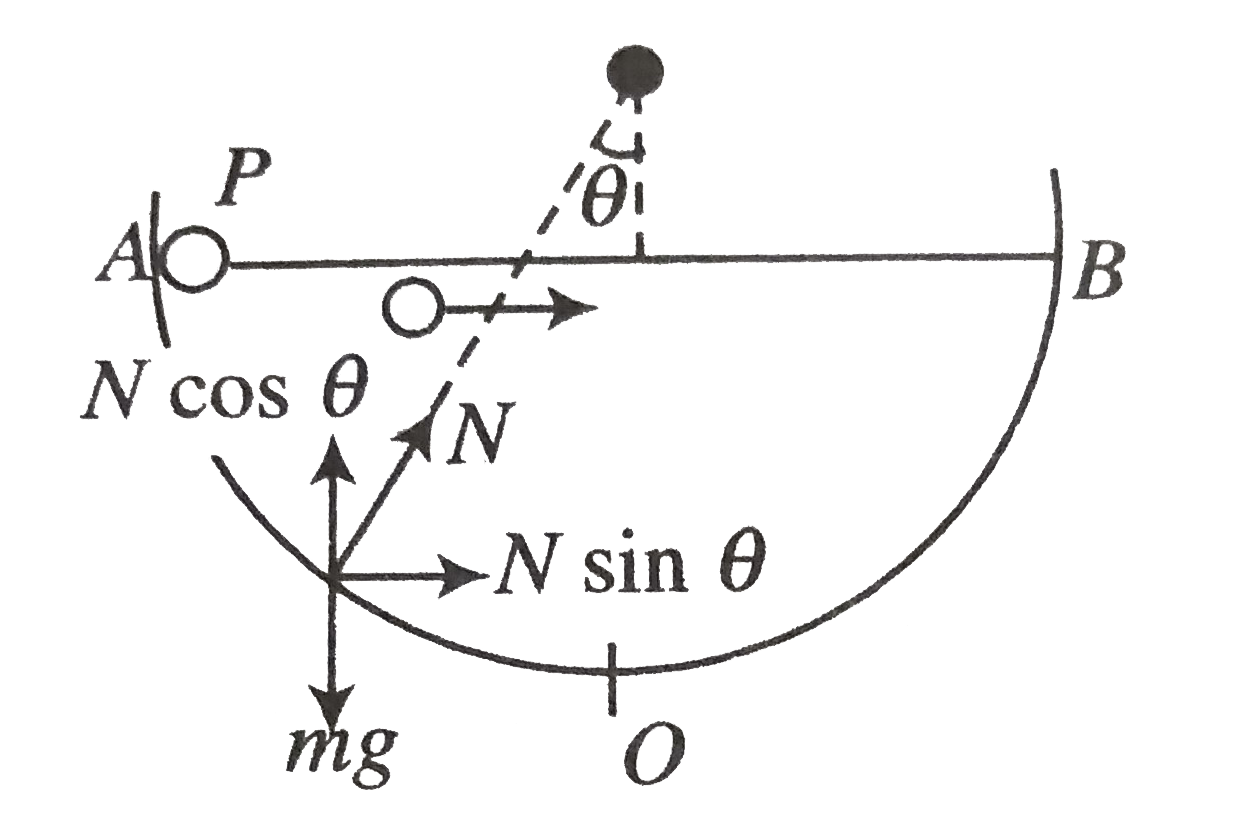
As `A` the horizontal speeds of both the masses is the same .The velocity of `Q` remain the same horizontal as so force it acting on the horizontal dipection but it case of P as shown at any internadiate position the horizontal velocity first increase (the as `N sin theta)` reaches a maximum value at O and then decreases this it always remain greater than v Therefore `t_(p) lt t_(Q)`

Promotional Banner

Topper's Solved these Questions

  • NEWTON'S LAWS OF MOTION 2

    CENGAGE PHYSICS ENGLISH|Exercise Assertion -reasoning|2 Videos
  • NEWTON'S LAWS OF MOTION 2

    CENGAGE PHYSICS ENGLISH|Exercise Integer type|1 Videos
  • NEWTON'S LAWS OF MOTION 2

    CENGAGE PHYSICS ENGLISH|Exercise Single correct answer type|13 Videos
  • NEWTON'S LAWS OF MOTION 1

    CENGAGE PHYSICS ENGLISH|Exercise Integer|5 Videos
  • PROPERTIES OF SOLIDS AND FLUIDS

    CENGAGE PHYSICS ENGLISH|Exercise INTEGER_TYPE|2 Videos

