Home
Class 12
PHYSICS
The mass density of a spherical body is ...

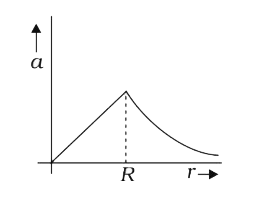
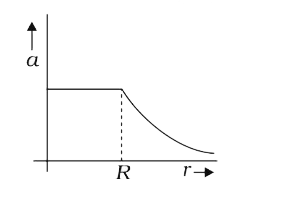
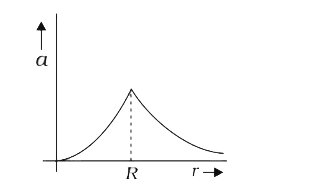
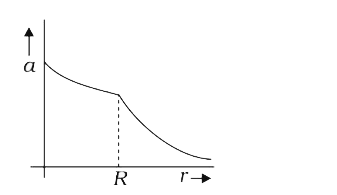
The mass density of a spherical body is given by `rho(r)=k/r` for `r le R` and `rho (r)=0`for r > R , where r is the distance from the centre. The correct graph that describes qualitatively the acceleration, a, of a test particle as a function of r is :

A

B

C

D

Text Solution

AI Generated Solution

The correct Answer is:

To solve the problem, we need to analyze the given mass density function and determine how it affects the gravitational acceleration of a test particle as a function of the distance \( r \) from the center of the spherical body. ### Step-by-Step Solution: 1. **Understanding the Mass Density**: The mass density of the spherical body is given by: \[ \rho(r) = \frac{k}{r} \quad \text{for } r \leq R \] and \[ \rho(r) = 0 \quad \text{for } r > R \] Here, \( k \) is a constant, and \( R \) is the radius of the sphere. 2. **Finding the Mass of a Shell**: To find the mass of a thin spherical shell of thickness \( dr \) at a distance \( r \) from the center, we use the formula for the volume of the shell: \[ dV = 4\pi r^2 dr \] The mass of this shell is: \[ dm = \rho(r) \cdot dV = \frac{k}{r} \cdot 4\pi r^2 dr = 4\pi k r \, dr \] 3. **Calculating the Total Mass Inside Radius \( r \)**: To find the total mass \( M(r) \) inside a radius \( r \), we integrate the mass of the shell from \( 0 \) to \( r \): \[ M(r) = \int_0^r 4\pi k r' \, dr' = 4\pi k \int_0^r r' \, dr' = 4\pi k \left[\frac{(r')^2}{2}\right]_0^r = 4\pi k \frac{r^2}{2} = 2\pi k r^2 \] 4. **Finding the Gravitational Field \( g(r) \)**: The gravitational field \( g(r) \) at a distance \( r \) from the center is given by: \[ g(r) = \frac{G M(r)}{r^2} \] Substituting \( M(r) \): \[ g(r) = \frac{G (2\pi k r^2)}{r^2} = 2\pi G k \] This shows that \( g(r) \) is constant for \( r \leq R \). 5. **Behavior for \( r > R \)**: For \( r > R \), the mass inside the sphere is constant (equal to \( M(R) \)). Thus, the gravitational field becomes: \[ g(r) = \frac{G M(R)}{r^2} \] Since \( M(R) = 2\pi k R^2 \), we have: \[ g(r) = \frac{G (2\pi k R^2)}{r^2} \] This indicates that \( g(r) \) decreases with \( r^2 \) for \( r > R \). 6. **Conclusion**: - For \( r \leq R \), \( g(r) \) is constant. - For \( r > R \), \( g(r) \) decreases as \( \frac{1}{r^2} \). ### Correct Graph: The graph of the gravitational acceleration \( g(r) \) as a function of \( r \) will be constant for \( r \leq R \) and will decrease for \( r > R \). Thus, the correct option is the one that shows a constant value for \( g \) up to \( R \) and a decreasing curve after \( R \).

To solve the problem, we need to analyze the given mass density function and determine how it affects the gravitational acceleration of a test particle as a function of the distance \( r \) from the center of the spherical body. ### Step-by-Step Solution: 1. **Understanding the Mass Density**: The mass density of the spherical body is given by: \[ \rho(r) = \frac{k}{r} \quad \text{for } r \leq R ...
Promotional Banner

Topper's Solved these Questions

  • GRAVITATION

    VMC MODULES ENGLISH|Exercise JEE Advance (Archive) SINGLE OPTION CORRECT|14 Videos
  • GRAVITATION

    VMC MODULES ENGLISH|Exercise JEE Advance (Archive) MULTIPLE OPTIONS CORRECT TYPE|5 Videos
  • GRAVITATION

    VMC MODULES ENGLISH|Exercise Level-2|30 Videos
  • GASEOUS STATE & THERMODYNAMICS

    VMC MODULES ENGLISH|Exercise JEE ADVANCED (ARCHIVE )|111 Videos
  • INTRODUCTION TO VECTORS & FORCES

    VMC MODULES ENGLISH|Exercise JEE Advanced ( ARCHIVE LEVEL-2)|12 Videos

Similar Questions

Explore conceptually related problems

Find the gravitational potential due to a spherical shell of mass M and radius R at r lt R and r gt R , where r is the distance from the centre of the shell.

Let there be a spherical symmetric charge density varying as p(r )=p_(0)(r )/(R ) upto r = R and rho(r )=0 for r gt R , where r is the distance from the origin. The electric field at on a distance r(r lt R) from the origin is given by -

The density inside a solid sphere of radius a is given by rho=rho_0/r , where rho_0 is the density at the surface and r denotes the distance from the centre. Find the gravitational field due to this sphere at a distance 2a from its centre.

The potential energy function of a particle is given by U(r)=A/(2r^(2))-B/(3r) , where A and B are constant and r is the radial distance from the centre of the force. Choose the correct option (s)

Let there be a spherically symmetric charge distribution with charge density varying as rho(r)=rho(5/4-r/R) upto r=R , and rho(r)=0 for rgtR , where r is the distance from the origin. The electric field at a distance r(rltR) from the origin is given by

The density inside a solid sphere of radius a is given by rho=rho_0/r , where rho_0 is the density ast the surface and r denotes the distance from the centre. Find the graittional field due to this sphere at a distance 2a from its centre.

The mass density of a spherical galaxy varies as (K)/(r) over a large distance 'r' from its centre . In that region , a small star is in a circular orbit of radius R . Then the period of revolution , T depends on R as :

Charge density of a sphere of radius R is rho = rho_0/r where r is distance from centre of sphere.Total charge of sphere will be

Let a total charge 2Q be distributed in a sphere of radius R, with the charge density given by , rho(r)=kr , where r is the distance from the centre. Two charge A and B, of –Q each, are placed on diametrically opposite points, at equal distance, a from the centre. If A and B do not experience any force, then:

The potential energy of a particle in a force field is: U = (A)/(r^(2)) - (B)/(r ) ,. Where A and B are positive constants and r is the distance of particle from the centre of the field. For stable equilibrium the distance of the particle is

VMC MODULES ENGLISH-GRAVITATION-JEE Main (Archive)
  1. The dependence of acceleration due to gravity g on the distance r from...

    Text Solution

    |

  2. If the earth has no rotational motion, the weight of a person on the e...

    Text Solution

    |

  3. The mass density of a spherical body is given by rho(r)=k/r for r le R...

    Text Solution

    |

  4. Suppose that angular velocity of rotation of earth is increased. Then...

    Text Solution

    |

  5. The relative uncertainty in the period of a satellite orbiting around ...

    Text Solution

    |

  6. A body of mass m is moving in a circular orbit of radius R about a pla...

    Text Solution

    |

  7. Take the mean distance of the moon and the sun from the earth to be0.4...

    Text Solution

    |

  8. Four identical particles of mass M are located at the corners of a squ...

    Text Solution

    |

  9. A rocket has to be launched from earh in such a way that it never retu...

    Text Solution

    |

  10. A solid sphere of radius a and mass m is surrounded by cocentric spher...

    Text Solution

    |

  11. A test particle is moving in a circular orbit in the gravitational fie...

    Text Solution

    |

  12. A ball is thrown upward with an initial velocity V0 from the surface o...

    Text Solution

    |

  13. If g is acceleration due to gravity on the surface of the earth, havin...

    Text Solution

    |

  14. A spaceship orbits around a planet at a height of 20 km from its surfa...

    Text Solution

    |

  15. The ratio of the weight of a body on the Earth’s surface to that on th...

    Text Solution

    |

  16. The energy required to take a satellite to a height ‘h’ above Earth su...

    Text Solution

    |

  17. If the angular momentum of a planet of mass m, moving around the Sun i...

    Text Solution

    |

  18. Two stars of masses 3 xx 10^(31) kg each, and at distance 2 xx 10^(11)...

    Text Solution

    |

  19. A satellite is moving with a constant speed v in circular orbit around...

    Text Solution

    |

  20. A satellite is revolving in a circular orbit at a height h from the ea...

    Text Solution

    |
