Home
Class 12
PHYSICS
A spherically symmetric gravitational sy...

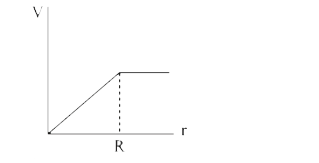
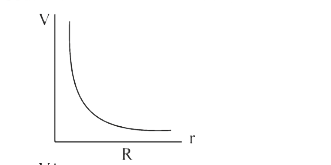
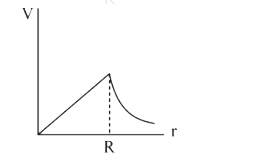
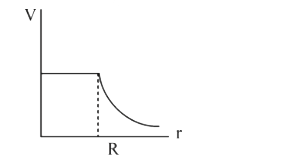
A spherically symmetric gravitational system of particles has a mass density` rho={(rho_0,for, r,lt,R),(0,for,r,gt,R):}` where`rho_0` is a constant. A test mass can undergo circular motion under the influence of the gravitational field of particles. Its speed v as a function of distahce `r(0ltrltOO)` form the centre of the system is represented by

A

B

C

D

Text Solution

AI Generated Solution

The correct Answer is:

To solve the problem of determining the speed \( v \) of a test mass undergoing circular motion in a spherically symmetric gravitational system, we will analyze two cases based on the distance \( r \) from the center of the system. ### Step-by-Step Solution **Step 1: Define the mass density and gravitational field** Given the mass density: \[ \rho = \begin{cases} \rho_0 & \text{for } r < R \\ 0 & \text{for } r \geq R \end{cases} \] The gravitational field \( g \) at a distance \( r \) from the center can be derived using Gauss's law for gravity. **Step 2: Case 1: For \( r \geq R \)** When \( r \geq R \), the gravitational field \( g \) is due to the entire mass enclosed within radius \( R \). The mass \( M \) within radius \( R \) can be calculated as: \[ M = \rho_0 \cdot \frac{4}{3} \pi R^3 \] The gravitational field \( g \) at distance \( r \) (where \( r \geq R \)) is given by: \[ g = \frac{GM}{r^2} = \frac{G \left( \rho_0 \cdot \frac{4}{3} \pi R^3 \right)}{r^2} \] **Step 3: Relate gravitational force to centripetal force** For circular motion, the centripetal force required is provided by the gravitational force: \[ \frac{mv^2}{r} = mg \] Substituting for \( g \): \[ \frac{mv^2}{r} = m \cdot \frac{G \left( \rho_0 \cdot \frac{4}{3} \pi R^3 \right)}{r^2} \] Cancelling \( m \) from both sides: \[ \frac{v^2}{r} = \frac{G \left( \rho_0 \cdot \frac{4}{3} \pi R^3 \right)}{r^2} \] Rearranging gives: \[ v^2 = \frac{G \left( \rho_0 \cdot \frac{4}{3} \pi R^3 \right)}{r} \] Thus, we find: \[ v \propto \frac{1}{\sqrt{r}} \] **Step 4: Case 2: For \( r < R \)** For \( r < R \), the gravitational field \( g \) is due only to the mass within radius \( r \): \[ M' = \rho_0 \cdot \frac{4}{3} \pi r^3 \] Thus, the gravitational field \( g \) is: \[ g = \frac{GM'}{r^2} = \frac{G \left( \rho_0 \cdot \frac{4}{3} \pi r^3 \right)}{r^2} = \frac{G \rho_0 \cdot \frac{4}{3} \pi r}{3} \] **Step 5: Relate gravitational force to centripetal force** Again, using the centripetal force: \[ \frac{mv^2}{r} = mg \] Substituting for \( g \): \[ \frac{mv^2}{r} = m \cdot \frac{G \rho_0 \cdot \frac{4}{3} \pi r}{3} \] Cancelling \( m \): \[ \frac{v^2}{r} = \frac{G \rho_0 \cdot \frac{4}{3} \pi r}{3} \] Rearranging gives: \[ v^2 = \frac{G \rho_0 \cdot \frac{4}{3} \pi}{3} r^2 \] Thus, we find: \[ v \propto r \] ### Conclusion The speed \( v \) as a function of distance \( r \) from the center of the system is represented by: - For \( r < R \): \( v \propto r \) (linear relationship) - For \( r \geq R \): \( v \propto \frac{1}{\sqrt{r}} \) (inverse square root relationship)

To solve the problem of determining the speed \( v \) of a test mass undergoing circular motion in a spherically symmetric gravitational system, we will analyze two cases based on the distance \( r \) from the center of the system. ### Step-by-Step Solution **Step 1: Define the mass density and gravitational field** Given the mass density: \[ ...
Promotional Banner

Topper's Solved these Questions

  • GRAVITATION

    VMC MODULES ENGLISH|Exercise JEE Advance (Archive) MULTIPLE OPTIONS CORRECT TYPE|5 Videos
  • GRAVITATION

    VMC MODULES ENGLISH|Exercise JEE Advance (Archive)ASSERTIOIN AND REASON|1 Videos
  • GRAVITATION

    VMC MODULES ENGLISH|Exercise JEE Main (Archive)|43 Videos
  • GASEOUS STATE & THERMODYNAMICS

    VMC MODULES ENGLISH|Exercise JEE ADVANCED (ARCHIVE )|111 Videos
  • INTRODUCTION TO VECTORS & FORCES

    VMC MODULES ENGLISH|Exercise JEE Advanced ( ARCHIVE LEVEL-2)|12 Videos

Similar Questions

Explore conceptually related problems

Two particles of equal mass go around a circle of radius R under the action of their mutual gravitational attraction. The speed v of each particle is

Two particles of equal mass go round a circle of radius R under the action of their mutual gravitational attraction. Find the speed of each particle.

Which one of the following plots represents the variation of the gravitational field on a particle with distance r due to a thin spherical shell of raduis R ? ( r is measured from the centre of the spherical shell).

The density inside a solid sphere of radius a is given by rho=rho_0/r , where rho_0 is the density at the surface and r denotes the distance from the centre. Find the gravitational field due to this sphere at a distance 2a from its centre.

Three particles of equal mass M each are moving on a circular path with radius r under their mutual gravitational attraction. The speed of each particle is

A particle of mass M moves with constant speed along a circular path of radius r under the action of a force F. Its speed is

The density inside a solid sphere of radius a is given by rho=rho_0/r , where rho_0 is the density ast the surface and r denotes the distance from the centre. Find the graittional field due to this sphere at a distance 2a from its centre.

Find the gravitational potential due to a spherical shell of mass M and radius R at r lt R and r gt R , where r is the distance from the centre of the shell.

Four particles of equal masses M move along a circle of radius R under the action of their mutual gravitational attraction. Find the speed of each particle.

Two particles of equal mass (m) each move in a circle of radius (r) under the action of their mutual gravitational attraction find the speed of each particle.
