Home
Class 12
CHEMISTRY
The state of a mole of an ideal gas chan...

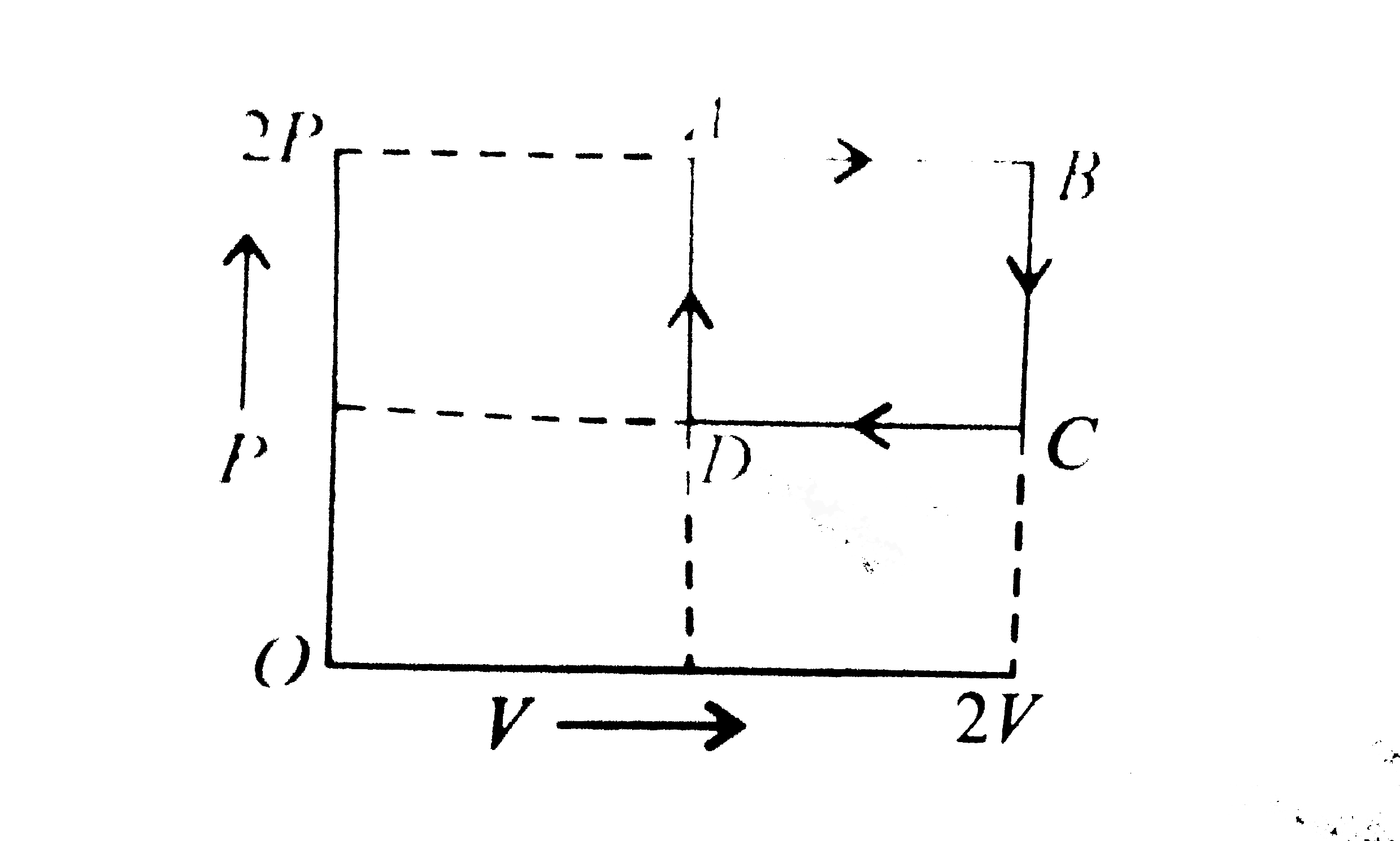
The state of a mole of an ideal gas changed from state `A` at pressure `2P` and volume `V` follows four different processes and finally returns to initial state `A` reversibly as shown below in the graph. By interpreting the graph, answer the following questions.

What would be the work done in state `B to C`?

A

`PV`

B

PV

C

2PV

D

Zero

Text Solution

Verified by Experts

The correct Answer is:

D

In Converstion from B to C, volume does not change or `DeltaV =0`, therefore w=0
Promotional Banner

Topper's Solved these Questions

  • THERMODYNAMICS

    VMC MODULES ENGLISH|Exercise LEVEL-2 (NUMERICAL VALUE TYPE)|15 Videos
  • THERMODYNAMICS

    VMC MODULES ENGLISH|Exercise JEE (MAIN ARCHIVE)|32 Videos
  • THERMODYNAMICS

    VMC MODULES ENGLISH|Exercise LEVEL-1|75 Videos
  • THERMOCHEMISTRY

    VMC MODULES ENGLISH|Exercise JEE ADVANCED (ARCHIVE)|31 Videos
  • THERMODYNAMICS & THERMOCHEMISTRY

    VMC MODULES ENGLISH|Exercise Impeccable|48 Videos

Similar Questions

Explore conceptually related problems

The state of a mole of an ideal gas changed from state A at pressure 2P and volume V follows four different processes and finally returns to initial state A reversibly as shown below in the graph. By interpreting the graph, answer the following questions. what would the be total work done by the gas?

The state of a mole of an ideal gas changed from state A at pressure 2P and volume V follows four different processes and finally returns to initial state A reversibly as shown below in the graph. By interpreting the graph, answer the following questions. what would the be total done by the gas?

The state of a mole of an ideal gas changed from state A at pressure 2P and volume V follows four different processes and finally returns to initial state A reversibly as shown below in the graph. By interpreting the graph, answer the following questions. What would be the heat obsorbed by the system in this cyclic process?

The state of a mole of an ideal gas changed from state A at pressure 2P and volume V follows four different processes and finally returns to initial state A reversibly as shown below in the graph. By interpreting the graph, answer the following questions. Which is the kind of process followed from state A to state, B ?

The state of a mole of an ideal gas changed from state A at pressure 2P and volume V follows four different processes and finally returns to initial state A reversibly as shown below in the graph. By interpreting the graph, answer the following questions. Which is the kind of process followed from state A to state, B ?

The state of a mole of an ideal gas changed from state A at pressure 2P and volume V follows four different processes and finally returns to initial state A reversibly as shown below in the graph. By interpreting the graph, answer the following questions. In state D to state A , what kind of process is followed?

The state of a mole of an ideal gas changed from state A at pressure 2P and volume V follows four different processes and finally returns to initial state A reversibly as shown below in the graph. By interpreting the graph, answer the following questions. In state D to state A , what kind of process is followed?

An ideal gas change from state a to state b as shown in Fig. what is the work done by the gas in the process?

One mole of an ideal gas is taken from state A to state B by three different processes (a) ACB , (b) ADB and (c ) AEB as shown in the P - V diagram. The heat absorbed by the gas is

One mole of an ideal gas is taken from state A to state B by three different processes (a) ACB , (b) ADB and (c ) AEB as shown in the P - V diagram. The heat absorbed by the gas is

VMC MODULES ENGLISH-THERMODYNAMICS-LEVEL-2
  1. The state of a mole of an ideal gas changed from state A at pressure 2...

    Text Solution

    |

  2. The state of a mole of an ideal gas changed from state A at pressure 2...

    Text Solution

    |

  3. The state of a mole of an ideal gas changed from state A at pressure 2...

    Text Solution

    |

  4. What would be the heat absorbed by the system in the cyclic process?

    Text Solution

    |

  5. A sample consisting of 1 mole of a mono-atomic perfect gas (C(v) = 3/2...

    Text Solution

    |

  6. A sample consisting of 1mol of a mono-atomic perfect gas (C(V) = (3)/(...

    Text Solution

    |

  7. A sample consisting of 1mol of a mono-atomic perfect gas (C(V) = (3)/(...

    Text Solution

    |

  8. A sample consisting of 1mol of a mono-atomic perfect gas (C(V) = (3)/(...

    Text Solution

    |

  9. The enthalpy of vaporization of chloroform is 29.4 kJmol^(-1) at its n...

    Text Solution

    |

  10. Combustion of sucuose is used by aeroic organisms for providing energy...

    Text Solution

    |

  11. The freezing of any liquid to a solid is expected to have:

    Text Solution

    |

  12. Industrial acetylene gas (ethyne: C(2)H(2)) is made by the high temper...

    Text Solution

    |

  13. Which one of the following statements is true

    Text Solution

    |

  14. Calculate the standard free energy change for the formation of methane...

    Text Solution

    |

  15. Given: Delta(f)H^(@) (kJ//mol) " " S(m)^(@)(J//K mol) {:( C Cl(4)(...

    Text Solution

    |

  16. Calculate the change in molar Gibbs energy of carbon dioxide gas at 20...

    Text Solution

    |

  17. Calculate Delta(r)S("sys")^(@) for the following reaction at 373 K: ...

    Text Solution

    |

  18. A certain process releases 64.0 kJ of heat, which is transferred to th...

    Text Solution

    |

  19. Which of the following is (are) correct?

    Text Solution

    |

  20. When ice melts at 1^(@)C :

    Text Solution

    |
