Home
Class 11
PHYSICS
Two blocks each of mass M are connected ...

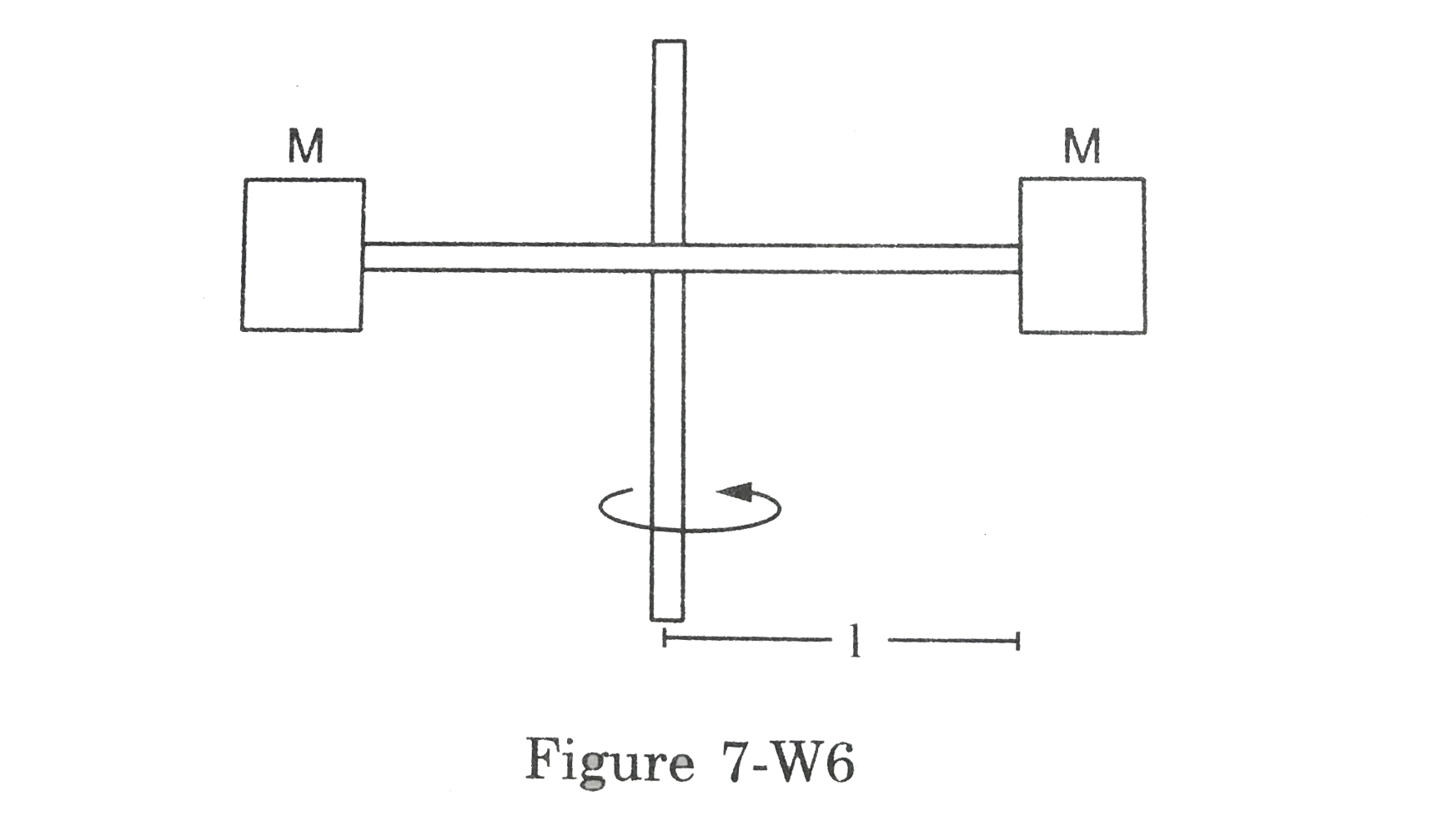
Two blocks each of mass M are connected to the ends of a light frame as shown in figure. The frame is rotated about the vertical line of symmetry. The rod breaks if the tension in it exceeds `T_0`. Find the maximum frequency with which the frame may be rotted without breaking the rod.

Text Solution

Verified by Experts

Consider one of the blocks. If the frequencey of revolution is f, the angular velocity is `omega=2pif`. The acceleration towards the centre is `v^2/l=omega^2l=4pi^2f^2l`. The only horizontal force on the blck is the tension of the rod. At the point of breaking this foce is `T_0`. So from Newton's second law
`T_0=M.4pi^2f^2l`
or `f=1/(2pi) [T_0/(Ml)]^(1/2)`
Promotional Banner

Topper's Solved these Questions

  • CIRCULAR MOTION

    HC VERMA|Exercise Question for short Answer|10 Videos
  • CIRCULAR MOTION

    HC VERMA|Exercise Objective -1|16 Videos
  • CIRCULAR MOTION

    HC VERMA|Exercise Exercises|30 Videos
  • CENTRE OF MASS, LINEAR MOMENTUM, COLLISION

    HC VERMA|Exercise Exercises|64 Videos
  • FLUID MECHANICS

    HC VERMA|Exercise All Questions|96 Videos

Similar Questions

Explore conceptually related problems

Two uniform identicla rods each of mass M and length l are joined to form a cross as shown in figure. Find the momet of inertia of the cross about a bisector as shown doted in the figure

A block of mass m and a pan of equal mass are connected by a string going over a smooth light pulley as shown in figure. Initially the system is at rest when a particle of mass m falls on the pan and sticks to it. If the particle strikes the pan with a speed v find the speed with which the system moves just after the collision.

Two small balls A and B each of mass m, are attached tightly to the ends of a light rod of length d. The structure rotates about the perpendicular bisector of the rod at an angular speed omega . Calculate the angular momentum of the individual balls and of the system about the axis of rotation.

Two small balls, each of mass m are connected by a light rigid rod of length L. The system is suspended from its centre by a thin wire of torsional constant k. The rod is rotated about the wire through an angle theta_0 and released. Find the tension in the rod as the system passes through the mean position.

Two blocks of equal mass m are tied to each other through light string. One of the blocks is pulled along the line joining them with a constant force F. Find the tension in the string joining the blocks.

Two bodies of masses m_1 and m_2 are connected by a light string going over a smooth lilght pulley at the end of an incline. The m_1 lies on the incline m_2 hangs vertically. The system is t rest. Find the angle of the incline and the fore exerted by the incline on the body of mass m_1.

In a rotor, a hollow vertical cylindrical structure rotates about its axis and a person rests against the inner wall. At a particular speed of the rotor, the floor below the person is removed and the person hangs resting against the wall without any floor. If the radius of the rotor is 2m and the coefficient of static friction between the wall and the person is 0.2, find the minimum speed at which the floor may be removed Take g=10 m/s^2 .

Two identical uniform rods AB and CD, each of length L are jointed to form a T-shaped frame as shown in figure. Locate the centre of mass of the frame. The centre of mass of a uniform rod is at the middle point of the rod.

Two small balls A and B each of mass m, are joined rigidly to the ends of a light rod of length L figure. The system translates on a frictionless horizontal surface with a velocity v_0 in a direction perpendicular to the rod. A particle P of mass kept at rest on the surface sticks to the ball A as the ball collides with it . Find a. the linear speeds of the balls A and B after the collision, b. the velocity of the centre of mass C of the system A+B+P and c. the angular speed of the system about C after the collision.

Three particles, each of mass m are situated at the vertices of an equilateral triangle ABC of side L as shown in the figure. Find the moment of inertia of the system about the line AX perpendicular to AB in the plane of ABC
