Home
Class 11
PHYSICS
A table with smooth horiztonal surface i...

A table with smooth horiztonal surface is truning at an angular speed `omega` abouyt its axis. A groove is made on the surface along a radius and a particle is gently placed inside the groove at a distance a from the centre. Find the speed of the speed of the particle as its distance from teh centre becomes L.

Text Solution

Verified by Experts
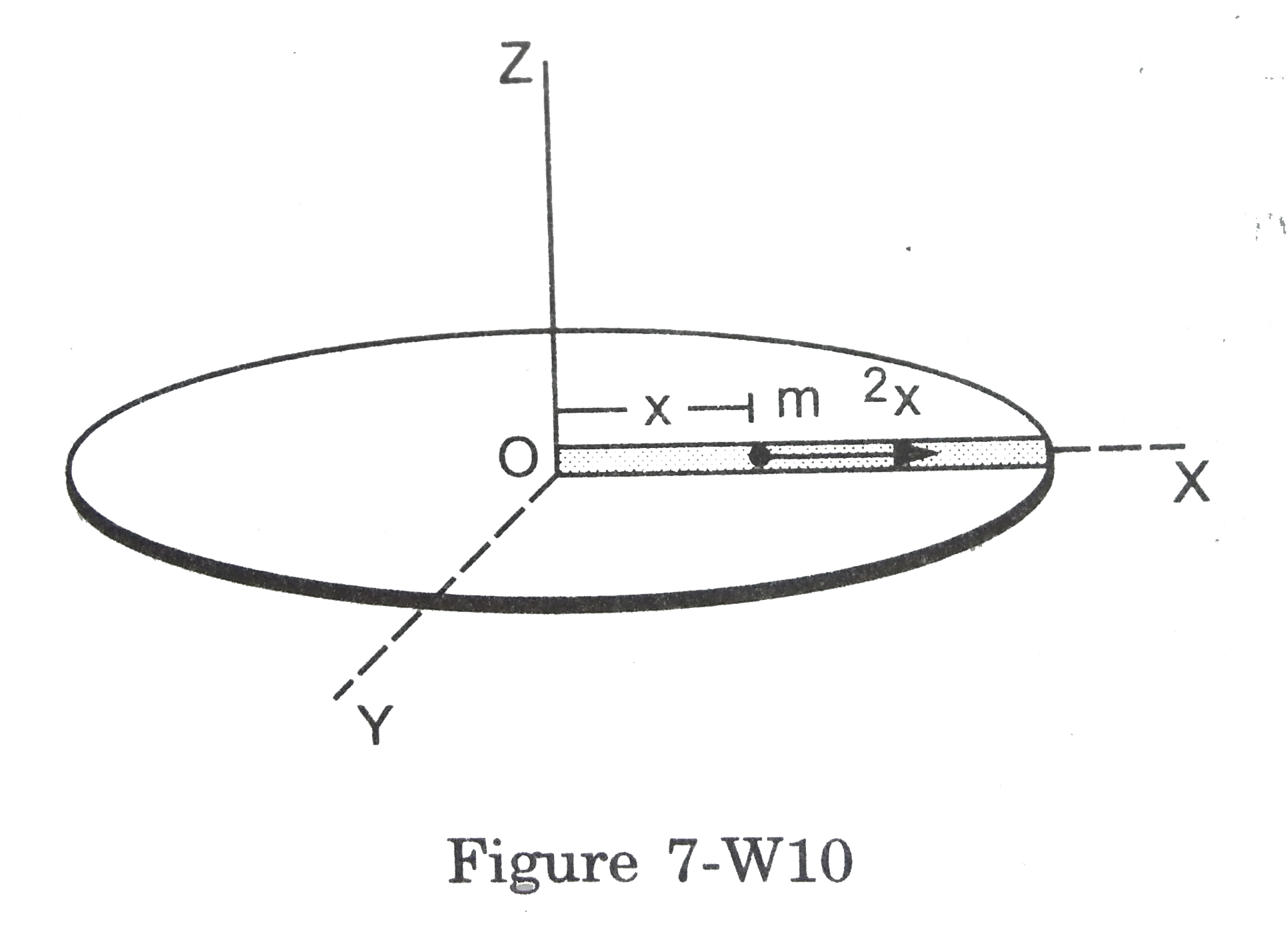
The situation is hwon in ure.

Let us work from the frame of reference of the table. Let us take the origin at the centre of rottion O an the X-axis along the groove ure. The Y-axis is along the lineperpendicular to OX coplaN/Ar with the surface of the table and the Z-axis is along the vertical.
Suppose at time t particle in the groove is at a distance x fromn the origin and is moving along The X-axis witha speed v. The forces acting on the particle (including the pseudeo forces that we must assume because we have taken our frame on the table which is rotating and is nonintertial) are
a. weight mg vetically downward
b. normal contact force `N_1` verticall upward by te bottom surfce of the groove,
c. normal contact force `N_2` parallel to the Y-axis by the side walls of the groove,
d. centrifugal force `momega^2x` alongthe X-axis, and
e. Coriolis force along Y-axis (coriolis force is perpendicular to the velocity of the particle and the axis of rotation).
As the particle can only move in the groove. Its acceleration is along the X-axis. The only force along teh X-axis is the centrifugal force `momega^2x`. all the other forces are perpendicular to the X-axis adn have no components along the X-axis.
Thus, the acceleration along the X-axis is
`a=F/m =(momega^2x)/m = omega^2x`
or, `(dv)/(dt)=omega^2x`
or ` (dv)/(dx).(dx)/(dt)=omega^2x`
or `(dv)/(dx).v=omega^2x`
or, ` v dv = omega^2 x dx `
or, `int^v_0 v dv = int^L_aomega^2 x dx `
or, ` [1/2 v^2]_0^v=[1/2 omega^2x^2]^L_a`
or, `v^2/2=1/2 omega^2(L^2-a^2)`
or, v=omega sqrt(L^2-a^2)`
Promotional Banner

Topper's Solved these Questions

  • CIRCULAR MOTION

    HC VERMA|Exercise Question for short Answer|10 Videos
  • CIRCULAR MOTION

    HC VERMA|Exercise Objective -1|16 Videos
  • CIRCULAR MOTION

    HC VERMA|Exercise Exercises|30 Videos
  • CENTRE OF MASS, LINEAR MOMENTUM, COLLISION

    HC VERMA|Exercise Exercises|64 Videos
  • FLUID MECHANICS

    HC VERMA|Exercise All Questions|96 Videos

Similar Questions

Explore conceptually related problems

A tunnel is dug along a diameter of the earth. Find the force on a particle of mass m placed in the tunnel at a distance x from the centre.

A ring of radius a contains a charge q distributed. uniformly ober its length. Find the electric field at a point. on the axis of the ring at a distance x from the centre.

A table with smooth horizontal surface is fixed in a cabin that rotates with a uniform angular velocity omega in a circular pathof radius R. A smooth groove AB of length L(ltltR) is made on the surface of the table. The groove makes an angle theta with the radius OA of the circle in which the cabin rotates. A small particle is kept at the point A in the groove and is released to move along AB. Find the time taken by tehparticle to reach the point B.

A positive charge q is placed in front of conducting solid cube at a distance d from its centre. Find the electric field at the centre of the cube due to the charges appearing on its surface.

Write down the moment of inertia of a disc of radius R and mass m about an axis in its plane at a distance R/2 from its centre.

The radius of the circle is 25 cm and the length of one of its chord is 40 cm. Find the distance of the chord from the centre.

The radius of the circle is 25 cm and the length of one of its chord is 40 cm. Find the distance of the chord from the centre.

A wheel is rotating at an angular speed omega about its axis which is kept vertical. An identical wheel initially at rest is gently dropped into the same axle and the two wheels start rotating with a common angular speed. Find this common angular speed.

The density inside a solid sphere of radius a is given by rho=rho_0/r , where rho_0 is the density ast the surface and r denotes the distance from the centre. Find the graittional field due to this sphere at a distance 2a from its centre.

A particle is kept at rest at a distance R (earth's radius) above the earth's surface, the minimum speed with which it should projected so that it does not return is

