Home
Class 11
PHYSICS
A block of mass m is pressed against a w...

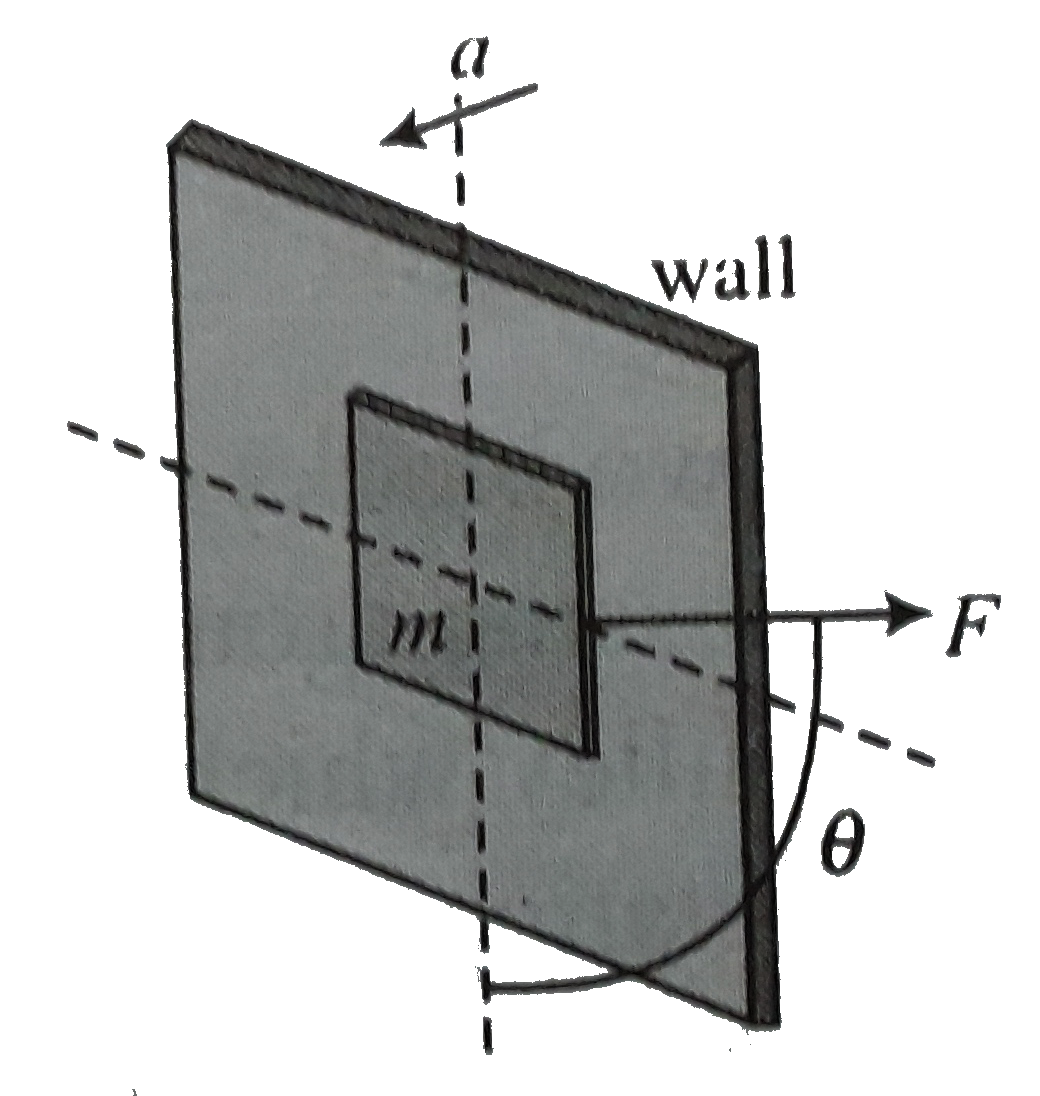
A block of mass `m` is pressed against a wall which is moving with an acceleration a as shown in figure If the block is pulled at an angle `theta` with downward vertical by a force `F` and it does not slide relative to the wall . Find the
a. friction force between the block and wall
b.inimum magnitude of `F` so as to cayse a relative sliding between the block and wall

Text Solution

Verified by Experts

The correct Answer is:
a.`f = sqrt(F^(2) + m^(2) g^(2) + 2f mg cos theta)`
b.`F = -mg cos theta + sqrt(m^(2) g^(2)cos^(2) theta - m^(2) (g^(2) - mu^(2) a^(2)))`

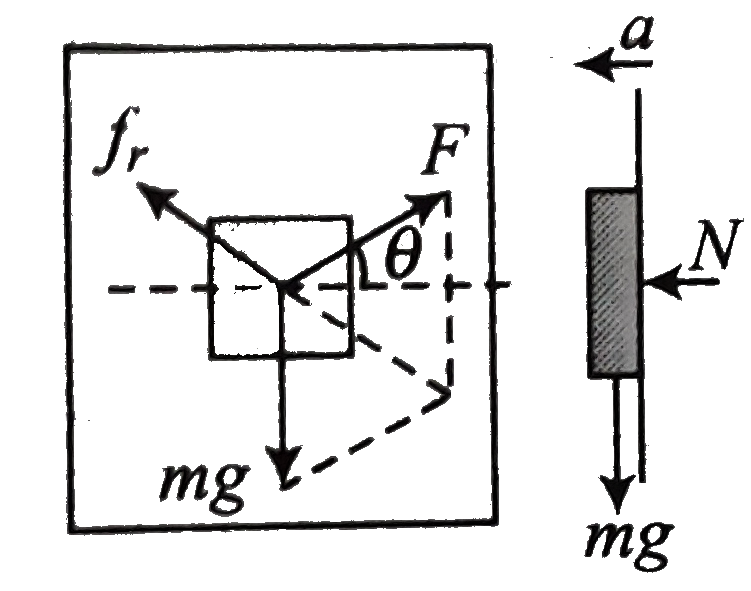
Adopting ground frame method we have mentioned normal reaction N applied force F gravity `mg` and friction f (arbitearity assumed) in the `FBD` (fig(a and b)].

Force equation :Appling Newton 2nd law on the block , we have `f + sum vec F_(||) = m vec a_(||)` where `vec a _(||) = 0` because the block does not side vertically. This given `vec f + sum vec F_(||) = 0` where `sum vec F_(||) = mvec(g) + vec F` This yieds `vec f + vec F + m vec g = 0`. Hence we have `vec f + - (vec F +m vec g)` as the angle between `vecF` and `m vec g` is `theta`we have
`f = sqrt(F^(2) + m^(2) g^(2) + 2F mg cos theta)`
where` vec F` is direction opposite to the resulting of `vec F` and `m vec g`
b. Force equation : Appling law of motion perpendicular to the plane we have `N = ma`
Law of static friction : The gives as the magnitude of limiting friction `f_(max) = mu_(s) N = mu_(s) ma`
where `f_(s_(max)) = sqrt(F^(2) + m^(2) g^(2) + 2F mg cos theta) `
Then we have `sqrt(F^(2) + m^(2) g^(2) + 2F mg cos theta = mu_(s) ma)`
`F = -mg cos theta + sqrt(m^(2) g^(2)cos^(2) theta - m^(2) (g^(2) - mu^(2) a^(2))`
Promotional Banner

Topper's Solved these Questions

  • NEWTON'S LAWS OF MOTION 2

    CENGAGE PHYSICS|Exercise Single Correct|87 Videos
  • NEWTON'S LAWS OF MOTION 2

    CENGAGE PHYSICS|Exercise Multiple Correct|2 Videos
  • NEWTON'S LAWS OF MOTION 2

    CENGAGE PHYSICS|Exercise Exercise 7.3|27 Videos
  • NEWTON'S LAWS OF MOTION 1

    CENGAGE PHYSICS|Exercise Integer|5 Videos
  • PROPERTIES OF SOLIDS AND FLUIDS

    CENGAGE PHYSICS|Exercise INTEGER_TYPE|2 Videos

Similar Questions

Explore conceptually related problems

A rectangular block is held against a vertical wall by applying a force of 200N normal to the wall. If the frictional froce just prevents the block from sliding down the wall, what is the mass of the block? (The coefficient of static friction between the block and the wall is 0.49)

A block of mass m is at rest under the action of force F against a wall as shown in figure. Which of the following statement is incorrect?

In fig Block m_(2) is loaded on block m_(1) . If there is no relative sliding between the block and the inclined plane is smooth , find the friction force between the block

A block of 50 N is pressed normally against a wall as shown. The frictional force acting on the block is : ]

A block of mass m is held fixed against a wall by a applying a horizontal force F . Which of the following option is incorrect : .

A block of mass m kg is pushed up against a wall by a force P That makes an angle 'theta' with the horizontal as shown in The coefficient of static friction between the block and the wall is mu The minimum value of P that allows the block to remain stationary is .

A block of mass 1kg is pressed against a wall by applying a horizontal force of 10N on the block. If the coefficient of friction between the block and the wall is 0.5 ,magnitude of the frictional force acting on the block is

A block weighing w is held against a vertical wall be pressing horizontally with a force F. Then, F needed to hold the block is

A block of mass 0.1 kg is held against a wall by applying a horizontal force of 5 N on the block. If the coefficient of friction between the block and the wall is 0.5, then the magnitude of the frictional force acting on the block is

CENGAGE PHYSICS-NEWTON'S LAWS OF MOTION 2-Subjective
  1. Block A as shown in figure weight 1.40 N and block B weight 4.20 N The...

    Text Solution

    |

  2. Two block , with masses m(1) and m(2) are staked as shown in fig and p...

    Text Solution

    |

  3. Block A has a mass of 30 kg and block B a mass of 15 kg . The coeffici...

    Text Solution

    |

  4. Block A weight 20 kg placed on a smooth surface. Weight B of 2 kg is m...

    Text Solution

    |

  5. In figure find the acceleration of m assuming that there is friction b...

    Text Solution

    |

  6. The masses of the block A and B are m and M Between A and B there is a...

    Text Solution

    |

  7. Two block of masses m and M are connected by a chord passing around a ...

    Text Solution

    |

  8. A block with mass m(1) is placed on an inclined plane with slope angle...

    Text Solution

    |

  9. Consider three blocks placed one over the other as shown in Fig. Let a...

    Text Solution

    |

  10. Four block are arranged on a smooth horizontal surface as shown in fi...

    Text Solution

    |

  11. A block of mass m is pressed against a wall which is moving with an ac...

    Text Solution

    |

  12. In the arrangement shown in figure pulleys are mass of block A,b and C...

    Text Solution

    |

  13. In the arrangement shown in figure mass of blocks A,B and C is 18.5 kg...

    Text Solution

    |

  14. A cubical block is experiencing three forces F(1) = 20 N acts at angle...

    Text Solution

    |

  15. A block of mass m = 3 kg is resting over a rough horizontal surface ha...

    Text Solution

    |

  16. The mass of the wedge shown in fig is M = 4 kg and that of block is m...

    Text Solution

    |

  17. Calculate the maximum possible value of mass m(0) of block C upto whic...

    Text Solution

    |

  18. With two hands you hold a cone motionless upside doen , as shown in fi...

    Text Solution

    |

  19. A prismatic block of mass m is kept on a groove . The bottom line of t...

    Text Solution

    |

  20. A block of mass m(1) connected with another of mass m(2) by a light s...

    Text Solution

    |

