Home
Class 11
PHYSICS
In the arrangement shown in figure pulle...

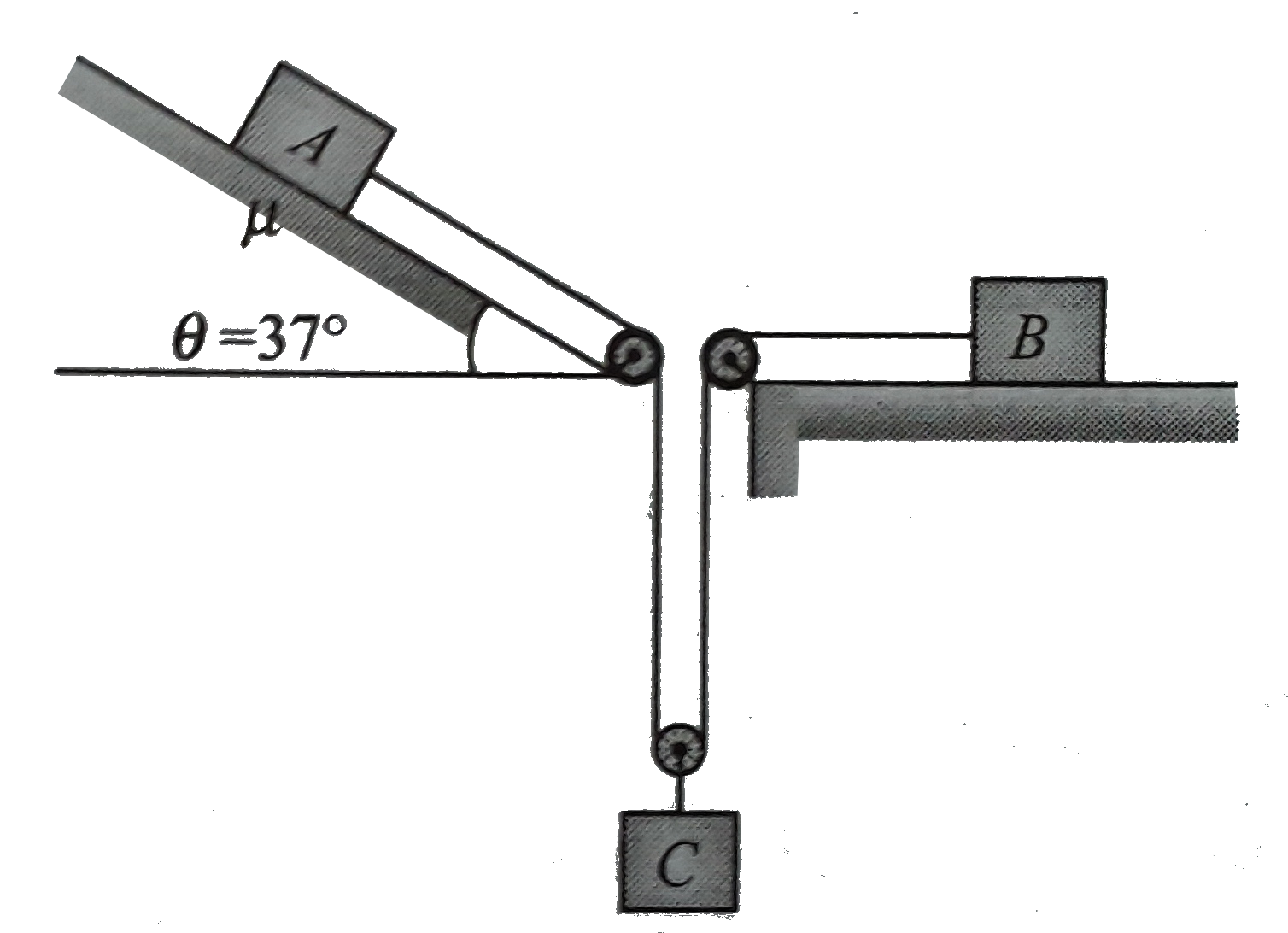
In the arrangement shown in figure pulleys are mass of block A,b and C is `m_(1) = 5 kg m_(2) = 4 kg` and `m_(3) = 2.5 kg` respectively .Co-efficient acceleration of friction for both the plane is `mu = 0.50` Calculate acceleration of which block when system is released from rest

Text Solution

Verified by Experts

The correct Answer is:
`a_(1) = 4ms^(-2)` b. `a_(2) = 0` c. `a_(3) = 2ms^(-2)`

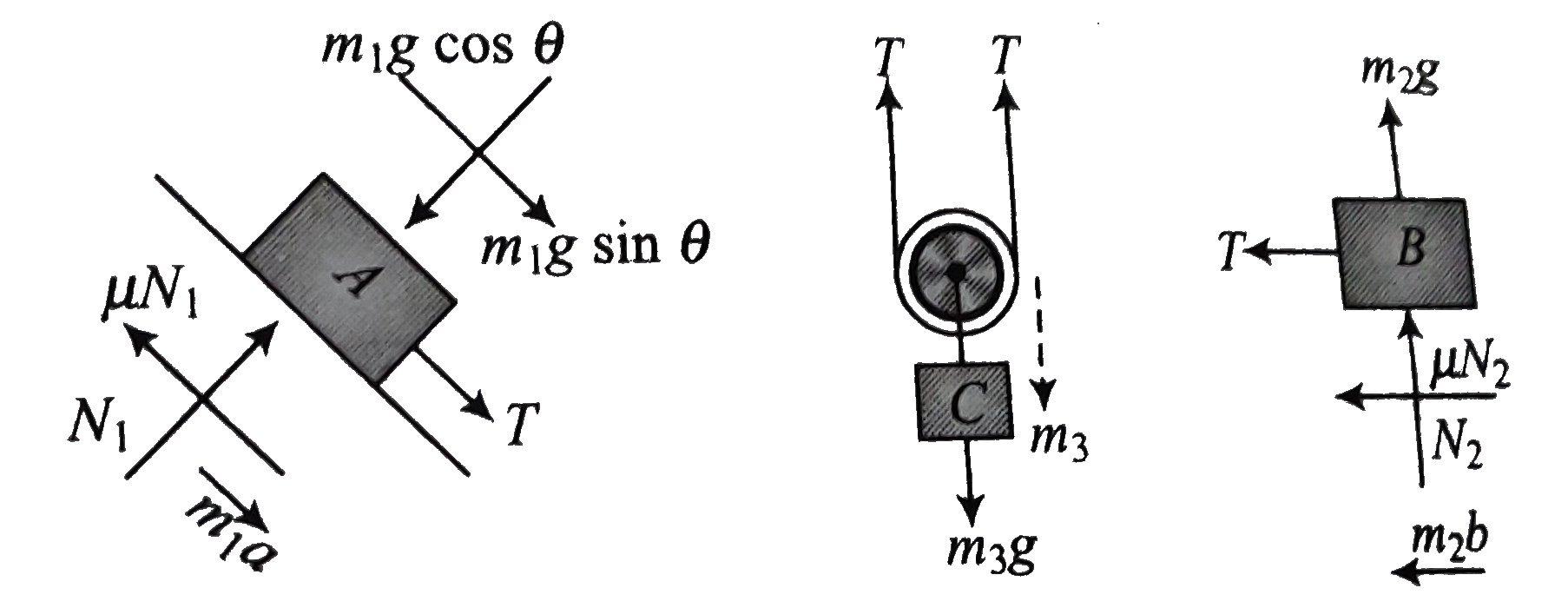
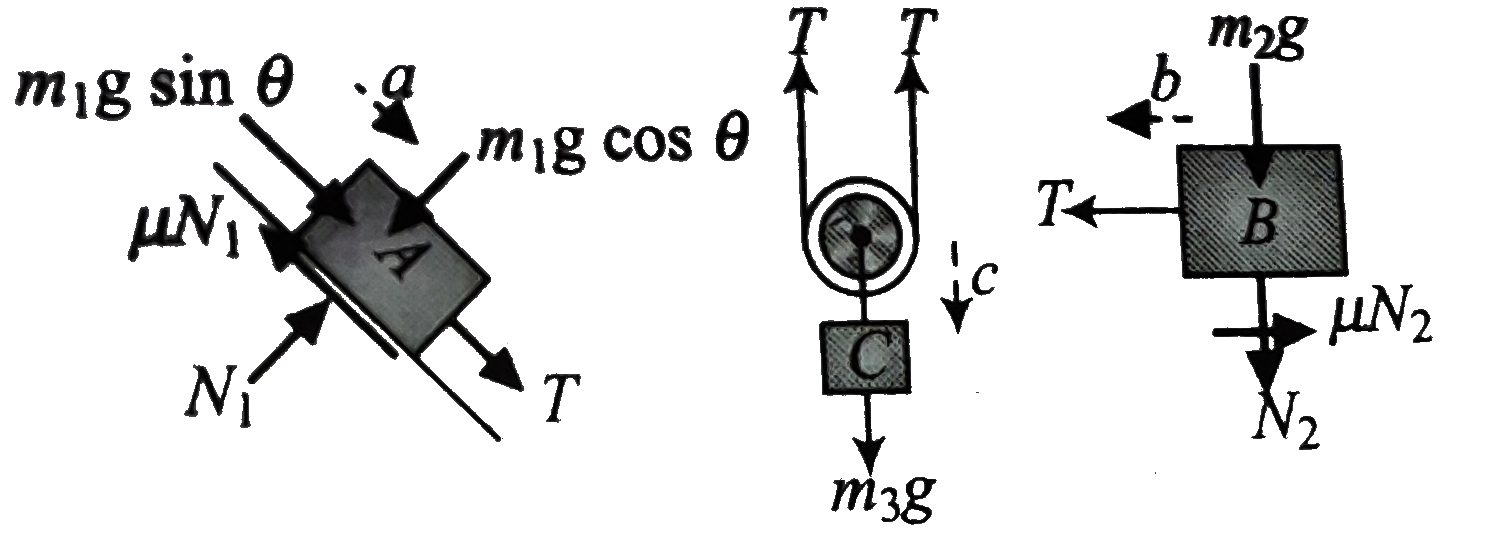
When the system is released , block C tries to move vertically downward due to its own weight in the process blocks A and B are pulled by tension in the thread Hence block A tries to move down the plane and block B leftward.
Let the magnitude of acceleration of A and B be a and b respectively along the direction dicassed above . Then acceleration of block C will be `((a + b)/(2))` downward considering free body diagram

For force on block A `N_(1) = m_(2)g cos theta = 40 N`
`m_(2)g sin theta + T - mu N_(1) = m_(1) a or T - 10 = 5a`...(i)
For force on block C
`m_(2)g- 2T = m_(3)((a + b)/(2)) rArr 25 - 2T = 1.25 (a + b)`....(ii)
For force on blockB
`N_(2) = m_(2)g = 40 N `
`T - mu N_(2) = m_(2)b or (T - 20) = 4b`...(iii)
From above three equations
`T = (460)/(41) N, a = (174)/(41)ms^(-2)` and `b = (90)/(41) ms^(-2)`
Negative value of b indicans that block b does not slide along the assumed direction which is leftward from geomery it is clear that B camon move rightward . Therefore the block B remain stationary B is due to the fact tension T in thread is less than the limitiung friction `muN_(2)`
Hence `b = 0`
Considering free body diagram again

for force on block `A N_(1) = m_(2) g cos theta = 40` newton
`T + m_(2)g sin theta - muN_(1) = m_(1)a`
or `(T + 10) = 5a`....(iv)
For force on blocks `C m_(2)g - 2T = m_(3)((a)/(2))`
`(25 - 2T) = 1.25a`...(vi)
From Eqs (v) and (vi)
`T = 10 N and a= 4 ms^(-2)`
Acceleration of block `A a_(1) = 4ms^(-2)`
Acceleration of block `B a_(2) = 0`
Acceleration of block `CB a_(3) = 2ms^(-2)`
Promotional Banner

Topper's Solved these Questions

  • NEWTON'S LAWS OF MOTION 2

    CENGAGE PHYSICS|Exercise Single Correct|87 Videos
  • NEWTON'S LAWS OF MOTION 2

    CENGAGE PHYSICS|Exercise Multiple Correct|2 Videos
  • NEWTON'S LAWS OF MOTION 2

    CENGAGE PHYSICS|Exercise Exercise 7.3|27 Videos
  • NEWTON'S LAWS OF MOTION 1

    CENGAGE PHYSICS|Exercise Integer|5 Videos
  • PROPERTIES OF SOLIDS AND FLUIDS

    CENGAGE PHYSICS|Exercise INTEGER_TYPE|2 Videos

Similar Questions

Explore conceptually related problems

In the arrangement shown in the figure pulleys are small, light and frictionless, threads are inextensible and mass of blocks A , B and C is m_(1)=5kg , m_(2)=4kg and m_(3)=2.5kg respectively and co-efficient of friction for both the planes is mu=0.50 . Calculate the acceleration of block A (in m//s^(2) ) when the system is released from rest. ( g=10 m//s^(2) )

In the arrangement shown in figure mass of blocks A,B and C is 18.5 kg .8 kg and 1.5 kg respectively . The bottom surface of A is A is smooth while coefficient of friction that between block A and C is mu_(1) = 1//3 between B and floor is mu_(2) = 1//5 System is relased from rest r = 0 and pulley are light and friction Calculate acceleration of block A ,B and C

Pulleys shown in the system of the figure are massless and friction less. Threads are inextensible. Mass of block A, B and C are m_(1) kg,m_(2) =4kg and m_(3) = 2.75kg , respectively .Calculate acceleration of A block

In the figure-2.205 shown in blocks A, B and C has masses m_(A)= 5 kg, m_(B) = 5 kg and m_(C )= 10kg respectively, find the acceleration of the three blocks. Assume all pulleys and strings are ideal. (Take g = 10m//s^(2) )

Pulleys shown in the system are massless and fricionless. Threads are inextensible. The mass of blocks A, B, and C are m_(1)=2kg, m_(2)=4kg , and (m_3)=2.75 kg , respectively. Calculate the acceleration of each block.

In the figure shown, if friction coefficient of block 1 kg and 2kg with inclined plane is mu_(1) = 0.5 and mu_(2) = 0.4 respectively, then

The acceleration of 3 kg block in the arrangement shown in the diagram ,when the given system is released from rest is

Three blocks of masses m_(1) = 1kg, m_(2)=2kg and m_(3) = 3kg are placed in contact on a horizontal frictionaless plane as shown in figure. A force of 12 N is applied on m_(1) . Acceleration of the system is

Two block A and B are arrenged as shown in figure (m_(A) = 5 kg and m_(B) = 10 kg) Find the acceleration of blocks if F = 40 N

CENGAGE PHYSICS-NEWTON'S LAWS OF MOTION 2-Subjective
  1. Block A as shown in figure weight 1.40 N and block B weight 4.20 N The...

    Text Solution

    |

  2. Two block , with masses m(1) and m(2) are staked as shown in fig and p...

    Text Solution

    |

  3. Block A has a mass of 30 kg and block B a mass of 15 kg . The coeffici...

    Text Solution

    |

  4. Block A weight 20 kg placed on a smooth surface. Weight B of 2 kg is m...

    Text Solution

    |

  5. In figure find the acceleration of m assuming that there is friction b...

    Text Solution

    |

  6. The masses of the block A and B are m and M Between A and B there is a...

    Text Solution

    |

  7. Two block of masses m and M are connected by a chord passing around a ...

    Text Solution

    |

  8. A block with mass m(1) is placed on an inclined plane with slope angle...

    Text Solution

    |

  9. Consider three blocks placed one over the other as shown in Fig. Let a...

    Text Solution

    |

  10. Four block are arranged on a smooth horizontal surface as shown in fi...

    Text Solution

    |

  11. A block of mass m is pressed against a wall which is moving with an ac...

    Text Solution

    |

  12. In the arrangement shown in figure pulleys are mass of block A,b and C...

    Text Solution

    |

  13. In the arrangement shown in figure mass of blocks A,B and C is 18.5 kg...

    Text Solution

    |

  14. A cubical block is experiencing three forces F(1) = 20 N acts at angle...

    Text Solution

    |

  15. A block of mass m = 3 kg is resting over a rough horizontal surface ha...

    Text Solution

    |

  16. The mass of the wedge shown in fig is M = 4 kg and that of block is m...

    Text Solution

    |

  17. Calculate the maximum possible value of mass m(0) of block C upto whic...

    Text Solution

    |

  18. With two hands you hold a cone motionless upside doen , as shown in fi...

    Text Solution

    |

  19. A prismatic block of mass m is kept on a groove . The bottom line of t...

    Text Solution

    |

  20. A block of mass m(1) connected with another of mass m(2) by a light s...

    Text Solution

    |